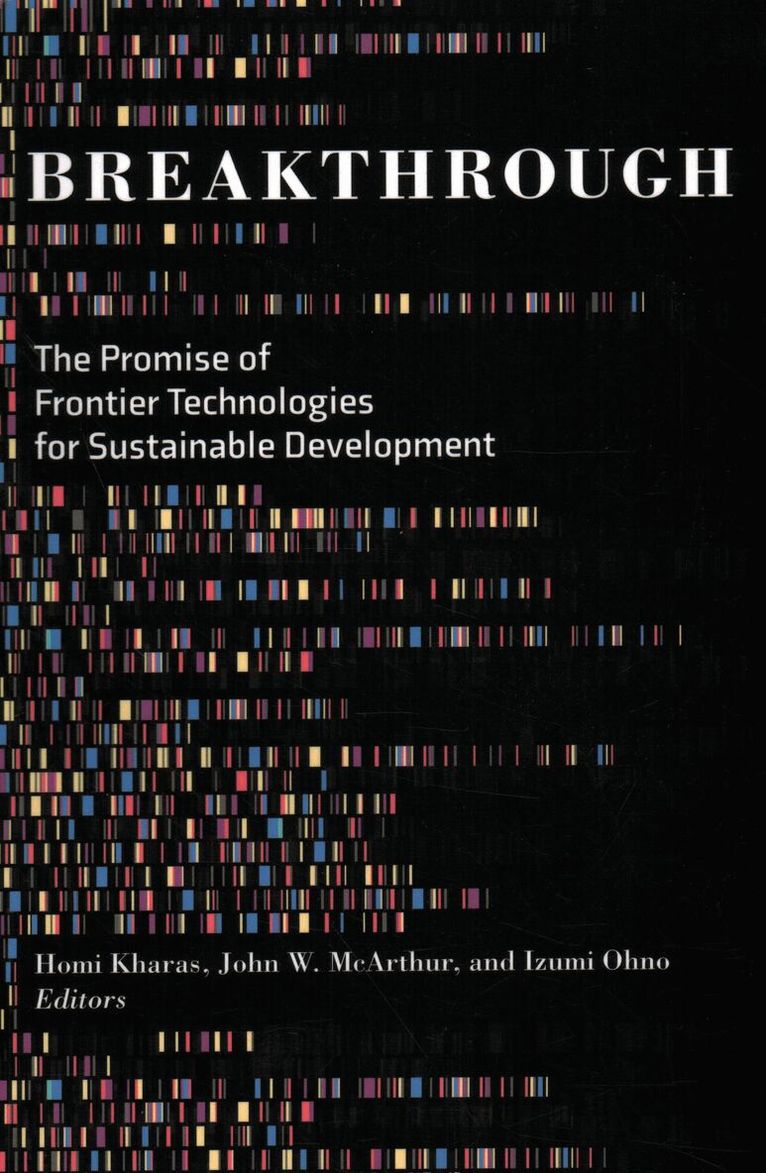
Häftad, Engelska, 2022
Breakthrough
The Promise of Frontier Technologies for Sustainable Development
Av Homi Kharas, John W. McArthur, Izumi Ohno
Del i serien Thornton Center Chinese Thinkers Series
365 kr
Skickas torsdag 12/11. Fri frakt över 249 kr.
Beskrivning
Produktinformation
- Utgivningsdatum: 2022-01-25
- Mått: 156 x 224 x 17 mm
- Vikt: 372 g
- Format: Häftad
- Språk: Engelska
- Serie: Thornton Center Chinese Thinkers Series
- Antal sidor: 256
- Förlag: Bloomsbury Publishing Plc
- ISBN: 9780815739654
Utforska kategorier
Mer om författaren
Homi Kharas is asenior fellow in the Center for Sustainable Development at the Brookings Institution, where he specializes in analyzing policies and finance in supportof sustainable development. His previous books include Leave No One Behind:Time for Specifics on the Sustainable Development Goals.John W. McArthuris a senior fellow in, and Director of, the Center for Sustainable Development at the Brookings Institution. He co-chairs the 17-Rooms initiative, a newapproach to spurring action, insight, and community for the SustainableDevelopment Goals. His previous books include From Summits to Solutions:Innovations in Implementing the Sustainable Development Goals.Izumi Ohno is a Professor at the NationalGraduate Institute for Policy Studies in Japan, and a Senior Research Adviserto the Japan International Cooperation Agency (JICA) Ogata Sadako ResearchInstitute for Peace and Development. She specializes in internationaldevelopment policy, industrial policy and Japanese development cooperation. Herprevious books include Industrial Human Resource Development in DevelopingCountries: Knowledge and Skills in the Era of SDGs.
Recensioner i media
Focusing on UN Sustainable Development Goals (SDGs)—ending poverty, malnutrition, deforestation, and climate change—Kharas, McArthur, and Ohno ask what key ingredients produce nonlinear breakthroughs. They argue that a gradualist approach will fail and that exponential progress comes only with better policy and politics as well as technology. The book's 12 chapters draw on more than a dozen authors with expertise in science, business, civil society, and policy making. Overall, they find that best practices for innovation include user-centered design, understanding the context and concerns of affected communities, smart risk-taking, designing for scale and sustainability from the start, and collaboration. Chapter 4 examines utility-scale solar power, finding it nearly free as costs lie with battery storage and metering rather than with the electrical power itself. Chapter 7 targets smallholder agriculture with the maxim "think big, act fast, start small" to help improve agronomic decisions regarding activities such as fertilizing, watering, and harvesting. Chapter 9 explores "smart cities" as more than just a venue for showcasing new technology, from transportation to utilizing sensors for collecting large data sets for AI analysis. Throughout, contributing authors rightly recognize that new breakthrough technologies risk primarily benefiting the world's wealthiest, further exacerbating inequities borne by poor and rural populations. Highly recommended.
Betyg & recensioner
0 recensioner
Inga recensioner tillgängliga.