• Fri frakt över 249 kr
  • •
  • Snabba leveranser
  • •
  • Billiga böcker
Kundservice

Du är på sajten för privatpersoner.

Företag, bibliotek eller offentlig verksamhet?

Du handlar på classic.bokus.com, där alla dina funktioner finns intakta.
Till classic.bokus.com
Bokus logotyp. Gå till startsidan.
  • Erbjudanden
  • Nyheter
  • Student
  • Topplistor
  • Barn & ungdom
  • Bokus Play
  • E-böcker
  • Pocketböcker
  • Spel & pussel

10% rabatt på allt med kod NYSTART10 →

Sidfot

Mina sidor

    Hjälp

    • Kundservice
    • Vanliga frågor och svar
    • Frakt och leverans
    • Retur vid ångerrätt
    • Reklamera vara
    • Betalning
    • Köpvillkor
    • Allmänna villkor
    • Information om webbplatsens tillgänglighet

    Om Bokus

    • Om oss
    • Pressrum
    • För studenter
    • För företag
    • För bibliotek och offentlig verksamhet
    • För leverantörer
    • Hållbarhet

    Populärt

    • Aktuella erbjudanden
    • Presentkort
    • Studentlitteratur
    • Nya böcker
    • Topplistor
    • Signerade böcker
    • Engelska böcker

    Inspiration

    • Boktips
    • BookTok
    • Populära bokserier
    • Barnbokskaraktärer
    • Populära författare
    Logotyp för Bokus
    Följ oss på Facebook (extern länk)Följ oss på Instagram (extern länk)Följ oss på YouTube (extern länk)Följ oss på TikTok (extern länk)
    bokus @ CookiesAnpassa cookiesIntegritetspolicyKöpvillkor
    Till Citymail hemsida (extern länk)Till Budbee hemsida (extern länk)Till Postnord hemsida (extern länk)Till Schenker hemsida (extern länk)Till Early Bird hemsida (extern länk)Till Walleys hemsida (extern länk)
    1. Historia och arkeologi
    2. Historia
    3. Historia: särskilda händelser och ämnen
    4. Socialhistoria och kulturhistoria

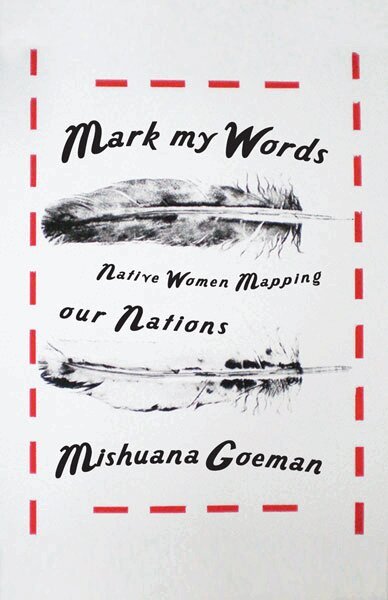
    Mark My Words

    Native Women Mapping Our Nations

    AvMishuana Goeman

    Häftad, Engelska, 2013

    Del i serien First Peoples: New Directions in Indigenous Studies

    339 kr

    Beställningsvara. Skickas inom 5-8 vardagar. Fri frakt över 249 kr.

    Beskrivning

    Dominant history would have us believe that colonialism belongs to a previous era that has long come to an end. But as Native people become mobile, reservation lands become overcrowded and the state seeks to enforce means of containment, closing its borders to incoming, often indigenous, immigrants.In Mark My Words, Mishuana Goeman traces settler colonialism as an enduring form of gendered spatial violence, demonstrating how it persists in the contemporary context of neoliberal globalization. The book argues that it is vital to refocus the efforts of Native nations beyond replicating settler models of territory, jurisdiction, and race. Through an examination of twentieth-century Native women’s poetry and prose, Goeman illuminates how these works can serve to remap settler geographies and center Native knowledges. She positions Native women as pivotal to how our nations, both tribal and nontribal, have been imagined and mapped, and how these women play an ongoing role in decolonization.In a strong and lucid voice, Goeman provides close readings of literary texts, including those of E. Pauline Johnson, Esther Belin, Joy Harjo, Leslie Marmon Silko, and Heid Erdrich. In addition, she places these works in the framework of U.S. and Canadian Indian law and policy. Her charting of women’s struggles to define themselves and their communities reveals the significant power in all of our stories.

    Produktinformation

    • Utgivningsdatum:2013-04-12
    • Mått:140 x 216 x 38 mm
    • Vikt:348 g
    • Format:Häftad
    • Språk:Engelska
    • Serie:First Peoples: New Directions in Indigenous Studies
    • Antal sidor:260
    • Förlag:University of Minnesota Press
    • ISBN:9780816677917

    Utforska kategorier

    • Socialhistoria och kulturhistoria inom Historia och arkeologi
    • Amerikas historia inom Historia och arkeologi
    • Litteraturvetenskap inom Skönlitteratur

    Mer om författaren

    Mishuana Goeman, Tonawanda Band of Seneca, is an Associate Professor of Gender and American Indian Studies at the University of California, Los Angeles. She received her doctorate from Stanford University's Modern Thought and Literature and was a UC Presidential Post-doctoral fellow at Berkeley. Her book was honored at the American Association for Geographic Perspectives on Women. She has published in several peer reviewed journals and has guest edited journal volumes on Native Feminisms and Indigenous Performances. She has also co-authored a book chapter in Handbook for GenderEquity on "Gender Equity for American Indians," a chapter on visual geographies and settler colonialism in Theorizing Native Studies, and a chapter on trauma, geography, and decolonization in Native Feminisms. Currently she is also part of a grant on Mapping Indigenous L.A. that is working toward creating a community oriented mobile application that decolonizes the LA landscape. Her interdisciplinary process enables her to implement a plan that tackles the complexity of Los Angeles Indigeneity and landscapes.

    Recensioner i media

    "Mark My Words is a sophisticated, significant, and exceedingly original examination of the complex ways in which Native women’s poetry and prose reveal settler colonialism in North America as an enduring form of gendered spatial violence and imagine alternatives to such violence. Mishuana Goeman provides beautifully elaborated, historically and theoretically informed, and stunning close readings of literary works by Native women spanning the twentieth century."-Jodi Kim, University of California, Riverside"Mishuana Goeman breaks new theoretical and methodological ground through her conceptualization of gendered spatial geographies and cartographies. As such, this book makes a timely and important contribution to current theorizing about space and place."-Aileen Moreton-Robinson, Queensland University of Technology"The strongest contribution of Mark My Words is the emphasis on the process by which places are made and constructed, rather than on the materiality of the land on which people act. This allows Goeman to identify the ways decolonized spatial knowledges are created. In so doing, Goeman insightfully demonstrates that decolonization is a multifaceted process, as opposed to a single discrete moment or strategy."-Wicazo Sa Review"What Goeman offers is a geographical analysis of Native women’s literature from outside geography."-Journal of Historical Geography"Mishuana Goeman’s long-awaited exploration of cultural, social, and literary spatial constructions is punctuated by personally experienced geographies as it applies an indigenous feminist lens to (re)map colonial landscapes. Her analysis strategically moves through and remaps history and policies by marking Native women’s literary responses to these ongoing relationships between individuals, nations, and the land. Mark My Words provides a necessary addition to the study of American and global relationships, and the land we share. Most importantly, however, the text offers a compelling map towards global decolonization."-American Indian Culture and Research Journal"Its strength lies in the sophistication and depth with which it sustains [engagement with high geographical theory], and in the inclusion of a well-chosen set of primary readings and real-world examples of policies and practices of colonization and exclusion against which North American Natives are compelled to resist."-Cartographica"Essential for anyone concerned with education in Hawai’i.  A hopeful, successful, and concrete example of what Indigenous education can accomplish."-Hawaiian Journal of History"Goeman challenges the pervasive myth of the disappearing Indian by demonstrating that both the peoples and geographies foundational to Native communities have not disappeared but “are waiting to be remapped and ‘grasped.’""-Canadian Literature"Mark My Words is an astute, productive analysis that will prove enormously useful to scholars in Native American studies, social geograpaphy, and English literature."-SAIL"Goeman clearly demonstrates the necessity of combining multiple critical approaches in order to understand the ways that literature can empower us to remap the world."-American Indian Quarterly"Eloquent, compelling, and unique."-NAIS"A thoughtful and carefully constructed argument about the power of imagination and the tremendous value of reimagining colonial spatialities."-MELUS"Connecting state spatial violence with interpersonal violence, Goeman seeks out texts that rearticulate spatial relations, point out the spatial injustices of settler colonialism, document the history of Native women’s refusal to be erased, remind us that colonialism was and is gendered, and show how Native women 'produces places of their own making that are vital to Native communities.'"-American Quarterly

    Innehållsförteckning

    • ContentsIntroduction: Gendered Geographies and Narrative Markings1. “Remember What You Are”: Gendering Citizenship, the Indian Act, and (Re)mapping the Settler Nation-State2. (Re)routing Native Mobility, Uprooting Settler Spaces in the Poetry of Esther Belin3. From the Stomp Grounds on Up: Indigenous Movement and the Politics of Globalization4. “Someday a Story Will Come”: Rememorative FuturesConclusion: “She Can Map Herself Like a Country She Discovers”AcknowledgmentsNotesIndex