• Fri frakt över 249 kr
  • •
  • Snabba leveranser
  • •
  • Billiga böcker
Kundservice

Du är på sajten för privatpersoner.

Företag, bibliotek eller offentlig verksamhet?

Du handlar på classic.bokus.com, där alla dina funktioner finns intakta.
Till classic.bokus.com
Bokus logotyp. Gå till startsidan.
  • Erbjudanden
  • Nyheter
  • Student
  • Topplistor
  • Barn & ungdom
  • Bokus Play
  • E-böcker
  • Pocketböcker
  • Spel & pussel

10% rabatt på allt med kod: NYSTART10 →

Sidfot

Mina sidor

    Hjälp

    • Kundservice
    • Vanliga frågor och svar
    • Frakt och leverans
    • Retur vid ångerrätt
    • Reklamera vara
    • Betalning
    • Köpvillkor
    • Allmänna villkor
    • Information om webbplatsens tillgänglighet

    Om Bokus

    • Om oss
    • Pressrum
    • För studenter
    • För företag
    • För bibliotek och offentlig verksamhet
    • För leverantörer
    • Hållbarhet

    Populärt

    • Aktuella erbjudanden
    • Presentkort
    • Studentlitteratur
    • Nya böcker
    • Topplistor
    • Signerade böcker
    • Engelska böcker

    Inspiration

    • Boktips
    • BookTok
    • Populära bokserier
    • Barnbokskaraktärer
    • Populära författare
    Logotyp för Bokus
    Följ oss på Facebook (extern länk)Följ oss på Instagram (extern länk)Följ oss på YouTube (extern länk)Följ oss på TikTok (extern länk)
    bokus @ CookiesAnpassa cookiesIntegritetspolicyKöpvillkor
    Till Citymail hemsida (extern länk)Till Budbee hemsida (extern länk)Till Postnord hemsida (extern länk)Till Schenker hemsida (extern länk)Till Early Bird hemsida (extern länk)Till Walleys hemsida (extern länk)
    1. Historia och arkeologi
    2. Historia
    3. Europas historia

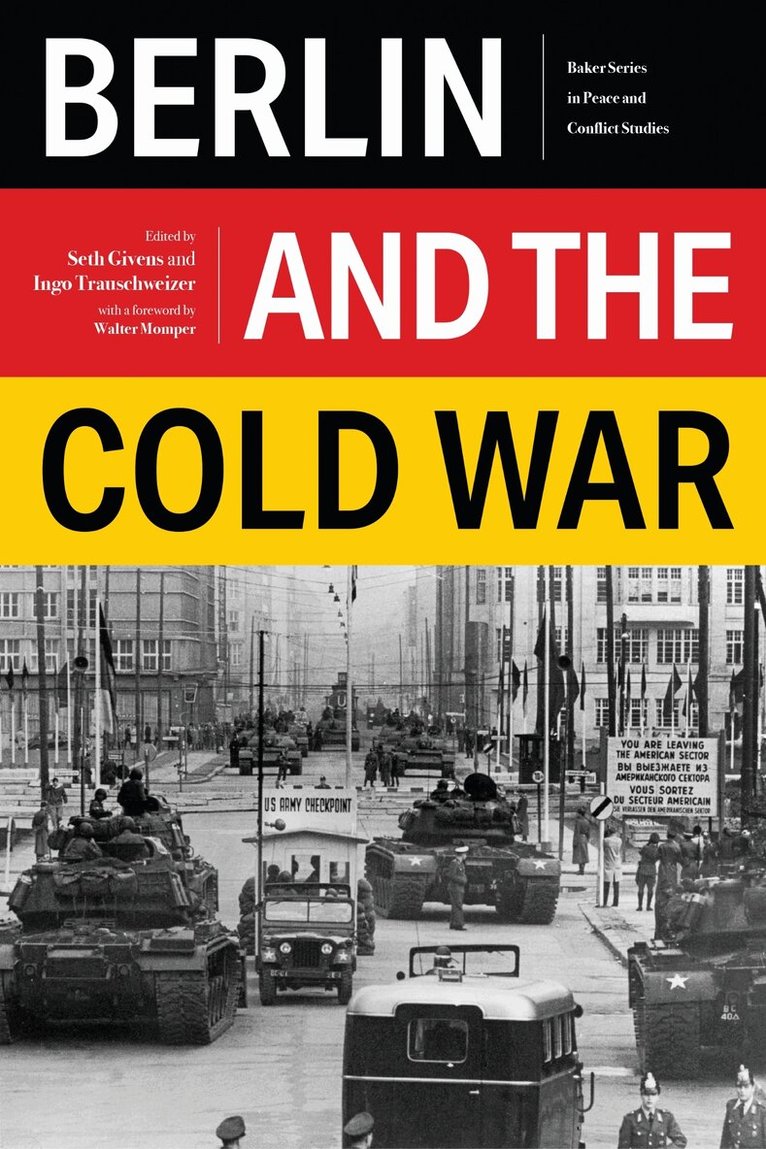
    Berlin and the Cold War

    AvSeth Givens,Ingo Trauschweizer

    Häftad, Engelska, 2024

    Del i serien Baker Series in Peace and Conflict Studies

    444 kr

    Beställningsvara. Skickas inom 5-8 vardagar. Fri frakt över 249 kr.

    Beskrivning

    The Cold War is back in the news. So is history, in the sense of past geopolitical confrontations that for a span of a few decades were thought to be largely decoupled from present-day political developments. Of course, such reflexive reactions lack nuance and, until the Russian invasion of Ukraine in February 2022, tended to refer more to tensions between the United States and China. We should neither see Russia’s aggressive war in Ukraine immediately as part of a new cold war-though it could certainly become one of its foundation pieces-nor define history simply in terms of warfare and conflict. Yet such history has great appeal in efforts to understand the dizzying and depressing events of recent years. For example, correspondents and commentators have likened the delivery of weapons systems, protective gear, and humanitarian aid to a beleaguered Ukraine to the Berlin Airlift of 1948–49. But relying on history as a guide may mislead as much as enlighten.No city symbolizes the Cold War quite as Berlin does. When we think of the Cold War and of Berlin, we tend to emphasize the crises-the 1948–49 blockade and airlift, perhaps the 1953 East German workers’ uprising, surely the 1958­–61 crisis, during which the Berlin Wall was built-and the climactic ending of the Cold War in Europe when the wall came down. Berlin may conjure up iconic moments and tropes, from a statement attributed to Nikita Khrushchev in 1963 that Berlin was “the testicles of the West,” to John F. Kennedy’s insistence that all free men had to be invested in the defense of Berlin, to Ronald Reagan’s exhortation to Mikhail Gorbachev to “tear down this wall.” For American presidents (or presidential hopefuls), Berlin and the Brandenburg Gate have remained powerful images, even in the twenty-first century. A presence in Berlin signals strong leadership in the West, even though the proximate reasons why the West, as a political construct, emerged in the first place may be gone. In that sense, Berlin also stands for overcoming the past: first, West Berlin as the counterpoint not only to eastern communism but also to defeated fascism, and second, the new Berlin as the capital of a unified Germany and as a symbol that the West has won.

    Produktinformation

    • Utgivningsdatum:2024-06-28
    • Mått:152 x 229 x 23 mm
    • Vikt:424 g
    • Format:Häftad
    • Språk:Engelska
    • Serie:Baker Series in Peace and Conflict Studies
    • Antal sidor:280
    • Förlag:Ohio University Press
    • ISBN:9780821425343

    Utforska kategorier

    • Europas historia inom Historia och arkeologi
    • Internationella relationer inom Samhälle och politik

    Mer om författaren

    Seth Givens is a historian at the United States Marine Corps History Division in Quantico, Virginia. He has published on U.S. policy, strategy, and military operations in the Cold War.Ingo Trauschweizer is a professor of history and former director of the Contemporary History Institute at Ohio University, where he teaches courses on American and global military history, the Cold War, and the Vietnam War. His books include The Cold War U.S. Army: Building Deterrence for Limited War and Maxwell Taylor's Cold War: From Berlin to Vietnam.

    Recensioner i media

    This rich and fascinating collection of essays treats the story of Cold War Berlin with the complexity that it deserves. The authors position Berlin as a crucial site of German, European, and transatlantic history from the end of World War II to the Russo-Ukrainian War. - Adam R. Seipp, Texas A&M University This volume’s intriguing essays convincingly demonstrate Berlin’s lasting place in the transatlantic world―as a strategic asset and political battleground no less than a symbolic site where contesting visions of Germany’s past and future become tangible. Their insights matter today as a new cold war threatens to redivide Europe, reminding readers of the complications inherent in any attempt to reconcile American and Russian interests in the "old continent" with those of the diverse nation-states it hosts. - Andreas W. Daum, University at Buffalo, SUNY

    Innehållsförteckning

    • List of illustrationsForewordWALTER MOMPERIntroductionINGO TRAUSCHWEIZERPart I. Postwar to Cold War, 1945–1957Gone but Not Forgotten: The Status of Berlin and the Founding of the West German State, 1944–1952SAMUEL MINERThe First Crisis: US Army Planning and the Defense of Berlin, 1945–1950SETH GIVENSThe United States, Berlin, and the 1953 UprisingCHRISTIAN F. OSTERMANNAbduction City: Abductions by the GDR State Security Service in Cold War BerlinSUSANNE MUHLEPart II. Crisis, 1958–1971The Never-Ending Berlin Crisis and the Limits of Alliance PoliticsERIN MAHANThe Berlin Wall in History and MemoryHOPE M. HARRISONBetween Freedom’s Symbol and Casus Belli: Berlin in the Johnson and Nixon YearsTHOMAS SCHWARTZPart III. Beyond the Cold War in Berlin, 1972–1990sTrade and Energy Diplomacy as Catalysts for Détente: Berlin and the Schmidt and Kohl GovernmentsSTEPHAN KIENINGERBerlin 1989 and the New Atlanticism: US and West German Visions for the Post–Cold War Architecture of EuropePETER RIDDERPerforming the Wall after Its FallMATT CORNISHContributorsIndex