• Fri frakt över 249 kr
  • •
  • Snabba leveranser
  • •
  • Billiga böcker
Kundservice

Du är på sajten för privatpersoner.

Företag, bibliotek eller offentlig verksamhet?

Du handlar på classic.bokus.com, där alla dina funktioner finns intakta.
Till classic.bokus.com
Bokus logotyp. Gå till startsidan.
  • Erbjudanden
  • Nyheter
  • Student
  • Topplistor
  • Barn & ungdom
  • Bokus Play
  • E-böcker
  • Pocketböcker
  • Spel & pussel

Må bättre, för mindre! Upp till 50% rabatt på hälsoböcker

Sidfot

Mina sidor

    Hjälp

    • Kundservice
    • Vanliga frågor och svar
    • Frakt och leverans
    • Retur vid ångerrätt
    • Reklamera vara
    • Betalning
    • Köpvillkor
    • Allmänna villkor
    • Information om webbplatsens tillgänglighet

    Om Bokus

    • Om oss
    • Pressrum
    • För studenter
    • För företag
    • För bibliotek och offentlig verksamhet
    • För leverantörer
    • Hållbarhet

    Populärt

    • Aktuella erbjudanden
    • Presentkort
    • Studentlitteratur
    • Nya böcker
    • Topplistor
    • Signerade böcker
    • Engelska böcker

    Inspiration

    • Boktips
    • BookTok
    • Populära bokserier
    • Barnbokskaraktärer
    • Populära författare
    Logotyp för Bokus
    Följ oss på Facebook (extern länk)Följ oss på Instagram (extern länk)Följ oss på YouTube (extern länk)Följ oss på TikTok (extern länk)
    bokus @ CookiesAnpassa cookiesIntegritetspolicyKöpvillkor
    Till Citymail hemsida (extern länk)Till Budbee hemsida (extern länk)Till Postnord hemsida (extern länk)Till Schenker hemsida (extern länk)Till Early Bird hemsida (extern länk)Till Walleys hemsida (extern länk)
    1. Kultur
    2. Scenkonst och film
    3. Film

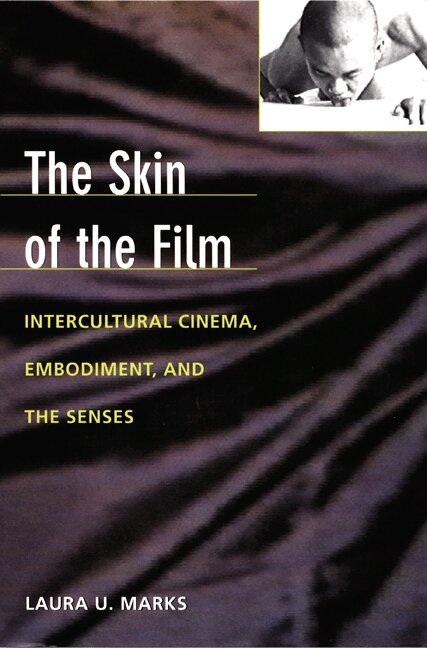
    Skin of the Film

    Intercultural Cinema, Embodiment, and the Senses

    AvLaura U. Marks

    Häftad, Engelska, 2000

    320 kr

    Skickas . Fri frakt över 249 kr.

    Fler format och utgåvor

    Inbunden

    1 372 kr

    Beskrivning

    Memories that evoke the physical awareness of touch, smell, and bodily presence can be vital links to home for people living in diaspora from their culture of origin. How can filmmakers working between cultures use cinema, a visual medium, to transmit that physical sense of place and culture? In The Skin of the Film Laura U. Marks offers an answer, building on the theories of Gilles Deleuze and others to explain how and why intercultural cinema represents embodied experience in a postcolonial, transnational world.Much of intercultural cinema, Marks argues, has its origin in silence, in the gaps left by recorded history. Filmmakers seeking to represent their native cultures have had to develop new forms of cinematic expression. Marks offers a theory of “haptic visuality”-a visuality that functions like the sense of touch by triggering physical memories of smell, touch, and taste-to explain the newfound ways in which intercultural cinema engages the viewer bodily to convey cultural experience and memory. Using close to two hundred examples of intercultural film and video, she shows how the image allows viewers to experience cinema as a physical and multisensory embodiment of culture, not just as a visual representation of experience. Finally, this book offers a guide to many hard-to-find works of independent film and video made by Third World diasporic filmmakers now living in the United States, Great Britain, and Canada.The Skin of the Film draws on phenomenology, postcolonial and feminist theory, anthropology, and cognitive science. It will be essential reading for those interested in film theory, experimental cinema, the experience of diaspora, and the role of the sensuous in culture.

    Produktinformation

    • Utgivningsdatum:2000-01-19
    • Mått:152 x 232 x 21 mm
    • Vikt:499 g
    • Format:Häftad
    • Språk:Engelska
    • Antal sidor:320
    • Förlag:Duke University Press
    • ISBN:9780822323914

    Utforska kategorier

    • Film inom Kultur

    Mer om författaren

    Laura U. Marks is an independent critic and curator, as well as Assistant Professor of Film Studies at Carleton University in Ottawa, Canada.

    Recensioner i media

    “The promise of Laura Marks’s The Skin of Film is the promise of thinking and living between critical discourses, experiences and cultures: the willingness to explore an embodied response capable of meeting the ‘hybrid microcultures’ of global modernity; the power to transform the memory of images, things, and the senses into ‘sensuous geographies’ of touch, smell and rhythm that inhabit and drift into a world increasingly divided between the policed frontier and the ‘placeless’ metropolis; and finally, the capacity to dwell in the critical interstice that allows thought to articulate itself on the edge of the unthought. - Tollof Nelson, CiNÉMAS “[A] fascinating exploration of the ways that diasporic filmmakers have excavated, rediscovered, and reignited cultural memories through appeals to multisensorial forms of recollection that challenge the Western cinematic reliance on visual imagery . . . . [H]ighly informative and will introduce the reader to many intercultural works that have previously gone unnoticed. Marks’s clear exuberance for her work and passion for the films she discusses also shine through. Highly recommended.” - Avi Santo, The Velvet Light Trap "[A]n important document and substantial treatment of many sometimes ephemeral works of intercultural cinema. . . . Marks draws on a rich and somewhat dazzling array of theoretical sources and disciplinary fields. . . . The Skin of the Film also offers a very rich and extensive archive of intercultural cinematic productions of the eighties and nineties. . . . She manages to cover a vast range of work in an elegant, often moving writing style with curatorial detail. . . . [A]n extremely stimulating and original book. It signals a promising and very welcome move in film theory. . . . It has much to contribute to the emerging literature on affect in political and cultural studies. . . . Like the sound of dripping water or an itch that you don’t feel until you scratch, once your attention is drawn to The Skin of the Film, it becomes impossible to ignore it." - Tamara Vukov, Topia: A Canadian Journal of Cultural Studies "[A] rich and rewarding read. . . . The Skin of the Film is quite unique. Offering important contributions to the redefinition of aesthetic scholarship, the author simultaneously conducts close readings of filmic works which are not well known, and presents nuanced readings of their significance, within an original theoretical framework."- Melanie Swalwell, Film-Philosophy “A marvelous interweaving of theory and historiography. This is a book that can interest film theorists, film historians, students of performance art, and scholars of postcoloniality and interculturalism. Marks explains-with rich detail-a whole range of recent cultural productions in film and video and makes those works come to life. The Skin of the Film suggests important ways to extend film theory.”-Dana Polan, University of Southern California “Marks’s nuanced reading of a large number of films and videos is based on her deep engagement with the politics of place and displacement that drives the films. This book is a delightful read.”-Hamid Naficy, Rice University “This is a terrific book! Not only does it have a significant argument to make, but it also works with a variety of little-known film/video examples in such a way as to give the reader both a vivid sense of them and a desire to go out and get hold of them.”-Vivian Sobchack, University of California at Los Angeles “[A] fascinating exploration of the ways that diasporic filmmakers have excavated, rediscovered, and reignited cultural memories through appeals to multisensorial forms of recollection that challenge the Western cinematic reliance on visual imagery . . . . [H]ighly informative and will introduce the reader to many intercultural works that have previously gone unnoticed. Marks’s clear exuberance for her work and passion for the films she discusses also shine through. Highly recommended.” - Avi Santo (The Velvet Light Trap) “The promise of Laura Marks’s The Skin of Film is the promise of thinking and living between critical discourses, experiences and cultures: the willingness to explore an embodied response capable of meeting the ‘hybrid microcultures’ of global modernity; the power to transform the memory of images, things, and the senses into ‘sensuous geographies’ of touch, smell and rhythm that inhabit and drift into a world increasingly divided between the policed frontier and the ‘placeless’ metropolis; and finally, the capacity to dwell in the critical interstice that allows thought to articulate itself on the edge of the unthought. - Tollof Nelson (CiNéMAS) "[A] rich and rewarding read. . . . The Skin of the Film is quite unique. Offering important contributions to the redefinition of aesthetic scholarship, the author simultaneously conducts close readings of filmic works which are not well known, and presents nuanced readings of their significance, within an original theoretical framework."- Melanie Swalwell (Film-Philosophy) "[A]n important document and substantial treatment of many sometimes ephemeral works of intercultural cinema. . . . Marks draws on a rich and somewhat dazzling array of theoretical sources and disciplinary fields. . . . The Skin of the Film also offers a very rich and extensive archive of intercultural cinematic productions of the eighties and nineties. . . . She manages to cover a vast range of work in an elegant, often moving writing style with curatorial detail. . . . [A]n extremely stimulating and original book. It signals a promising and very welcome move in film theory. . . . It has much to contribute to the emerging literature on affect in political and cultural studies. . . . Like the sound of dripping water or an itch that you don’t feel until you scratch, once your attention is drawn to The Skin of the Film, it becomes impossible to ignore it." - Tamara Vukov (Topia: A Canadian Journal of Cultural Studies)

    Innehållsförteckning

    • List of Illustrations Preface Acknowledgements Introduction 1. The Memory of Images 2. The Memory of Things 3. The Memory of Touch 4. The Memory of the Senses Conclusion: The Portable Sensorium Notes Bibliography Filmography/Videography Index