• Fri frakt över 249 kr
  • •
  • Snabba leveranser
  • •
  • Billiga böcker
Kundservice

Du är på sajten för privatpersoner.

Företag, bibliotek eller offentlig verksamhet?

Du handlar på classic.bokus.com, där alla dina funktioner finns intakta.
Till classic.bokus.com
Bokus logotyp. Gå till startsidan.
  • Erbjudanden
  • Nyheter
  • Student
  • Topplistor
  • Barn & ungdom
  • Bokus Play
  • E-böcker
  • Pocketböcker
  • Spel & pussel

10% rabatt på allt med kod: NYSTART10 →

Sidfot

Mina sidor

    Hjälp

    • Kundservice
    • Vanliga frågor och svar
    • Frakt och leverans
    • Retur vid ångerrätt
    • Reklamera vara
    • Betalning
    • Köpvillkor
    • Allmänna villkor
    • Information om webbplatsens tillgänglighet

    Om Bokus

    • Om oss
    • Pressrum
    • För studenter
    • För företag
    • För bibliotek och offentlig verksamhet
    • För leverantörer
    • Hållbarhet

    Populärt

    • Aktuella erbjudanden
    • Presentkort
    • Studentlitteratur
    • Nya böcker
    • Topplistor
    • Signerade böcker
    • Engelska böcker

    Inspiration

    • Boktips
    • BookTok
    • Populära bokserier
    • Barnbokskaraktärer
    • Populära författare
    Logotyp för Bokus
    Följ oss på Facebook (extern länk)Följ oss på Instagram (extern länk)Följ oss på YouTube (extern länk)Följ oss på TikTok (extern länk)
    bokus @ CookiesAnpassa cookiesIntegritetspolicyKöpvillkor
    Till Citymail hemsida (extern länk)Till Budbee hemsida (extern länk)Till Postnord hemsida (extern länk)Till Schenker hemsida (extern länk)Till Early Bird hemsida (extern länk)Till Walleys hemsida (extern länk)
    1. Samhälle och politik
    2. Samhälle och kultur
    3. Kultur och medier
    4. Referensverk och tvärvetenskap

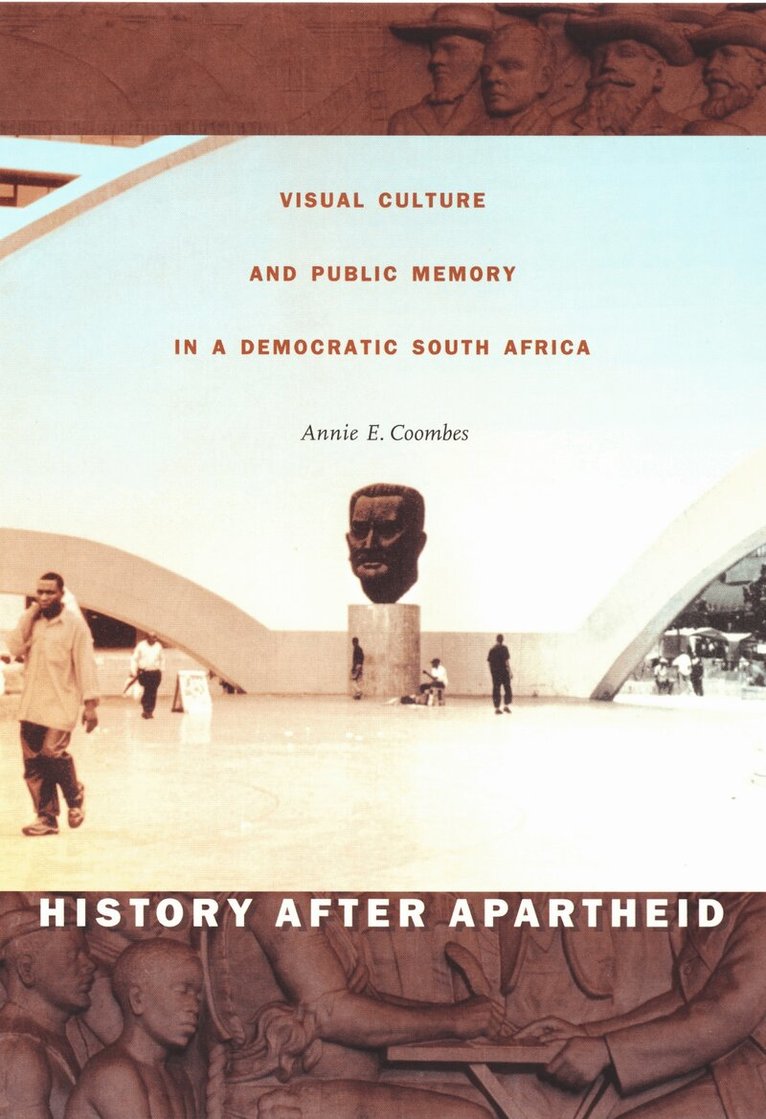
    History After Apartheid

    Visual Culture and Public Memory in a Democratic South Africa

    AvAnnie E. Coombes

    Häftad, Engelska, 2003

    501 kr

    Beställningsvara. Skickas inom 5-8 vardagar. Fri frakt över 249 kr.

    Fler format och utgåvor

    E-bok

    732 kr

    Beskrivning

    The democratic election of Nelson Mandela as president of South Africa in 1994 marked the demise of apartheid and the beginning of a new struggle to define the nation’s past. History after Apartheid analyzes how, in the midst of the momentous shift to an inclusive democracy, South Africa’s visual and material culture represented the past while at the same time contributing to the process of social transformation. Considering attempts to invent and recover historical icons and narratives, art historian Annie E. Coombes examines how strategies for embodying different models of historical knowledge and experience are negotiated in public culture-in monuments, museums, and contemporary fine art.History after Apartheid explores the dilemmas posed by a wide range of visual and material culture including key South African heritage sites. How prominent should Nelson Mandela and the African National Congress be in the museum at the infamous political prison on Robben Island? How should the postapartheid government deal with the Voortrekker Monument mythologizing the Boer Trek of 1838? Coombes highlights the contradictory investment in these sites among competing constituencies and the tensions involved in the rush to produce new histories for the “new” South Africa. She reveals how artists and museum officials struggled to adequately represent painful and difficult histories ignored or disavowed under apartheid, including slavery, homelessness, and the attempted destruction of KhoiSan hunter-gatherers. Describing how contemporary South African artists address historical memory and the ambiguities uncovered by the Truth and Reconciliation Commission, Coombes illuminates a body of work dedicated to the struggle to simultaneously remember the past and move forward into the future.

    Produktinformation

    • Utgivningsdatum:2003-11-24
    • Mått:156 x 229 x 26 mm
    • Vikt:540 g
    • Format:Häftad
    • Språk:Engelska
    • Antal sidor:384
    • Förlag:Duke University Press
    • ISBN:9780822330721

    Utforska kategorier

    • Referensverk och tvärvetenskap inom Samhälle och politik
    • Konsthistoria inom Kultur

    Mer om författaren

    Annie E. Coombes teaches art history and cultural studies at Birkbeck College, University of London, where she is Director of Graduate Studies in the School of History of Art, Film, and Visual Media. She is the author of Reinventing Africa: Museums, Material Culture, and Popular Imagination in Late Victorian and Edwardian England and coeditor of Hybridity and Its Discontents: Politics, Science, Culture.

    Recensioner i media

    “Exquisitely detailed, ethically engaged, theoretically consequential, this book will delight readers across a wide spectrum of the humanities and social sciences. Annie E. Coombes captures the complexities of contemporary South Africa via an intriguing analysis of the country’s public culture. The South African case studies become portable and are intelligently linked to global debates in this highly readable study.”-Isabel Hofmeyr, University of the Witwatersrand, Johannesburg “With verve, imagination, and engagement, Annie E. Coombes gives us an incisive account of memorial culture in South Africa since apartheid. She foregrounds the political tensions and ambiguities of rehabilitating traditional monuments, making Robben Island into an icon of resistance and liberation, creating museums of urban and township living that hover between reflective nostalgia and traumatized remembrance. Revisionism is a political necessity, but how is one to remember a brutal and painful history without rekindling the divisive passions of the past? A must read for anyone interested in memory culture on a global scale.”-Andreas Huyssen, author of Present Pasts: Urban Palimpsests and the Politics of Memory

    Innehållsförteckning

    • List of Illustrations ixAcknowledgments xiiiList of Abbreviations xviiIntroduction: Making History Memorable 11. Translating the Past: Apartheid Moments in Postapartheid South Africa 192. Robben Island: Site of Memory/Site of Nation 543. District Six: The Archaeology of Memory 1164. New Histories for Old: Museological Strategies 1495. What's in a Name? The Place of "Ethnicity" in the "New" South Africa 2066. New Subjectivities for the New Nation 243Epilogue: Changing Places 279Notes 297Bibliography 339Index 355