• Fri frakt över 249 kr
  • •
  • Snabba leveranser
  • •
  • Billiga böcker
Kundservice

Du är på sajten för privatpersoner.

Företag, bibliotek eller offentlig verksamhet?

Du handlar på classic.bokus.com, där alla dina funktioner finns intakta.
Till classic.bokus.com
Bokus logotyp. Gå till startsidan.
  • Erbjudanden
  • Nyheter
  • Student
  • Topplistor
  • Barn & ungdom
  • Bokus Play
  • E-böcker
  • Pocketböcker
  • Spel & pussel

10% rabatt på allt med kod: NYSTART10 →

Sidfot

Mina sidor

    Hjälp

    • Kundservice
    • Vanliga frågor och svar
    • Frakt och leverans
    • Retur vid ångerrätt
    • Reklamera vara
    • Betalning
    • Köpvillkor
    • Allmänna villkor
    • Information om webbplatsens tillgänglighet

    Om Bokus

    • Om oss
    • Pressrum
    • För studenter
    • För företag
    • För bibliotek och offentlig verksamhet
    • För leverantörer
    • Hållbarhet

    Populärt

    • Aktuella erbjudanden
    • Presentkort
    • Studentlitteratur
    • Nya böcker
    • Topplistor
    • Signerade böcker
    • Engelska böcker

    Inspiration

    • Boktips
    • BookTok
    • Populära bokserier
    • Barnbokskaraktärer
    • Populära författare
    Logotyp för Bokus
    Följ oss på Facebook (extern länk)Följ oss på Instagram (extern länk)Följ oss på YouTube (extern länk)Följ oss på TikTok (extern länk)
    bokus @ CookiesAnpassa cookiesIntegritetspolicyKöpvillkor
    Till Citymail hemsida (extern länk)Till Budbee hemsida (extern länk)Till Postnord hemsida (extern länk)Till Schenker hemsida (extern länk)Till Early Bird hemsida (extern länk)Till Walleys hemsida (extern länk)
    1. Samhälle och politik
    2. Sociologi och antropologi
    3. Sociologi

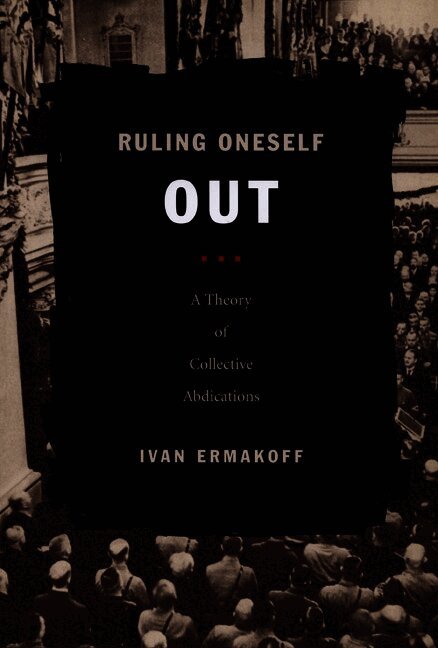
    Ruling Oneself Out

    A Theory of Collective Abdications

    AvIvan Ermakoff

    Häftad, Engelska, 2008

    Del i serien Politics, History, and Culture

    431 kr

    Beställningsvara. Skickas inom 5-8 vardagar. Fri frakt över 249 kr.

    Fler format och utgåvor

    E-bok

    650 kr

    Beskrivning

    What induces groups to commit political suicide? This book explores the decisions to surrender power and to legitimate this surrender: collective abdications. Commonsensical explanations impute such actions to coercive pressures, actors’ miscalculations, or their contamination by ideologies at odds with group interests. Ivan Ermakoff argues that these explanations are either incomplete or misleading. Focusing on two paradigmatic cases of voluntary and unconditional surrender of power-the passing of an enabling bill granting Hitler the right to amend the Weimar constitution without parliamentary supervision (March 1933), and the transfer of full executive, legislative, and constitutional powers to Marshal PÉtain (Vichy, France, July 1940)-Ruling Oneself Out recasts abdication as the outcome of a process of collective alignment. Ermakoff distinguishes several mechanisms of alignment in troubled and uncertain times and assesses their significance through a fine-grained examination of actors’ beliefs, shifts in perceptions, and subjective states. To this end, he draws on the analytical and methodological resources of perspectives that usually stand apart: primary historical research, formal decision theory, the phenomenology of group processes, quantitative analyses, and the hermeneutics of testimonies. In elaborating this dialogue across disciplinary boundaries, Ruling Oneself Out restores the complexity and indeterminate character of pivotal collective decisions and demonstrates that an in-depth historical exploration can lay bare processes of crucial importance for understanding the formation of political preferences, the paradox of self-deception, and the makeup of historical events as highly consequential.

    Produktinformation

    • Utgivningsdatum:2008-04-21
    • Mått:156 x 235 x 25 mm
    • Vikt:658 g
    • Format:Häftad
    • Språk:Engelska
    • Serie:Politics, History, and Culture
    • Antal sidor:277
    • Förlag:Duke University Press
    • ISBN:9780822341642

    Utforska kategorier

    • Sociologi inom Samhälle och politik
    • Statsvetenskap och politisk teori inom Samhälle och politik

    Mer om författaren

    Ivan Ermakoff is Associate Professor of Sociology at the University of Wisconsin, Madison.

    Recensioner i media

    “Ruling Oneself Out presents a compelling theory of why solitary legislative dissent. . . is rare, particularly in highly charged political contexts. . . . [S]cholars. . . should be reading and referring to this book for a long time to come. It should also find its way onto the shelves of social scientists interested in formal modeling, democratic breakdown, and/or exemplary methodology in historical research.” - Malcolm Fairbrother, Contemporary Sociology “Ruling Oneself Out is an extremely impressive scholarly achievement at multiple levels. It offers a model of how to identify and pose an important research question; that is, a question worth asking and answering not only because it is intrinsically interesting but also because it is theoretically puzzling and at the same time of great practice significance. Ruling Oneself Out is all this and more.” - Howard Kimeldorf, Social Science History “Ruling Oneself Out is a tour de force, a compelling contribution to our understanding of two of the most troubling moments of the past century and the more general phenomenon of democratic representation and its retention.”-David D. Laitin, Stanford University “Ruling Oneself Out reads like a novel: we hear the voices of the protagonists, enter their minds, and emerge with an understanding of a fascinating theoretical puzzle. Drawing on richly documented primary sources, employing state-of-the-art analytical tools, and carefully staking theoretical claims, Ivan Ermakoff makes intelligible events that shook world history. A remarkable achievement.”-Adam Przeworski, New York University “In this innovative book, Ivan Ermakoff combines game theory with detailed archival research to provide a brilliant and surprising interpretation of a long-standing historical puzzle. Ruling Oneself Out opens new vistas for the sociological study of historical events.”-William H. Sewell Jr., University of Chicago “Ruling Oneself Out is an extremely impressive scholarly achievement at multiple levels. It offers a model of how to identify and pose an important research question; that is, a question worth asking and answering not only because it is intrinsically interesting but also because it is theoretically puzzling and at the same time of great practice significance. Ruling Oneself Out is all this and more.” - Howard Kimeldorf (Social Science History) “Ruling Oneself Out presents a compelling theory of why solitary legislative dissent. . . is rare, particularly in highly charged political contexts. . . . [S]cholars. . . should be reading and referring to this book for a long time to come. It should also find its way onto the shelves of social scientists interested in formal modeling, democratic breakdown, and/or exemplary methodology in historical research.” - Malcolm Fairbrother (Contemporary Sociology)

    Innehållsförteckning

    • List of Tables viiList of Figures ixPreface xiAcknowledgments xxxiA Note on Citations xxxvPart I: The Stage and the Problem 11. Actors and Events 32. Constitutional Abdication 37Part II: Subservience, Common Sense 593. Coercion 614. Miscalculation 925. Ideological Collusion 131Part III: The Terms of the Challenge 1796. Collective Alignment: Three Processes 1817. Diffusion 211Part IV: Collective Stances 2438. The Production of Consent 2459. Vacillations, Convergence 277Part V: Coda: Judgments of Significance 30510. The Consistency of Inconsistency 30711. The Event as Statement 323Appendix A: Counts and Accounts 333Appendix B: A Two-Pronged Model of Alignment 346Bibliography 369Index 393