• Fri frakt över 249 kr
  • •
  • Snabba leveranser
  • •
  • Billiga böcker
Kundservice

Du är på sajten för privatpersoner.

Företag, bibliotek eller offentlig verksamhet?

Du handlar på classic.bokus.com, där alla dina funktioner finns intakta.
Till classic.bokus.com
Bokus logotyp. Gå till startsidan.
  • Erbjudanden
  • Nyheter
  • Student
  • Topplistor
  • Barn & ungdom
  • Bokus Play
  • E-böcker
  • Pocketböcker
  • Spel & pussel

10% rabatt på allt med kod: NYSTART10 →

Sidfot

Mina sidor

    Hjälp

    • Kundservice
    • Vanliga frågor och svar
    • Frakt och leverans
    • Retur vid ångerrätt
    • Reklamera vara
    • Betalning
    • Köpvillkor
    • Allmänna villkor
    • Information om webbplatsens tillgänglighet

    Om Bokus

    • Om oss
    • Pressrum
    • För studenter
    • För företag
    • För bibliotek och offentlig verksamhet
    • För leverantörer
    • Hållbarhet

    Populärt

    • Aktuella erbjudanden
    • Presentkort
    • Studentlitteratur
    • Nya böcker
    • Topplistor
    • Signerade böcker
    • Engelska böcker

    Inspiration

    • Boktips
    • BookTok
    • Populära bokserier
    • Barnbokskaraktärer
    • Populära författare
    Logotyp för Bokus
    Följ oss på Facebook (extern länk)Följ oss på Instagram (extern länk)Följ oss på YouTube (extern länk)Följ oss på TikTok (extern länk)
    bokus @ CookiesAnpassa cookiesIntegritetspolicyKöpvillkor
    Till Citymail hemsida (extern länk)Till Budbee hemsida (extern länk)Till Postnord hemsida (extern länk)Till Schenker hemsida (extern länk)Till Early Bird hemsida (extern länk)Till Walleys hemsida (extern länk)
    1. Samhälle och politik
    2. Samhälle och kultur
    3. Sociala grupper och identitet
    4. Genusvetenskap

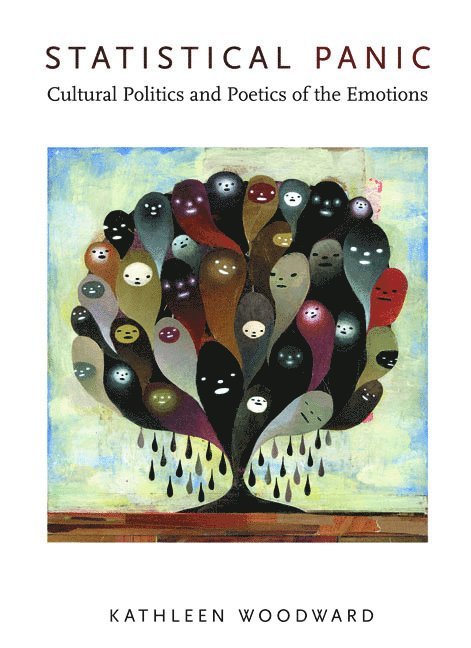
    Statistical Panic

    Cultural Politics and Poetics of the Emotions

    AvKathleen Woodward

    Häftad, Engelska, 2009

    433 kr

    Beställningsvara. Skickas inom 5-8 vardagar. Fri frakt över 249 kr.

    Fler format och utgåvor

    E-bok

    635 kr

    Beskrivning

    In this moving and thoughtful book, Kathleen Woodward explores the politics and poetics of the emotions, focusing on American culture since the 1960s. She argues that we are constrained in terms of gender, race, and age by our culture’s scripts for “emotional” behavior and that the accelerating impoverishment of interiority is a symptom of our increasingly media-saturated culture. She also shows how we can be empowered by stories that express our experience, revealing the value of our emotions as a crucial form of intelligence.Referring discreetly to her own experience, Woodward examines the interpenetration of social structures and subjectivity, considering how psychological emotions are social phenomena, with feminist anger, racial shame, old-age depression, and sympathy for non-human cyborgs (including robots) as key cases in point. She discusses how emerging institutional and discursive structures engender “new” affects that in turn can help us understand our changing world if we are attentive to them-the “statistical panic” produced by the risk society, with its numerical portents of disease and mortality; the rage prompted by impenetrable and bloated bureaucracies; the brutal shame experienced by those caught in the crossfire of the media; and the conservative compassion that is not an emotion at all, only an empty political slogan.The orbit of Statistical Panic is wide, drawing in feminist theory, critical phenomenology, and recent theories of the emotions. But at its heart are stories. As an antidote to the vacuous dramas of media culture, with its mock emotions and scattershot sensations, Woodward turns to the autobiographical narrative. Stories of illness-by Joan Didion, Yvonne Rainer, Paul Monette, and Alice Wexler, among others-receive special attention, with the inexhaustible emotion of grief framing the book as a whole.

    Produktinformation

    • Utgivningsdatum:2009-01-16
    • Mått:152 x 229 x 22 mm
    • Vikt:472 g
    • Format:Häftad
    • Språk:Engelska
    • Antal sidor:336
    • Förlag:Duke University Press
    • ISBN:9780822343776

    Utforska kategorier

    • Genusvetenskap inom Samhälle och politik
    • Litteraturvetenskap inom Skönlitteratur
    • Litteraturteori inom Skönlitteratur

    Mer om författaren

    Kathleen Woodward is Professor of English at the University of Washington, where she directs the Simpson Center for the Humanities. She is the author of Aging and Its Discontents: Freud and Other Fictions and the editor of Figuring Age: Women, Bodies, Generations and The Myths of Information: Technology and Postindustrial Culture.

    Recensioner i media

    “. . .Woodward makes a valuable contribution to the study of popular culture. She exhaustively contextualizes her work in that of the technology and media scholars (in addition to the affective scholars) who have come before her, while still managing to add a new narrative all her own that clarifies her paradoxical approach.” - Caroline Hagood, Journal of Popular Culture “The recent surge in interest in emotions from every imaginable discipline is richly explored in Kathleen Woodward’s lively new book, Statistical Panic.” - Maura Spiegel, American Literature “Woodward herself writes clearly in an almost ‘good-neighborly’ mode, and one can easily enough imagine talking with her over the backyard fence about life's difficulties. . . . The virtue of the book is clear: sociologists do not ‘own’ the ills of contemporary life in advanced societies, and when an English professor examines the same phenomena as do social scientists, but without the hindrances of methodological apparatus, genuinely useful notions become apparent that seldom make themselves known in conventional sociological research reports.” - Contemporary Sociology “Statistical Panic offers a critical exploration of emotions, how they are used for political gain, how they normatively reinforce social inequality, and how their subversion can combat the same inequalities. Woodward offers emotions as a source of political and social mobility, and her writing challenges us to be critical of the way statistical panic is used. She urges us complicate our understanding of our own emotional responses to everything from personal relationships to Twitter feeds.” - Lizzy Shramko, Feminist Review blog “If this reviewer were to recommend one current book to those in the emotion-science community, it would be this marvelous, wise collection of essays. Although nominally a work of literary and cultural criticism, the volume provides those interested in emotion in any discipline with a fresh exploration of the intersection of culture, emotions, and technology. . . . A deeply humane, gracefully written work of keen intelligence, this book is a critical resource for those interested in understanding emotions as represented in literature and as lived in daily life and in investigating what emotions reveal about human nature. Essential.” - R. R. Cornelius, Choice “Feelings have political consequences. Statistical Panic offers complexly layered readings of writers whose works have exposed the intimate connections between private sorrows and contemporary social realities, memoir and public policy, autobiography and theory: Joan Didion’s portrait of grief, Freud’s and Woolf’s anatomies of anger, Paul Monette’s affecting narrative of lives lost to AIDS, Morrison’s searing exposure of racial injustice. Kathleen Woodward has created a compassionate criticism for our post-September 11 world.”-Nancy K. Miller, author of But Enough About Me: Why We Read Other People’s Lives “Kathleen Woodward has written a clear, impassioned, and theoretically sophisticated argument that bridges the conceptual gulf separating psychoanalytical explanations for emotion from other models-most notably, Raymond Williams’s ‘structures of feeling’-that assume emotion is cultural in origin and susceptible to historical change. In a sequence of compelling examples-beginning with the anger characterizing first-wave feminists and peaking in what she calls ‘bureaucratic rage’-this book sets opposing concepts of emotion in a dialectic that reveals their interdependence. Woodward makes a powerful case, on the one hand, that the emotional intensities held responsible for a perceived ‘waning of affect’ during the twentieth century may also provide a basis for new affective communities. On the other hand, by looking at emotion through the lens of contemporary culture, she persuades me to see the emotions we come to share through the intimacy of literary autobiography as translations of the intensities generated by an intricately bureaucratized, mass-mediated society.”-Nancy Armstrong, Duke University “[W]oodward makes a valuable contribution to the study of popular culture. She exhaustively contextualizes her work in that of the technology and media scholars (in addition to the affective scholars) who have come before her, while still managing to add a new narrative all her own that clarifies her paradoxical approach.” - Caroline Hagood (Journal of Popular Culture) “Statistical Panic offers a critical exploration of emotions, how they are used for political gain, how they normatively reinforce social inequality, and how their subversion can combat the same inequalities. Woodward offers emotions as a source of political and social mobility, and her writing challenges us to be critical of the way statistical panic is used. She urges us complicate our understanding of our own emotional responses to everything from personal relationships to Twitter feeds.” - Lizzy Shramko (Feminist Review blog) “If this reviewer were to recommend one current book to those in the emotion-science community, it would be this marvelous, wise collection of essays. Although nominally a work of literary and cultural criticism, the volume provides those interested in emotion in any discipline with a fresh exploration of the intersection of culture, emotions, and technology. . . . A deeply humane, gracefully written work of keen intelligence, this book is a critical resource for those interested in understanding emotions as represented in literature and as lived in daily life and in investigating what emotions reveal about human nature. Essential.” - R. R. Cornelius (Choice) “The recent surge in interest in emotions from every imaginable discipline is richly explored in Kathleen Woodward’s lively new book, Statistical Panic.” - Maura Spiegel (American Literature) “Woodward herself writes clearly in an almost ‘good-neighborly’ mode, and one can easily enough imagine talking with her over the backyard fence about life's difficulties. . . . The virtue of the book is clear: sociologists do not ‘own’ the ills of contemporary life in advanced societies, and when an English professor examines the same phenomena as do social scientists, but without the hindrances of methodological apparatus, genuinely useful notions become apparent that seldom make themselves known in conventional sociological research reports.” (Contemporary Sociology)

    Innehållsförteckning

    • Acknowledgments ixIntroduction: Thinking Feeling, Feeling Thinking 1Part One: Cultural Politics, Communities of Feeling 291. Containing Anger, Advocating Anger: Freud and Feminism 352. Against Wisdom: Anger and Aging 583. Racial Shame, Mass-Mediated Shame, Mutual Shame 794. Liberal Compassion, Compassionate Conservatism 109Part Two: Structures of Feeling, "New" Feelings 1355. Sympathy for Nonhuman Cyborgs 1396. Bureaucratic Rage 1657. Statistical Panic 195Coda: Inexhaustible Grief 219Notes 235Bibliography 275Index 297