• Fri frakt över 249 kr
  • •
  • Snabba leveranser
  • •
  • Billiga böcker
Kundservice

Du är på sajten för privatpersoner.

Företag, bibliotek eller offentlig verksamhet?

Du handlar på classic.bokus.com, där alla dina funktioner finns intakta.
Till classic.bokus.com
Bokus logotyp. Gå till startsidan.
  • Erbjudanden
  • Nyheter
  • Student
  • Topplistor
  • Barn & ungdom
  • Bokus Play
  • E-böcker
  • Pocketböcker
  • Spel & pussel

10% rabatt på allt med kod: NYSTART10 →

Sidfot

Mina sidor

    Hjälp

    • Kundservice
    • Vanliga frågor och svar
    • Frakt och leverans
    • Retur vid ångerrätt
    • Reklamera vara
    • Betalning
    • Köpvillkor
    • Allmänna villkor
    • Information om webbplatsens tillgänglighet

    Om Bokus

    • Om oss
    • Pressrum
    • För studenter
    • För företag
    • För bibliotek och offentlig verksamhet
    • För leverantörer
    • Hållbarhet

    Populärt

    • Aktuella erbjudanden
    • Presentkort
    • Studentlitteratur
    • Nya böcker
    • Topplistor
    • Signerade böcker
    • Engelska böcker

    Inspiration

    • Boktips
    • BookTok
    • Populära bokserier
    • Barnbokskaraktärer
    • Populära författare
    Logotyp för Bokus
    Följ oss på Facebook (extern länk)Följ oss på Instagram (extern länk)Följ oss på YouTube (extern länk)Följ oss på TikTok (extern länk)
    bokus @ CookiesAnpassa cookiesIntegritetspolicyKöpvillkor
    Till Citymail hemsida (extern länk)Till Budbee hemsida (extern länk)Till Postnord hemsida (extern länk)Till Schenker hemsida (extern länk)Till Early Bird hemsida (extern länk)Till Walleys hemsida (extern länk)
    1. Samhälle och politik
    2. Politik och statsskick
    3. Statsskick och politiska processer

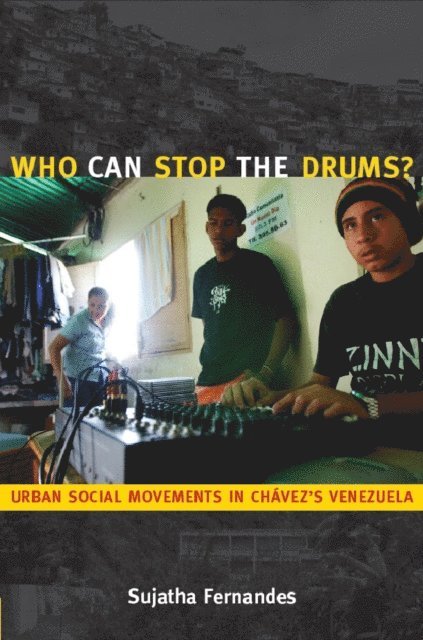
    Who Can Stop the Drums?

    Urban Social Movements in Chávez's Venezuela

    AvSujatha Fernandes

    Häftad, Engelska, 2010

    376 kr

    Beställningsvara. Skickas inom 5-8 vardagar. Fri frakt över 249 kr.

    Fler format och utgåvor

    E-bok

    568 kr

    Beskrivning

    In this vivid ethnography of social movements in the barrios, or poor shantytowns, of Caracas, Sujatha Fernandes reveals a significant dimension of political life in Venezuela since President Hugo ChÁvez was elected. Fernandes traces the histories of the barrios, from the guerrilla insurgency, movements against displacement, and cultural resistance of the 1960s and 1970s, through the debt crisis of the early 1980s and the neoliberal reforms that followed, to the ChÁvez period. She weaves barrio residents’ life stories into her account of movements for social and economic justice. Who Can Stop the Drums? demonstrates that the transformations under way in Venezuela are shaped by negotiations between the ChÁvez government and social movements with their own forms of historical memory, local organization, and consciousness.Fernandes portrays everyday life and politics in the shantytowns of Caracas through accounts of community-based radio, barrio assemblies, and popular fiestas, and the many interviews she conducted with activists and government officials. Most of the barrio activists she presents are ChÁvez supporters. They see the leftist president as someone who understands their precarious lives and has made important changes to the state system to redistribute resources. Yet they must balance receiving state resources, which are necessary to fund their community-based projects, with their desire to retain a sense of agency. Fernandes locates the struggles of the urban poor within Venezuela’s transition from neoliberalism to what she calls “post-neoliberalism.” She contends that in contemporary Venezuela we find a hybrid state; while ChÁvez is actively challenging neoliberalism, the state remains subject to the constraints and logics of global capital.

    Produktinformation

    • Utgivningsdatum:2010-04-02
    • Mått:156 x 235 x 18 mm
    • Vikt:467 g
    • Format:Häftad
    • Språk:Engelska
    • Antal sidor:336
    • Förlag:Duke University Press
    • ISBN:9780822346777

    Utforska kategorier

    • Statsskick och politiska processer inom Samhälle och politik
    • Sociologi inom Samhälle och politik

    Mer om författaren

    Sujatha Fernandes is Associate Professor of Sociology at Queens College and the Graduate Center, City University of New York. She is the author of Cuba Represent! Cuban Arts, State Power, and the Making of New Revolutionary Cultures, also published by Duke University Press.

    Recensioner i media

    “In the Spirit of Negro Primero is a marvelous contribution to the literature on social movements, neoliberalism, cultural politics, and Venezuela. While most analyses of the country portray Hugo ChÁvez as either a liberating figure fighting neoliberalism to help the poor, or an authoritarian caudillo preserving his own power while destroying liberties and human rights, Sujatha Fernandes goes far beyond such polarities. By concentrating on the experiences of poor activists in Caracas, she provides a unique and nuanced perspective on a complicated political process, and reveals the ChÁvez government as much more complicated and interesting than most other scholars have allowed.”-Nancy Postero, author of Now We Are Citizens: Indigenous Politics in Post-Multicultural Bolivia “Too much of the scholarly and political writing on the Venezuelan government centers on President Hugo ChÁvez and his style and rhetoric. In this original, timely, and important book, Sujatha Fernandes focuses on the barrio residents who form the social base of the ChÁvista movement. Along the way, she demonstrates a detailed understanding of Venezuela’s culture and recent political history.”-Steve Ellner, author of Rethinking Venezuelan Politics: Class, Conflict, and the ChÁvez Phenomenon “[A]n excellent, well-written, and engaging work of activist scholarship. It provides not only rich empirical data, but also theoretical insights on some of the key issues confronted by contemporary Latin American social activists. This book is highly recommended for scholars and activists with an interest in social movements and Latin America.” - Lynn Horton (Contemporary Sociology) “[T]his book certainly adds a flavorful icing, one that is certainly long overdue and more than welcome, to the existing literature on Venezuela.” - J. Michael Ryan (Anthropological Quarterly) “This book is a must read for scholars interested in Venezuela, as [Fernandes] provides an historical account of the growth of Caracas and the relationship between barrio residents and the state over time. The book would also be excellent for a graduate course on social movements or social change, as well as in a methods course on ethnography as a beautiful example of how to weave together ethnographic and interview data to provide a vivid and intellectually engaging work of scholarship.” - Tiffany Linton Page (Social Forces) “Fernandes forges a new and promising analytical approach to the study of social movements: that of examining the 'everyday wars of position.' … If others take up Fernandes’s research agenda, we will be rewarded with greater insight into the dynamics of contention within clientelism and revolution.” - Leslie C. Gates (Perspectives on Politics) “This well written and interesting book captures quite a lot about the ambiguities of urban politics, and the conditions of barrio life, in Caracas. . . . The book could certainly be recommended to students with some assurance that they would enjoy reading it. They will learn from it at the same time.” - George Philip (Bulletin of Latin American Research) “Fernandes elegantly places the struggles of the local poor in a larger political framework to allow readers to understand how residents make their own history by negotiating their post-neoliberal visions with their current social circumstances. Recommended.” - J. M. Santos-Hernindez (CHOICE) “Sujatha Fernandes reveals a world of activism deeply influenced by the history of Left movements in Latin America, but vulnerable to the kind of technocratic, bottom-line reasoning regrettably necessary for the state's economic success.” - Nicholas Gamso (Social Text)

    Innehållsförteckning

    • List of Illustrations Acknowledgments Introduction I. Individual and Collective Histories 1. Urban Political Histories 2. Poverty, Violence, and the Neoliberal Turn 3. Personal Lives II. Everyday Life and Politics 4. Culture, Identity, and Urban Movements 5. Barrio-Based Media and Communications 6. The Takeover of the Alameda Theater III. State-Society Mediation 7. The New Coalitional Politics of Social Movements Conclusion Notes Bibliography Index