• Fri frakt över 249 kr
  • •
  • Snabba leveranser
  • •
  • Billiga böcker
Kundservice

Du är på sajten för privatpersoner.

Företag, bibliotek eller offentlig verksamhet?

Du handlar på classic.bokus.com, där alla dina funktioner finns intakta.
Till classic.bokus.com
Bokus logotyp. Gå till startsidan.
  • Erbjudanden
  • Nyheter
  • Student
  • Topplistor
  • Barn & ungdom
  • Bokus Play
  • E-böcker
  • Pocketböcker
  • Spel & pussel

10% rabatt på allt med kod: NYSTART10 →

Sidfot

Mina sidor

    Hjälp

    • Kundservice
    • Vanliga frågor och svar
    • Frakt och leverans
    • Retur vid ångerrätt
    • Reklamera vara
    • Betalning
    • Köpvillkor
    • Allmänna villkor
    • Information om webbplatsens tillgänglighet

    Om Bokus

    • Om oss
    • Pressrum
    • För studenter
    • För företag
    • För bibliotek och offentlig verksamhet
    • För leverantörer
    • Hållbarhet

    Populärt

    • Aktuella erbjudanden
    • Presentkort
    • Studentlitteratur
    • Nya böcker
    • Topplistor
    • Signerade böcker
    • Engelska böcker

    Inspiration

    • Boktips
    • BookTok
    • Populära bokserier
    • Barnbokskaraktärer
    • Populära författare
    Logotyp för Bokus
    Följ oss på Facebook (extern länk)Följ oss på Instagram (extern länk)Följ oss på YouTube (extern länk)Följ oss på TikTok (extern länk)
    bokus @ CookiesAnpassa cookiesIntegritetspolicyKöpvillkor
    Till Citymail hemsida (extern länk)Till Budbee hemsida (extern länk)Till Postnord hemsida (extern länk)Till Schenker hemsida (extern länk)Till Early Bird hemsida (extern länk)Till Walleys hemsida (extern länk)
    1. Kultur
    2. Scenkonst och film
    3. Film

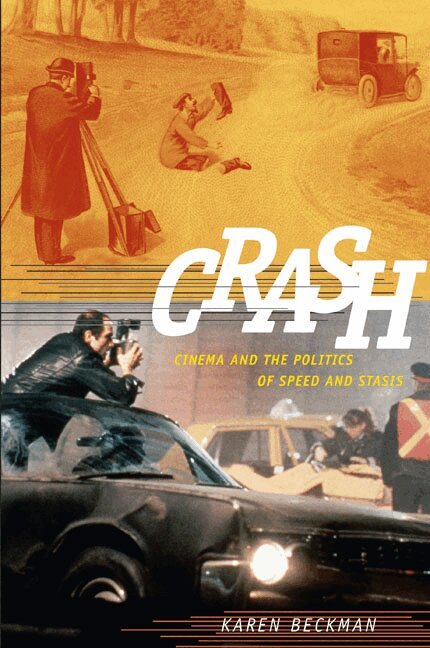
    Crash

    Cinema and the Politics of Speed and Stasis

    AvKaren Redrobe

    Häftad, Engelska, 2010

    399 kr

    Beställningsvara. Skickas inom 5-8 vardagar. Fri frakt över 249 kr.

    Fler format och utgåvor

    Inbunden

    1 372 kr

    Beskrivning

    Artists, writers, and filmmakers from Andy Warhol and J. G. Ballard to Alejandro GonzÁlez IÑÁrritu and Ousmane SembÈne have repeatedly used representations of immobilized and crashed cars to wrestle with the conundrums of modernity. In Crash, Karen Beckman argues that representations of the crash parallel the encounter of film with other media, and that these collisions between media offer useful ways to think about alterity, politics, and desire. Examining the significance of automobile collisions in film genres including the “cinema of attractions,” slapstick comedies, and industrial-safety movies, Beckman reveals how the car crash gives visual form to fantasies and anxieties regarding speed and stasis, risk and safety, immunity and contamination, and impermeability and penetration. Her reflections on the crash as the traumatic, uncertain moment of inertia that comes in the wake of speed and confidence challenge the tendency in cinema studies to privilege movement above film’s other qualities. Ultimately, Beckman suggests that film studies is a hybrid field that cannot apprehend its object of study without acknowledging the ways that cinema’s technology binds it to capitalism’s industrial systems and other media, technologies, and disciplines.

    Produktinformation

    • Utgivningsdatum:2010-08-03
    • Mått:152 x 235 x 29 mm
    • Vikt:467 g
    • Format:Häftad
    • Språk:Engelska
    • Antal sidor:320
    • Förlag:Duke University Press
    • ISBN:9780822347262

    Utforska kategorier

    • Film inom Kultur

    Mer om författaren

    Karen Redrobe (formerly Beckman) is the Elliot and Roslyn Jaffe Professor of Film Studies in the Department of the History of Art, and Director of the Program in Cinema Studies, at the University of Pennsylvania. She is author of Vanishing Women: Magic, Film, and Feminism and coeditor, with Jean Ma, of Still Moving: Between Cinema and Photography, both also published by Duke University Press.

    Recensioner i media

    “[A] fascinating study of the place of the car crash in cinema. . . . Although the book is written as a contribution to ongoing academic debates within film studies, the author’s observations and arguments should nonetheless be interesting to film lovers.” - Victor P. Corona, PopMatters “Beckman does a thorough job depicting the history of the car crash throughout the years of cinema. Her passion for mobility and stasis is engaging through her timeline of the evolution of the automobile. Crash will appeal to those in film and media studies, as well as to lovers of cinema. By combining literature, film, history, and art, she provides not only a good read, but also room to think.” - Stephanie Koury, International Journal of Communication “Beckman’s treatments are unfailingly interesting, and her arguments are provocative. . . . This important book will cause a stir in the field. Recommended. Upper-division undergraduates and above.” - W. A. Vincent, Choice “Crash: Cinema and the Politics of Speed and Stasis is exhaustively researched and argued with clarity. Blending cinema and media studies with a hard-edged critique of the capitalist machine, this book is both entertaining and enlightening.” - Simon Sellars, Media International Australia “Crash represents a major intervention in the field of film and media studies, and provides a model of thoughtful, nuanced scholarship…[Beckman’s] persuasive and finely wrought argument challenges film and media scholars to develop new ways of thinking about the relationships among movement, stasis and mediated vision.” - Allan Cameron, Screen “Crash is an extraordinarily original intervention in contemporary ‘technophilic’ discourses (even critical ones) focused on speed and mobility. As it resonates through a variety of cinematic and literary texts, Karen Beckman views the ‘car crash’ vividly (and viscerally) as a startling visual image, narrative thematic, and critical metaphor for what drives our contradictory desires for ‘automobility,’ inertia, feeling, and community on a collision course both productive and destructive. As she moves across theories and disciplines, Beckman’s textual and cultural analyses come together in a work that is passionate, illuminating, and politically engaged. Crash is a major contribution to film and media studies, comparative literature, art history, and cultural studies and, indeed, is a model of interdisciplinary scholarship.”-Vivian Sobchack, author of Carnal Thoughts: Embodiment and Moving Image Culture “In this inventive exploration of the car crash in the history of film, critical theory, and art practice, Karen Beckman invokes the crash as a way of working through questions of mobility and stasis, security and transgression, medium hybridity, and technology, spectatorship, and the body in new and exciting ways. Moving fluidly from the comic and reflexive moments of the car crash in early and silent cinema, to concerns with accident and trauma, especially in non-theatrical films from the 1930s to the 1960s, and then to more contemporary work, Beckman exhibits an impressive range of historical, artistic, and theoretical interests. She shows how the trope of the car crash weaves its way into the cultural life of the twentieth century in ways that parallel Wolfgang Schivelbusch’s pioneering work on the train accident in the nineteenth century.”-D. N. Rodowick, Professor of Visual and Environmental Studies, Harvard University “Crash: Cinema and the Politics of Speed and Stasis is exhaustively researched and argued with clarity. Blending cinema and media studies with a hard-edged critique of the capitalist machine, this book is both entertaining and enlightening.” - Simon Sellars (Media International Australia) “Crash represents a major intervention in the field of film and media studies, and provides a model of thoughtful, nuanced scholarship…[Beckman’s] persuasive and finely wrought argument challenges film and media scholars to develop new ways of thinking about the relationships among movement, stasis and mediated vision.” - Allan Cameron (Screen) “[A] fascinating study of the place of the car crash in cinema. . . . Although the book is written as a contribution to ongoing academic debates within film studies, the author’s observations and arguments should nonetheless be interesting to film lovers.” - Victor P. Corona (PopMatters) “Beckman does a thorough job depicting the history of the car crash throughout the years of cinema. Her passion for mobility and stasis is engaging through her timeline of the evolution of the automobile. Crash will appeal to those in film and media studies, as well as to lovers of cinema. By combining literature, film, history, and art, she provides not only a good read, but also room to think.” - Stephanie Koury (International Journal of Communication) “Beckman’s treatments are unfailingly interesting, and her arguments are provocative. . . . This important book will cause a stir in the field. Recommended. Upper-division undergraduates and above.” - W. A. Vincent (Choice)

    Innehållsförteckning

    • Acknowledgments ixIntroduction 11. "Jerky Nearness": Spectatorship, Mobility, and Collision in Early Cinema 252. Car Wreckers and Home Lovers: The Automobile in Silent Slapstick 553. Doing Death Over: Industrial-Safety Films, Accidental-Motion Studies, and the Involuntary Crash Test Dummy 1054. Disaster Time, the Kennedy Assassination, and Andy Warhol's Since (1966/2002) 1375. Film Falls Apart: Crash, Semen, and Pop 1616. Crash Aesthetics: Amores perros and the Dream of Cinematic Mobility 1797. The Afterlife of Weekend: Or, The University Found on a Scrapheap 205Notes 235Bibliography 275Index 289