• Fri frakt över 249 kr
  • •
  • Snabba leveranser
  • •
  • Billiga böcker
Kundservice

Du är på sajten för privatpersoner.

Företag, bibliotek eller offentlig verksamhet?

Du handlar på classic.bokus.com, där alla dina funktioner finns intakta.
Till classic.bokus.com
Bokus logotyp. Gå till startsidan.
  • Erbjudanden
  • Nyheter
  • Student
  • Topplistor
  • Barn & ungdom
  • Bokus Play
  • E-böcker
  • Pocketböcker
  • Spel & pussel

10% rabatt på allt med kod NYSTART10 →

Sidfot

Mina sidor

    Hjälp

    • Kundservice
    • Vanliga frågor och svar
    • Frakt och leverans
    • Retur vid ångerrätt
    • Reklamera vara
    • Betalning
    • Köpvillkor
    • Allmänna villkor
    • Information om webbplatsens tillgänglighet

    Om Bokus

    • Om oss
    • Pressrum
    • För studenter
    • För företag
    • För bibliotek och offentlig verksamhet
    • För leverantörer
    • Hållbarhet

    Populärt

    • Aktuella erbjudanden
    • Presentkort
    • Studentlitteratur
    • Nya böcker
    • Topplistor
    • Signerade böcker
    • Engelska böcker

    Inspiration

    • Boktips
    • BookTok
    • Populära bokserier
    • Barnbokskaraktärer
    • Populära författare
    Logotyp för Bokus
    Följ oss på Facebook (extern länk)Följ oss på Instagram (extern länk)Följ oss på YouTube (extern länk)Följ oss på TikTok (extern länk)
    bokus @ CookiesAnpassa cookiesIntegritetspolicyKöpvillkor
    Till Citymail hemsida (extern länk)Till Budbee hemsida (extern länk)Till Postnord hemsida (extern länk)Till Schenker hemsida (extern länk)Till Early Bird hemsida (extern länk)Till Walleys hemsida (extern länk)
    1. Samhälle och politik
    2. Samhälle och kultur
    3. Sociala grupper och identitet
    4. HBTQ+

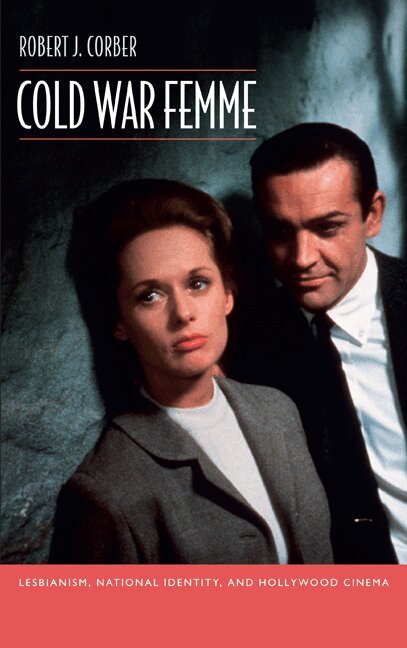
    Cold War Femme

    Lesbianism, National Identity, and Hollywood Cinema

    AvRobert J. Corber

    Häftad, Engelska, 2011

    336 kr

    Beställningsvara. Skickas inom 5-8 vardagar. Fri frakt över 249 kr.

    Fler format och utgåvor

    E-bok

    536 kr

    Beskrivning

    In his bestselling book The Grapevine: A Report on the Secret World of the Lesbian (1965), Jess Stearn announced that, contrary to the assumptions of many Americans, most lesbians appeared indistinguishable from other women. They could mingle “congenially in conventional society.” Some were popular sex symbols; some were married to unsuspecting husbands. Robert J. Corber contends that The Grapevine exemplified a homophobic Cold War discourse that portrayed the femme as an invisible threat to the nation. Underlying this panic was the widespread fear that college-educated women would reject marriage and motherhood as aspirations, weakening the American family and compromising the nation’s ability to defeat totalitarianism. Corber argues that Cold War homophobia transformed ideas about lesbianism in the United States. In the early twentieth century, homophobic discourse had focused on gender identity: the lesbian was a masculine woman. During the Cold War, the lesbian was reconceived as a woman attracted to other women. Corber develops his argument by analyzing representations of lesbianism in Hollywood movies of the 1950s and 1960s, and in the careers of some of the era’s biggest female stars. He examines treatments of the femme in All About Eve, The Children’s Hour, and Marnie, and he explores the impact of Cold War homophobia on the careers of Joan Crawford, Bette Davis, and Doris Day.

    Produktinformation

    • Utgivningsdatum:2011-01-27
    • Mått:146 x 235 x 25 mm
    • Vikt:399 g
    • Format:Häftad
    • Språk:Engelska
    • Antal sidor:240
    • Förlag:Duke University Press
    • ISBN:9780822349471

    Utforska kategorier

    • HBTQ+ inom Samhälle och politik
    • Film inom Kultur

    Mer om författaren

    Robert J. Corber is Professor and Director of the Women, Gender, and Sexuality Program at Trinity College. He is the author of Homosexuality in Cold War America: Resistance and the Crisis of Masculinity and In the Name of National Security: Hitchcock, Homophobia, and the Political Construction of Gender in Postwar America, both also published by Duke University Press.

    Recensioner i media

    “The Alfred Kinsey of film studies, Robert J. Corber has followed up his authoritative work on Cold War representations of male homosexuality with a companion volume on constructions of lesbianism in films of the period. Shedding new light on canonical films and iconic stars-All about Eve and Marnie, Bette Davis and Doris Day-Cold War Femme tracks how a shift in discourses of homosexuality from gender inversion to object choice gave a new frisson to Hollywood femininity. Corber’s historical perspective shows how female power was mapped on to filmic fears and fantasies.”-Patricia White, author of Uninvited: Classical Hollywood Cinema and Lesbian Representability “The only problem with Robert J. Corber’s Cold War Femme is that it gives so much pleasure on the way to providing a completely persuasive and significant history of the threat femininity posed to the sexually and politically paranoid denizens of the Cold War West. The chapter on Doris Day, an instant classic, will surprise, delight, and educate all of its students, whether in classrooms or in fandom. But let that not distract anyone from the serious contribution Corber makes here to the history of twentieth-century sexuality.”-Lauren Berlant, author of The Female Complaint: The Unfinished Business of Sentimentality in American Culture “[P]rovocative, detailed, buttressed by ample documentation, at times brilliantly insightful. . . .” - David Greven (Cineaste) “Insisting on the material significance of the categories through which women’s lives and desires are understood and regulated, Cold War Femme brilliantly and elegantly complicates our sense of cinema in the Cold War era, and underlines how vital historical analysis is for queer scholarship.” - Yvonne Tasker (Screen) “The strength of Corber’s scholarship rests in his attention to detail and the skillful way he creates effective, historically grounded contexts for understanding the texts and events he examines…. Cold War Femme, then, is a historical analysis, a gender study, a work of film scholarship and, crucially, much more than merely the sum of its parts.” - David Sidore (Film Criticism) “Not only solidly argued, the book is also nearly as much fun to read as the referenced films are to watch. Cold War Femme offers valuable insights for any reader interested in filmic representations of female sexuality. With this book, Corber redresses his admitted previous neglect of lesbian history as non-distinct from gay men's history, and he triumphs in his goal of bringing analysis of Hollywood's femme lesbian into the broader picture of American women's history.” - Kate Hogan (Media International Australia) “The theoretical framework developed in Cold War Femme is of key pedagogical and intellectual value, as it proves the presence and consequence of cold war femme gender and sexuality in cinema and brings range to femme identity-an under-theorized gender identity. . . . Corber’s discussions of the cold war femme ultimately charm the reader into considering and reconsidering his subject and perspective, inspiring one to want to do their own close reading of his questions, reengage his text, and also look for other presences of the cold war femme.” - Robyn A. Epstein and Mel Michelle Lewis (Feminist Formations) “Brilliant in conception, convincing in execution, charming and witty in the writing. . . . Moving seemingly without effort between his texts, Corber brings the films to life and makes the reader see them anew. He is particularly masterful in weaving together his analysis of the four versions of The Children's Hour, picking up one strand only to lay it down and pick up another, then another. The book as a whole is like an elegant tapestry. Essential.” - W. A. Vincent (Choice) “Cold War Femme’s thesis is absolutely fascinating. . . . [A] truly significant addition to films studies, American Studies, queer studies and studies on the left, providing deep insights into the Cold War and its affects - and effects.” - Paula Rabinowitz (Against the Current) “What makes Cold War Femme a particularly distinctive contribution to sexuality studies is its disentanglement of the Cold War lesbian from gay histories and her re-insertion into American women’s history. . . . Among lesbian-focused histories and scholarship, it repositions the femme as a queer figure who isn’t overshadowed by the heroic masculinity of the butch. And, amidst queer studies more generally, it develops a historical exploration of less visible queer figures who aren’t gender crossers or transgressors. Cold War Femme should be compulsory reading for all those interested in these themes.” - Dion Kagan (Screening the Past) “Corber has a winningly tart writing style and a dynamically convincing template for scrutinising some of the most significant films of the time with their observations about women’s social, sexual and political stakes. This is an ideal complement to his 1998 volume on homosexual representation in the same era (Homosexuality in Cold War America). It might also mark a new level of critique of heteronormative representation. The issue of spectatorship and its complex consequences for female subject positioning is a rich seam which he mines with clarity.” - Elaine Lennon (Offscreen)

    Innehållsförteckning

    • Acknowledgments ixIntroduction. Reclaiming the "Lost Sex": The Lesbian in Cold War Culture 1Part I. Screening the Femme1. Representing the Femme: All about Eve 272. Lesbian Unitelligibility: The Children's Hour 483. Recuperating Femme Femininity: Marnie 72Part II. Female Stardom and Cold War Culture4. Joan Crawford's Padded Shoulders 975. Remaking Bette Davis 1276. Doris Day's Queer Normativity 154Conclusion. Killing Off the Femme: The Haunting 185Notes 191Bibliography 215Index 223