• Fri frakt över 249 kr
  • •
  • Snabba leveranser
  • •
  • Billiga böcker
Kundservice

Du är på sajten för privatpersoner.

Företag, bibliotek eller offentlig verksamhet?

Du handlar på classic.bokus.com, där alla dina funktioner finns intakta.
Till classic.bokus.com
Bokus logotyp. Gå till startsidan.
  • Erbjudanden
  • Nyheter
  • Student
  • Topplistor
  • Barn & ungdom
  • Bokus Play
  • E-böcker
  • Pocketböcker
  • Spel & pussel

10% rabatt på allt med kod: NYSTART10 →

Sidfot

Mina sidor

    Hjälp

    • Kundservice
    • Vanliga frågor och svar
    • Frakt och leverans
    • Retur vid ångerrätt
    • Reklamera vara
    • Betalning
    • Köpvillkor
    • Allmänna villkor
    • Information om webbplatsens tillgänglighet

    Om Bokus

    • Om oss
    • Pressrum
    • För studenter
    • För företag
    • För bibliotek och offentlig verksamhet
    • För leverantörer
    • Hållbarhet

    Populärt

    • Aktuella erbjudanden
    • Presentkort
    • Studentlitteratur
    • Nya böcker
    • Topplistor
    • Signerade böcker
    • Engelska böcker

    Inspiration

    • Boktips
    • BookTok
    • Populära bokserier
    • Barnbokskaraktärer
    • Populära författare
    Logotyp för Bokus
    Följ oss på Facebook (extern länk)Följ oss på Instagram (extern länk)Följ oss på YouTube (extern länk)Följ oss på TikTok (extern länk)
    bokus @ CookiesAnpassa cookiesIntegritetspolicyKöpvillkor
    Till Citymail hemsida (extern länk)Till Budbee hemsida (extern länk)Till Postnord hemsida (extern länk)Till Schenker hemsida (extern länk)Till Early Bird hemsida (extern länk)Till Walleys hemsida (extern länk)
    1. Samhälle och politik
    2. Samhälle och kultur
    3. Kultur och medier
    4. Medievetenskap

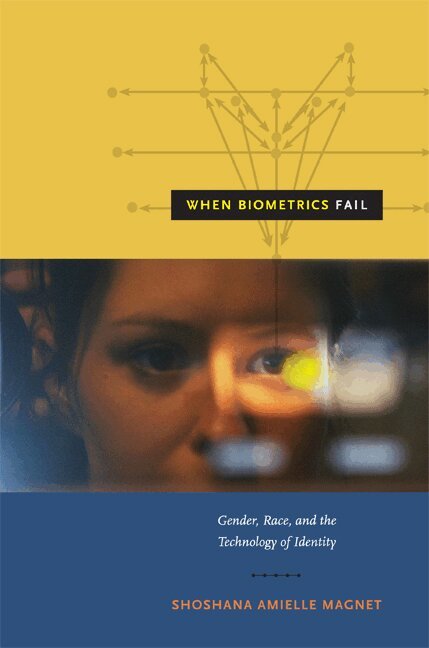
    When Biometrics Fail

    Gender, Race, and the Technology of Identity

    AvShoshana Amielle Magnet

    Häftad, Engelska, 2011

    335 kr

    Beställningsvara. Skickas inom 5-8 vardagar. Fri frakt över 249 kr.

    Fler format och utgåvor

    E-bok

    505 kr

    Beskrivning

    From digital fingerprinting to iris and retina recognition, biometric identification systems are a multibillion dollar industry and an integral part of post-9/11 national security strategy. Yet these technologies often fail to work. The scientific literature on their accuracy and reliability documents widespread and frequent technical malfunction. Shoshana Amielle Magnet argues that these systems fail so often because rendering bodies in biometric code falsely assumes that people’s bodies are the same and that individual bodies are stable, or unchanging, over time. By focusing on the moments when biometrics fail, Magnet shows that the technologies work differently, and fail to function more often, on women, people of color, and people with disabilities. Her assessment emphasizes the state’s use of biometrics to control and classify vulnerable and marginalized populations-including prisoners, welfare recipients, immigrants, and refugees-and to track individuals beyond the nation’s territorial boundaries. When Biometrics Fail is a timely, important contribution to thinking about the security state, surveillance, identity, technology, and human rights.

    Produktinformation

    • Utgivningsdatum:2011-11-11
    • Mått:154 x 233 x 17 mm
    • Vikt:340 g
    • Format:Häftad
    • Språk:Engelska
    • Antal sidor:224
    • Förlag:Duke University Press
    • ISBN:9780822351351

    Utforska kategorier

    • Medievetenskap inom Samhälle och politik
    • Naturvetenskap:allmänt inom Naturvetenskap och teknik

    Mer om författaren

    Shoshana Amielle Magnet is Assistant Professor in the Institute of Women’s Studies and the Department of Criminology at the University of Ottawa. She is a co-editor (with Kelly Gates) of The New Media of Surveillance.

    Recensioner i media

    “Taking her cue from science and technology studies' methods and theories, where definitions of ‘success’ in connection with technological developments are long-standing topics of interest . . ., Magnet focuses on its counterpart, the issue of technological failure. In view of the fact that their often substandard performance seldom seems to play a role in government decisions on whether to opt for the large-scale implementation of biometrics (eg, the US-Visitor and Immigrant Status Indicator Technology system, or Europe's use of biometric passports), exposing whole populations to the consequences of their failure, these are timely questions. . . . [F]or those interested in the technology, its social implications and use in a number of US contexts, the details of Magnet's investigations are very much worth reading.” - Irma van der Ploeg, Times Higher Education Supplement “When Biometrics Fail offers a damning analysis of the technical problems that dog biometric identification, many of which stem from the premises on which individual difference is defined. . . . [A] useful synthesis of the activities contemporary biometric industry, providing a compelling dissection of how the idea of a science of biometrics fails, and a timely critique of an industry and its claims which exploit a misconception about the human body and use technological fetishism to posit the solution as a high tech – and therefore ethically unproblematic -solution to a range of problems that have serious political and humanitarian consequences.”- Hannah Drayson, Leonardo Reviews “The book allows the reader to ponder what sorts of assumptions about people, science, and society are at play when biometrics continues to have ongoing success, in light of its failure…. These and other interdisciplinary questions pertaining to late capitalism, identity, resistance, and the violence of identification, make up the crux of this rather accessible book… [I]nsightful in terms of its crisscrossing empirical analysis…. [I]t will be of great interest to scholars and nonscholars alike who are interested in identity, gender, and race relations, as well as the impact of technology on strategies of political resistance and moral regulation.” - Bianca Baggiarini, Canadian Review of Sociology “Overall, Magnet’s critique of biometric discourse and technologies is penetrating, relentless and often devastating. This is an enlightening, exquisitely critical book that should be required reading as much for neo-liberal policy-makers considering quick-fix technological solutions to systemic social and crime control problems as for students and scholars of criminology.” - Randy K. Lippert, Theoretical Criminology “Magnet's When Biometrics Fail sounds some compelling notes of caution about placing too much reliance on unthinking machines to do human beings' work.” - Rick Docksai, World Future Review “When Biometrics Fail is overwhelmingly persuasive, exhaustively researched, eloquently written, and full of mordant humor and bitter truth. Shoshana Amielle Magnet explains the history, science, and ideology of our contemporary biometric moment with great skill and insight. Everyone needs to read this book. An outstanding study of the informationalization of race, gender, and immigration.”-Lisa Nakamura, author of Digitizing Race: Visual Cultures of the Internet “Impassioned, critical, and readable, When Biometrics Fail explores the underside of technologies that have been touted as a panacea for many of the discontents of post-9/11 society. Shoshana Amielle Magnet reveals the seldom-discussed impacts of these new technologies on people marginalized by race, ethnicity, gender, class, sexuality, and disability, and she challenges the commonplace assumption that human bodies can be reduced to a string of numbers.”-Simon A. Cole, author of Suspect Identities: A History of Fingerprinting and Criminal Identification “When Biometrics Fail offers a damning analysis of the technical problems that dog biometric identification, many of which stem from the premises on which individual difference is defined. . . . [A] useful synthesis of the activities contemporary biometric industry, providing a compelling dissection of how the idea of a science of biometrics fails, and a timely critique of an industry and its claims which exploit a misconception about the human body and use technological fetishism to posit the solution as a high tech – and therefore ethically unproblematic -solution to a range of problems that have serious political and humanitarian consequences.”- Hannah Drayson (Leonardo Reviews) “Taking her cue from science and technology studies' methods and theories, where definitions of ‘success’ in connection with technological developments are long-standing topics of interest . . ., Magnet focuses on its counterpart, the issue of technological failure. In view of the fact that their often substandard performance seldom seems to play a role in government decisions on whether to opt for the large-scale implementation of biometrics (eg, the US-Visitor and Immigrant Status Indicator Technology system, or Europe's use of biometric passports), exposing whole populations to the consequences of their failure, these are timely questions. . . . [F]or those interested in the technology, its social implications and use in a number of US contexts, the details of Magnet's investigations are very much worth reading.” - Irma van der Ploeg, (Times Higher Education) “The book allows the reader to ponder what sorts of assumptions about people, science, and society are at play when biometrics continues to have ongoing success, in light of its failure…. These and other interdisciplinary questions pertaining to late capitalism, identity, resistance, and the violence of identification, make up the crux of this rather accessible book… [I]nsightful in terms of its crisscrossing empirical analysis…. [I]t will be of great interest to scholars and nonscholars alike who are interested in identity, gender, and race relations, as well as the impact of technology on strategies of political resistance and moral regulation.” - Bianca Baggiarini (Canadian Review of Sociology) “Overall, Magnet’s critique of biometric discourse and technologies is penetrating, relentless and often devastating. This is an enlightening, exquisitely critical book that should be required reading as much for neo-liberal policy-makers considering quick-fix technological solutions to systemic social and crime control problems as for students and scholars of criminology.” - Randy K. Lippert (Theoretical Criminology) “Magnet's When Biometrics Fail sounds some compelling notes of caution about placing too much reliance on unthinking machines to do human beings' work.” - Rick Docksai (World Future Review) “Magnet’s theoretical reliance on corporeal fetishism while attending to failures, leads her to significant conclusions: first, the technology falsely imagines bodies as stable entities, and second, it intensifies inequalities. Of particular interest to sociologists is her focus, especially in the welfare chapter, on the human costs of the technologies. . . . The book is well organized and the archival material clearly presented. The introduction sets up the interesting question of how biometric technology codifies inequality, and subsequent chapters provide a convincing argument.” - Emily Fairchild (Contemporary Sociology) “Shoshana Amielle Magnet provides great insight into the rise of biometrics and offers a nuanced study of the complex social shaping of surveillance technologies at the intersection of the security industrial complex, cultural discourse, and code. This is a welcome addition to cultural studies and media studies scholarship as it examines representation and identity in a novel site.” - Peter A. Chow White (International Journal of Communication) “When Biometrics Fail succeeds in informing the audience about what underlies this evolving technology and its role in assigning identities to human beings. The author, Shoshana Amielle Magnet, has delicately dealt with the issue of science encroaching upon the territory of human rights and classifying people on the basis of race, gender and ethnicity.” - Subrata S Satapathy (International Journal of Gender, Science and Technology) “Throughout the book, Magnet ably shifts the reader's perception and understanding of biometric failures- wide-ranging and 'endemic to their technological functioning'. Stressing the limitations of non-scientific language to describe biometric failures, Magnet uses many examples to effectively question the objectivity of the technology. Most intriguing is how the three case studies point out the irony of privatisation of security and the over-reliance of these very same biometric companies on state governments for their profitability.”   - Angela Marianne Kuga Thas (Media International Australia)

    Innehållsförteckning

    • Acknowledgments ixIntroduction. Imagining Biometric Security 11. Biometric Failure 192. I-Tech and the Beginnings of Biometrics 513. Criminalizing Poverty: Adding Biometrics to Welfare 694. Biometrics at the Border 915. Representing Biometrics 127Conclusion. Biometric Failure and Beyond 149Appendix 159Notes 165Bibliography 171Index 199