• Fri frakt över 249 kr
  • •
  • Snabba leveranser
  • •
  • Billiga böcker
Kundservice

Du är på sajten för privatpersoner.

Företag, bibliotek eller offentlig verksamhet?

Du handlar på classic.bokus.com, där alla dina funktioner finns intakta.
Till classic.bokus.com
Bokus logotyp. Gå till startsidan.
  • Erbjudanden
  • Nyheter
  • Student
  • Topplistor
  • Barn & ungdom
  • Bokus Play
  • E-böcker
  • Pocketböcker
  • Spel & pussel

10% rabatt på allt med kod NYSTART10 →

Sidfot

Mina sidor

    Hjälp

    • Kundservice
    • Vanliga frågor och svar
    • Frakt och leverans
    • Retur vid ångerrätt
    • Reklamera vara
    • Betalning
    • Köpvillkor
    • Allmänna villkor
    • Information om webbplatsens tillgänglighet

    Om Bokus

    • Om oss
    • Pressrum
    • För studenter
    • För företag
    • För bibliotek och offentlig verksamhet
    • För leverantörer
    • Hållbarhet

    Populärt

    • Aktuella erbjudanden
    • Presentkort
    • Studentlitteratur
    • Nya böcker
    • Topplistor
    • Signerade böcker
    • Engelska böcker

    Inspiration

    • Boktips
    • BookTok
    • Populära bokserier
    • Barnbokskaraktärer
    • Populära författare
    Logotyp för Bokus
    Följ oss på Facebook (extern länk)Följ oss på Instagram (extern länk)Följ oss på YouTube (extern länk)Följ oss på TikTok (extern länk)
    bokus @ CookiesAnpassa cookiesIntegritetspolicyKöpvillkor
    Till Citymail hemsida (extern länk)Till Budbee hemsida (extern länk)Till Postnord hemsida (extern länk)Till Schenker hemsida (extern länk)Till Early Bird hemsida (extern länk)Till Walleys hemsida (extern länk)
    1. Hälsa och familj
    2. Hälsa

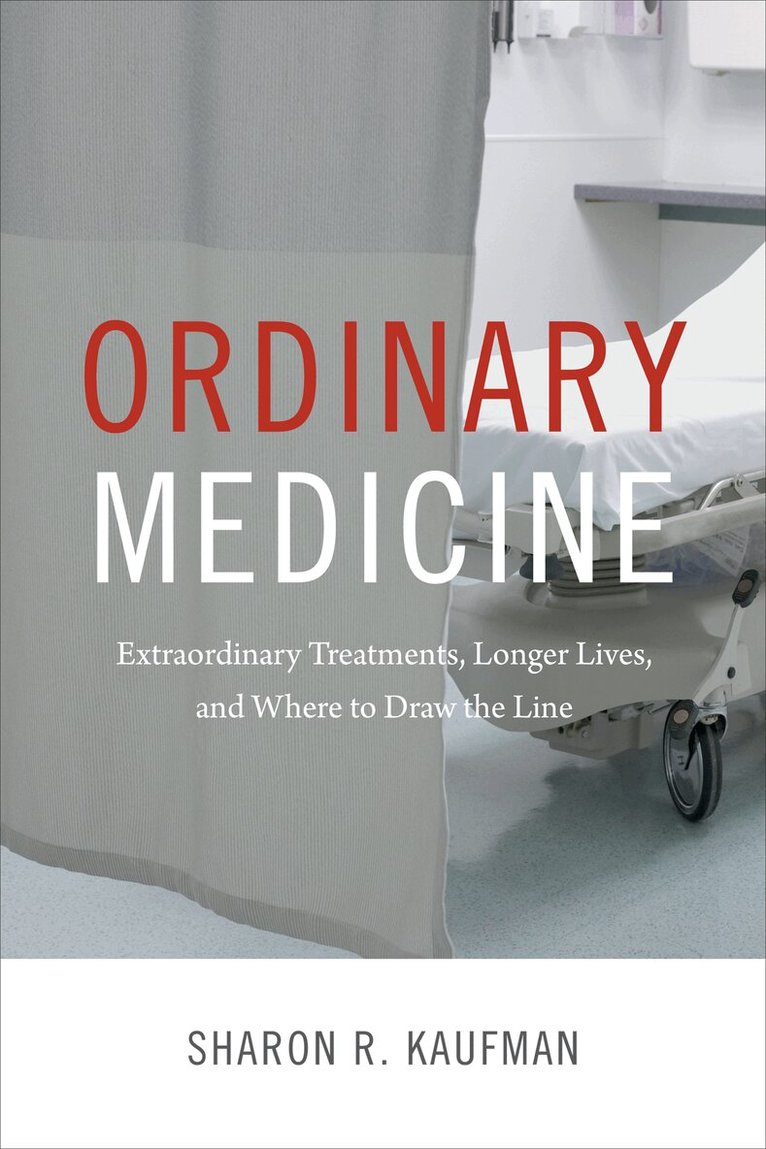
    Ordinary Medicine

    Extraordinary Treatments, Longer Lives, and Where to Draw the Line

    AvSharon R. Kaufman

    Inbunden, Engelska, 2015

    Del i serien Critical Global Health: Evidence, Efficacy, Ethnography

    1 586 kr

    Beställningsvara. Skickas inom 5-8 vardagar. Fri frakt över 249 kr.

    Fler format och utgåvor

    Häftad

    388 kr

    E-bok

    570 kr

    Beskrivning

    Most of us want and expect medicine’s miracles to extend our lives. In today’s aging society, however, the line between life-giving therapies and too much treatment is hard to see-it’s being obscured by a perfect storm created by the pharmaceutical and biomedical industries, along with insurance companies. In Ordinary Medicine Sharon R. Kaufman investigates what drives that storm’s “more is better” approach to medicine: a nearly invisible chain of social, economic, and bureaucratic forces that has made once-extraordinary treatments seem ordinary, necessary, and desirable. Since 2002 Kaufman has listened to hundreds of older patients, their physicians and family members express their hopes, fears, and reasoning as they faced the line between enough and too much intervention. Their stories anchor Ordinary Medicine. Today’s medicine, Kaufman contends, shapes nearly every American’s experience of growing older, and ultimately medicine is undermining its own ability to function as a social good. Kaufman’s careful mapping of the sources of our health care dilemmas should make it far easier to rethink and renew medicine’s goals.

    Produktinformation

    • Utgivningsdatum:2015-05-29
    • Mått:152 x 229 x 23 mm
    • Vikt:612 g
    • Format:Inbunden
    • Språk:Engelska
    • Serie:Critical Global Health: Evidence, Efficacy, Ethnography
    • Antal sidor:336
    • Förlag:Duke University Press
    • ISBN:9780822359029

    Utforska kategorier

    • Hälsa inom Hälsa och familj
    • Hälso- och sjukvård inom Medicin
    • Medicinsk genetik inom Medicin

    Mer om författaren

    Sharon R. Kaufman is Chair of the Department of Anthropology, History and Social Medicine at the University of California, San Francisco. She is the author of …And a Time to Die: How American Hospitals Shape the End of Life.

    Recensioner i media

    “Medical anthropologist Kaufman bravely delves into the heartbreaking predicament of modern medicine: ‘getting the medicine we wish for but then having to live with the unsettling and far-ranging consequences.’ … Kaufman is at her best when focusing on the heartbreaking dilemma of patients dealing with the consequences of ordinary medicine, such as an elderly patient who must choose between lifesaving treatments or palliative care, facing repeated hospital visits regardless of the choice. Kaufman calls for no less than making the ethics of medicine the ‘preeminent topic of our national conversation about health care reform.’” (Publishers Weekly) (Starred Review) “What makes Kaufman's analysis distinctive is the way she demonstrates the effects of Medicare policy on treatment benefits-namely, if a patient on Medicare is eligible for treatment, providers are often willing to supply it. But the author notes that this way of thinking has led us to stop examining issues around quality of life, obligations to our families, and the inevitable prospect that we will die. Health-care professionals, students of medical ethics, and others interested in the actions that frame American medicine will find this a thought-provoking read." - Aaron Klink (Library Journal) “If Gawande’s is the voice of comfort, and simple yet vital solutions, Sharon Kaufman’s brings her characteristic analytic and ethical precision, eschewing easy answers for an assessment of the structural density of our current predicament. Anyone who has read her earlier book on end-of-life care in American hospitals, And a Time to Die: How American Hospitals Shape the End of Life, will be familiar with her tremendous ability to narrate the ambiguities of American medicine as it unfolds on the ground via the stories of people who are caught up in its contradictions.” - Julie Livingston (Public Books) "The elegant part of Kaufman’s analysis-of a kind maybe only a sharp-eyed anthropologist with a wide lens can provide-concerns the way we all become unwitting victims of the chain, wrapped tightly around us.... Is there any good news here? Yes, Sharon Kaufman has written a wonderful, necessary, and readable book, and that is a start." - Daniel Callahan (Hastings Center Report) "Fascinating.... The book is written in a lucid and highly readable style, case studies of patients bringing the ‘health care system’ vividly alive through thick description.... The ethical dilemmas, small and large simultaneously, gripped me such that on two consecutive readings I found myself sitting up late into the night unable to put it down."   - Susan Pickard (Social History of Medicine) "Kaufman delivers a haunting and provocative meditation on the peculiarly American obsession with highly technologized longevity. Through a combination of historical analyses of debates in health policy and health economics, bioethical argumentation, and powerful ethnographic examples, Kaufman meticulously demonstrates the rise over the past few decades of what she calls ordinary medicine.... Kaufman’s book constitutes an important and troubling addition to current bioethical debates on health financing and the distribution of medical resources. At its heart, this book seems to be about how and why US health care costs have spiraled out of control-a topic of great timeliness and political interest." - Katherine A. Mason (American Ethnologist) "A must read for all practitioners and people experiencing the end of life.... Kaufman does a good job discussing the four outside issues that impact medicine today: the biomedical research industry, which pours out expensive new treatments; the determination of what treatments will be ordered according to what insurance or Medicare will reimburse for; evidence supporting a treatment’s use, causing it to become standard care for all; and the ethical imperative that if something is standard, everyone should receive it. Kaufman also provides several scenarios and an extensive bibliography. This book should be required reading for every health care provider.  Highly recommended. Upper-division undergraduates through professionals/practitioners"  - S. C. Grossman (Choice) "The strengths of this revealing study derive from Kaufman’s analysis of the chain of drivers that creates unprecedented growth in medical treatments; compelling evidence from case studies; multiple perspectives of physicians and other health care personnel, patients, and their families; and the questions raised about drawing the line. This book will create a deeper understanding of the expanding possibilities for medical treatments and the implications for the health care system." - Joanne McCloskey (Journal of Anthropological Research) "[T]his is a book whose moral passion is palpable, and admirable for just that reason, as well as for its excellent scholarship. Yet, it is Kaufman’s careful, insightful observations that carry us beyond her undeniably excellent analysis." - David Schenck (Society) "Overall, Kaufman’s latest book is moving to read and sets out the dilemmas of aging and dying within the American healthcare system.... I would recommend that anthropologists and healthcare professionals read her book to reflect on the healthcare practices they are part of and observe." - Erica Borgstrom (Anthropology and Medicine)

    Innehållsförteckning

    • Acknowledgments ixIntroduction. Diagnosing Twenty-First-Century Health Care 1Part I: The Quandry and Unexamined Ordinariness of Twenty-First-Century Medicine1. Ordinary Medicine in Our Aging Society: The Dilemma of Longevity 21Part II. The Chain of Health Care Drivers2. The Medical-Industrial Complex I: Evidence-Based Medicine, the Biomedical Economy, and the Ascendance of Clinical Trials 533. The Medical-Industrial Complex II: Access, Industry, and the Clincial Trials Phenomenon 794. "Reimbursement Is Critical for Everything": Medicare and the Ethics of Managing Life 99Part III: Medicine's Changing Means and Ends5. Standard and Necessary Treatments: The Changing Means and Ends of Technology 1276. Family Matters: Kidneys and New Forms of Care 1657. Influencing the Character of the Future: Prognosis, Risk, and Time Left 1958. For Whose Benefit? Our Shared Quandary 217Conclusion. Toward a New Social Contract? 238Notes on the Research 249Notes 255Bibliography 285Index  307