• Fri frakt över 249 kr
  • •
  • Snabba leveranser
  • •
  • Billiga böcker
Kundservice

Du är på sajten för privatpersoner.

Företag, bibliotek eller offentlig verksamhet?

Du handlar på classic.bokus.com, där alla dina funktioner finns intakta.
Till classic.bokus.com
Bokus logotyp. Gå till startsidan.
  • Erbjudanden
  • Nyheter
  • Student
  • Topplistor
  • Barn & ungdom
  • Bokus Play
  • E-böcker
  • Pocketböcker
  • Spel & pussel

10% rabatt på allt med kod NYSTART10 →

Sidfot

Mina sidor

    Hjälp

    • Kundservice
    • Vanliga frågor och svar
    • Frakt och leverans
    • Retur vid ångerrätt
    • Reklamera vara
    • Betalning
    • Köpvillkor
    • Allmänna villkor
    • Information om webbplatsens tillgänglighet

    Om Bokus

    • Om oss
    • Pressrum
    • För studenter
    • För företag
    • För bibliotek och offentlig verksamhet
    • För leverantörer
    • Hållbarhet

    Populärt

    • Aktuella erbjudanden
    • Presentkort
    • Studentlitteratur
    • Nya böcker
    • Topplistor
    • Signerade böcker
    • Engelska böcker

    Inspiration

    • Boktips
    • BookTok
    • Populära bokserier
    • Barnbokskaraktärer
    • Populära författare
    Logotyp för Bokus
    Följ oss på Facebook (extern länk)Följ oss på Instagram (extern länk)Följ oss på YouTube (extern länk)Följ oss på TikTok (extern länk)
    bokus @ CookiesAnpassa cookiesIntegritetspolicyKöpvillkor
    Till Citymail hemsida (extern länk)Till Budbee hemsida (extern länk)Till Postnord hemsida (extern länk)Till Schenker hemsida (extern länk)Till Early Bird hemsida (extern länk)Till Walleys hemsida (extern länk)
    1. Skönlitteratur
    2. Litteraturvetenskap

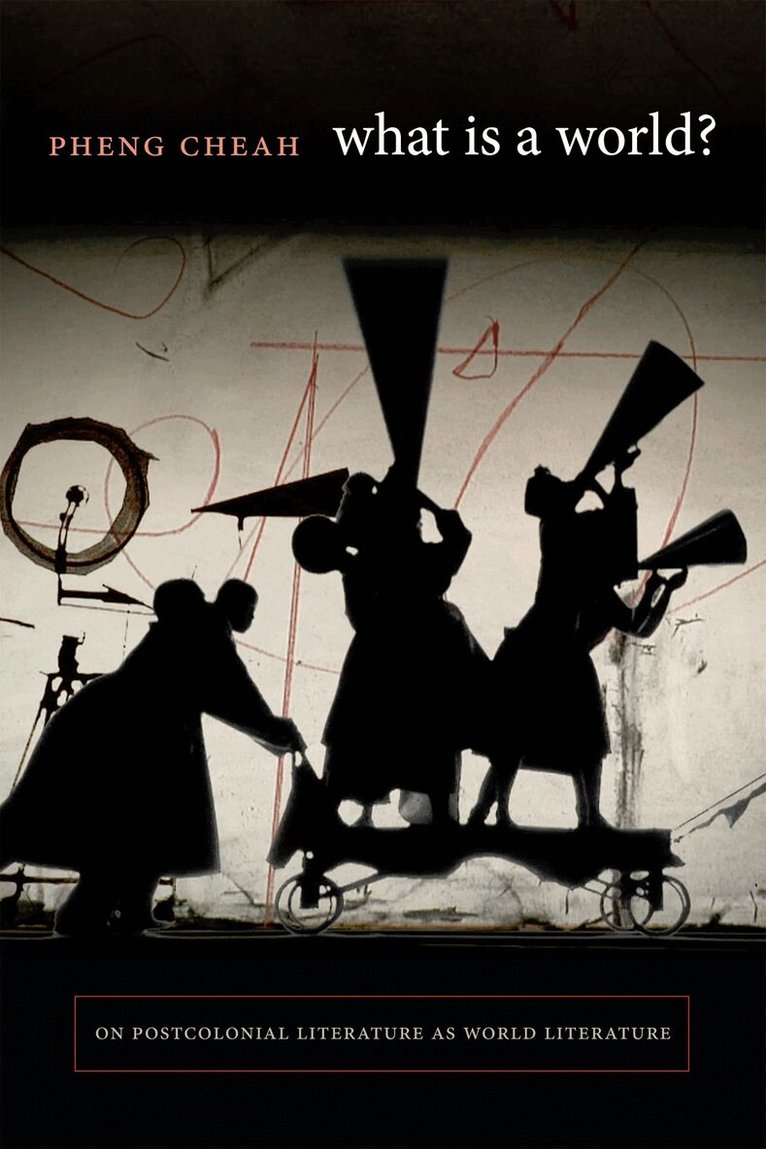
    What Is a World?

    On Postcolonial Literature As World Literature

    AvPheng Cheah

    Inbunden, Engelska, 2016

    1 456 kr

    Beställningsvara. Skickas inom 5-8 vardagar. Fri frakt över 249 kr.

    Fler format och utgåvor

    Häftad

    386 kr

    E-bok

    562 kr

    Beskrivning

    In What Is a World? Pheng Cheah, a leading theorist of cosmopolitanism, offers the first critical consideration of world literature’s cosmopolitan vocation.  Addressing the failure of recent theories of world literature to inquire about the meaning of world, Cheah articulates a normative theory of literature’s world-making power by creatively synthesizing four philosophical accounts of the world as a temporal process: idealism, Marxist materialism, phenomenology, and deconstruction. Literature opens worlds, he provocatively suggests, because it is a force of receptivity. Cheah compellingly argues for postcolonial literature’s exemplarity as world literature through readings of narrative fiction by Michelle Cliff, Amitav Ghosh, Nuruddin Farah, Ninotchka Rosca, and Timothy Mo that show how these texts open up new possibilities for remaking the world by negotiating with the inhuman force that gives time and deploying alternative temporalities to resist capitalist globalization.

    Produktinformation

    • Utgivningsdatum:2016-01-01
    • Mått:152 x 229 x 18 mm
    • Vikt:680 g
    • Format:Inbunden
    • Språk:Engelska
    • Antal sidor:408
    • Förlag:Duke University Press
    • ISBN:9780822360780

    Utforska kategorier

    • Litteraturvetenskap inom Skönlitteratur
    • Litteraturteori inom Skönlitteratur

    Mer om författaren

    Pheng Cheah is Professor of Rhetoric and Chair of the Center for Southeast Asia Studies at the University of California, Berkeley. He is the author of Inhuman Conditions: On Cosmopolitanism and Human Rights and Spectral Nationality: Passages of Freedom from Kant to Postcolonial Literatures of Liberation.

    Recensioner i media

    "Drawing from four critical philosophies–idealism, Marxist materialism, phenomenology, and deconstruction–theorist Pheng Cheah invites the reader to reconsider the presuppositions that underpin contemporary theories about world literature. Works from luminaries Amitav Ghosh, Michelle Cliff, and Timothy Mo, among others, providethe reader with concrete examples of Cheah’s theories in action." (World Literature Today) "[T]hrow[s] an intriguing new light on why and how 'world literature' succeeds in generating plurality and disruption rather than falling back into a flattening familiarity."- Caroline Levine (Public Books) "Cheah strategically broadens the notion of world literature beyond its most common reference points, which too often constrain literatures and the worlds they offer to their spatial geographies and global circulations." - David W. Hart (Postcolonial Text) "Pheng Cheah has contribued an eloquent volume that stands out in the crowd and belongs on the bookshelf of anyone interested in the field." - Thomas O. Beebee (Comparative Literature Studies) "As with Cheah’s earlier work, it is a magisterial study, written in his characteristically scrupulous and teacherly prose. There is much to learn from What Is a World? at the levels of its intervention into the field of world literature, its case for postcolonial literature as an exemplary modality of world literature, and Cheah’s own interpretive style as a reader and critic." - Ragini Tharoor Srinivasan (Qui Parle) "Beautifully written and eloquently constructed, What Is a World? will transform the landscape of world literature studies in the coming years by posing new questions about how the world is and should be conceived." - César Domínguez (Recherche Littéraire) "Pheng Cheah’s What Is a World? On Postcolonial Literature as World Literature makes a powerful intervention in current debates on world literature, arguing for the literary text to be seen as an ethico-political force in the world rather than just a commodity whose global trajectory is best understood in terms of existing networks of influence and exchange." - Ira Raja and Roanna Gonsalves (New Literatures) "What is a World? challenges scholars of world literature and postcolonial literature to reconsider and possibly to expand the definition of their fields. It is a thoughtful, theoretical work that further challenges all of us to reconsider the role literature plays in the world(s) around us and to assess our inclusion of literature beyond the Western tradition. Undoubtedly, this book will play an important role in the ongoing dialogue over what world literature really is." - Gregory R. Jackson (Studies in 20th & 21st Century Literature) "Cheah’s compelling and acute study ultimately proposes a radical and complex reassessment of the notion of world itself as temporal object, to better explore some of the long-ignored intersections-or what he calls “missed encounters”-between cosmopolitanism, world literature, and postcoloniality. In doing so, the book makes a significant intervention in the ongoing scholarly debates dedicated to these topics. . . . The book [also] constitutes a critical response to the pressing questions raised today by the uneven process of (capitalist) globalization."- Emmanuel Bruno Jean-François (Comparative Literature) "In bridging the postcolonial and the world, Cheah offers a powerfully refreshing account of the category of the 'world,' which arbiters in the world-literary field tend to take for granted." - Kelly Yin Nga Tse (Interventions)

    Innehållsförteckning

    • Acknowledgments  viiIntroduction. Missed Encounters: Cosmopolitanism, World Literature, and Postcoloniality  1Part I. The World of World in Literature in Question1. The New World Literature: Literary Studies Discovers Globalization  232. The World According to Hegel: Culture and Power in World History  463. The World as Market: The Materialist Inversion of Spiritualist Models of the World 60Part II. Worlding and Unworlding: Worldliness, Narrative, and "Literature" in Phenomenology and Deconstruction4. Worlding: The Phenomenological Concept of Worldliness and the Loss of World in Modernity  955. The In-Between World: Anthropologizing the Force of Worlding  1316. The Arriving World: The Inhuman Otherness of Time as Real Messianic Hope  161Part III. Of Other Worlds to Come7. Postcolonial Openings: How Postcolonial Literature Becomes World Literature  1918. Projecting a Future World from the Memory of Precolonial Time  2169. World Heritage Preservation and the Expropriation of Subaltern Worlds  24610. Resisting Humanitarianization  278Epilogue. Without Conclusion: Stories without End(s)  310Notes  333Select Bibliography  369Index  383