• Fri frakt över 249 kr
  • •
  • Snabba leveranser
  • •
  • Billiga böcker
Kundservice

Du är på sajten för privatpersoner.

Företag, bibliotek eller offentlig verksamhet?

Du handlar på classic.bokus.com, där alla dina funktioner finns intakta.
Till classic.bokus.com
Bokus logotyp. Gå till startsidan.
  • Erbjudanden
  • Nyheter
  • Student
  • Topplistor
  • Barn & ungdom
  • Bokus Play
  • E-böcker
  • Pocketböcker
  • Spel & pussel

10% rabatt på allt med kod: NYSTART10 →

Sidfot

Mina sidor

    Hjälp

    • Kundservice
    • Vanliga frågor och svar
    • Frakt och leverans
    • Retur vid ångerrätt
    • Reklamera vara
    • Betalning
    • Köpvillkor
    • Allmänna villkor
    • Information om webbplatsens tillgänglighet

    Om Bokus

    • Om oss
    • Pressrum
    • För studenter
    • För företag
    • För bibliotek och offentlig verksamhet
    • För leverantörer
    • Hållbarhet

    Populärt

    • Aktuella erbjudanden
    • Presentkort
    • Studentlitteratur
    • Nya böcker
    • Topplistor
    • Signerade böcker
    • Engelska böcker

    Inspiration

    • Boktips
    • BookTok
    • Populära bokserier
    • Barnbokskaraktärer
    • Populära författare
    Logotyp för Bokus
    Följ oss på Facebook (extern länk)Följ oss på Instagram (extern länk)Följ oss på YouTube (extern länk)Följ oss på TikTok (extern länk)
    bokus @ CookiesAnpassa cookiesIntegritetspolicyKöpvillkor
    Till Citymail hemsida (extern länk)Till Budbee hemsida (extern länk)Till Postnord hemsida (extern länk)Till Schenker hemsida (extern länk)Till Early Bird hemsida (extern länk)Till Walleys hemsida (extern länk)
    1. Samhälle och politik
    2. Sociologi och antropologi
    3. Antropologi

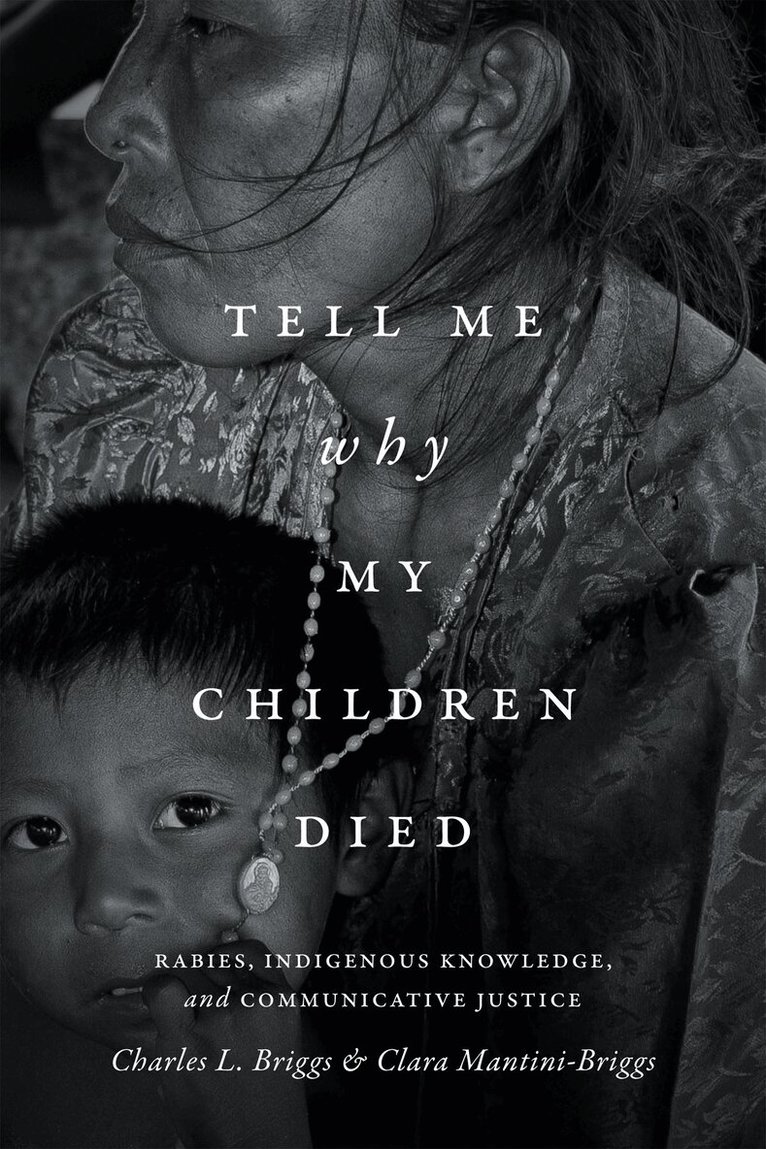
    Tell Me Why My Children Died

    Rabies, Indigenous Knowledge, and Communicative Justice

    AvCharles L. Briggs,Clara Mantini-Briggs

    Häftad, Engelska, 2016

    Del i serien Critical Global Health: Evidence, Efficacy, Ethnography

    388 kr

    Beställningsvara. Skickas inom 5-8 vardagar. Fri frakt över 249 kr.

    Fler format och utgåvor

    Inbunden

    1 332 kr

    Beskrivning

    Tell Me Why My Children Died tells the gripping story of indigenous leaders' efforts to identify a strange disease that killed thirty-two children and six young adults in a Venezuelan rain forest between 2007 and 2008. In this pathbreaking book, Charles L. Briggs and Clara Mantini-Briggs relay the nightmarish and difficult experiences of doctors, patients, parents, local leaders, healers, and epidemiologists; detail how journalists first created a smoke screen, then projected the epidemic worldwide; discuss the ChÁvez government's hesitant and sometimes ambivalent reactions; and narrate the eventual diagnosis of bat-transmitted rabies. The book provides a new framework for analyzing how the uneven distribution of rights to produce and circulate knowledge about health are wedded at the hip with health inequities. By recounting residents' quest to learn why their children died and documenting their creative approaches to democratizing health, the authors open up new ways to address some of global health's most intractable problems.

    Produktinformation

    • Utgivningsdatum:2016-05-27
    • Mått:152 x 229 x 22 mm
    • Vikt:499 g
    • Format:Häftad
    • Språk:Engelska
    • Serie:Critical Global Health: Evidence, Efficacy, Ethnography
    • Antal sidor:344
    • Förlag:Duke University Press
    • ISBN:9780822361244

    Utforska kategorier

    • Antropologi inom Samhälle och politik
    • Samhällsmedicin och preventiv medicin inom Medicin

    Mer om författaren

    Charles L. Briggs is Alan Dundes Distinguished Professor in the Department of Anthropology, University of California, Berkeley, and the author or coauthor of ten books.  Clara Mantini-Briggs, a Venezuelan public health physician, was the National Coordinator of the Dengue Fever Program in Venezuela's Ministry of Health and is a Lecturer in the Department of Anthropology at the University of California, Berkeley. They are coauthors of Stories in the Time of Cholera: Racial Profiling during a Medical Nightmare.

    Recensioner i media

    "Briggs and Mantini-Briggs do more than shed light on a tragedy-they give voice to the grieving parents and offer examples of innovative ways to combat health disparities around the world, such as examining the 'relational division of the labor of producing and circulating health knowledge.'” - Tracy Gnadinger (Health Affairs) “There are no easy explanations in this book, but it serves a valuable role by reminding us that lofty ideological claims and even passionate practical commitment are, in themselves, insufficient for eradicating deep structural inequalities, the real solutions to which can sometimes only be found among the people themselves.” - Eugene Carey (Latin American Review of Books) "It is in this combination of ambitious scope and gut-wrenching intimacy that Tell Me Why My Children Died really shines. This book is a model not just for anthropologists interested in epidemics (Ebola and Zika were frequently on my mind while I was reading, and they are occasionally invoked in the text), but, just as importantly, for readers interested in a first-hand account of the messy, frustrating and ambivalent work of communicating calls for justice." - Alex Nading (Journal of Latin American Studies) "This ethnography will undoubtedly be embraced by scholars and graduate students in the fields of medical and linguistic anthropology, Latin American Studies and Indigenous Studies. Nevertheless, in my opinion, a book like this is most needed to encourage critical approaches to communication, global health and public health disciplines, as well as engaging lower level students in sophisticated discussions around contemporary American societies." - Nicole S. Berry (Bulletin of Latin American Research) "The book will be useful and provocative for researchers, students, and faculties in the social sciences, medicine, and science and technology studies. I strongly recommend it." - Linda M. Whiteford (Ethnohistory)

    Innehållsförteckning

    • Illustrations  ixPrologue  xiiiPreface  xviiIntroduction  1Part I.1. Reliving the Epidemic: Parents' Perspectives  292. When Caregivers Fail: Doctors, Nurses, and Healers Facing an Intractable Disease  763. Explaining the Inexplicable in Mukoboina: Epidemiologists, Documents, and the Dialogue That Failed  1094. Heroes, Bureaucrats, and Millenarian Wisdom: Journalists Cover an Epidemic Conflict  127Part II.5. Narratives, Communicative Monopolies, and Acute Health Inequities  1596. Knowledge Production and Circulation  1797. Laments, Psychoanalysis, and the Work of Mourning  2058. Biomediatization: Health/Communicative Inequities and Health News  2259. Toward Health/Communicative Equities and Justice  245Conclusion  260Acknowledgments  275Notes  279References  287Index  303