• Fri frakt över 249 kr
  • •
  • Snabba leveranser
  • •
  • Billiga böcker
Kundservice

Du är på sajten för privatpersoner.

Företag, bibliotek eller offentlig verksamhet?

Du handlar på classic.bokus.com, där alla dina funktioner finns intakta.
Till classic.bokus.com
Bokus logotyp. Gå till startsidan.
  • Erbjudanden
  • Nyheter
  • Student
  • Topplistor
  • Barn & ungdom
  • Bokus Play
  • E-böcker
  • Pocketböcker
  • Spel & pussel

Må bättre, för mindre! Upp till 50% rabatt på hälsoböcker

Sidfot

Mina sidor

    Hjälp

    • Kundservice
    • Vanliga frågor och svar
    • Frakt och leverans
    • Retur vid ångerrätt
    • Reklamera vara
    • Betalning
    • Köpvillkor
    • Allmänna villkor
    • Information om webbplatsens tillgänglighet

    Om Bokus

    • Om oss
    • Pressrum
    • För studenter
    • För företag
    • För bibliotek och offentlig verksamhet
    • För leverantörer
    • Hållbarhet

    Populärt

    • Aktuella erbjudanden
    • Presentkort
    • Studentlitteratur
    • Nya böcker
    • Topplistor
    • Signerade böcker
    • Engelska böcker

    Inspiration

    • Boktips
    • BookTok
    • Populära bokserier
    • Barnbokskaraktärer
    • Populära författare
    Logotyp för Bokus
    Följ oss på Facebook (extern länk)Följ oss på Instagram (extern länk)Följ oss på YouTube (extern länk)Följ oss på TikTok (extern länk)
    bokus @ CookiesAnpassa cookiesIntegritetspolicyKöpvillkor
    Till Citymail hemsida (extern länk)Till Budbee hemsida (extern länk)Till Postnord hemsida (extern länk)Till Schenker hemsida (extern länk)Till Early Bird hemsida (extern länk)Till Walleys hemsida (extern länk)
    1. Historia och arkeologi
    2. Historia
    3. Historia: särskilda händelser och ämnen
    4. Socialhistoria och kulturhistoria

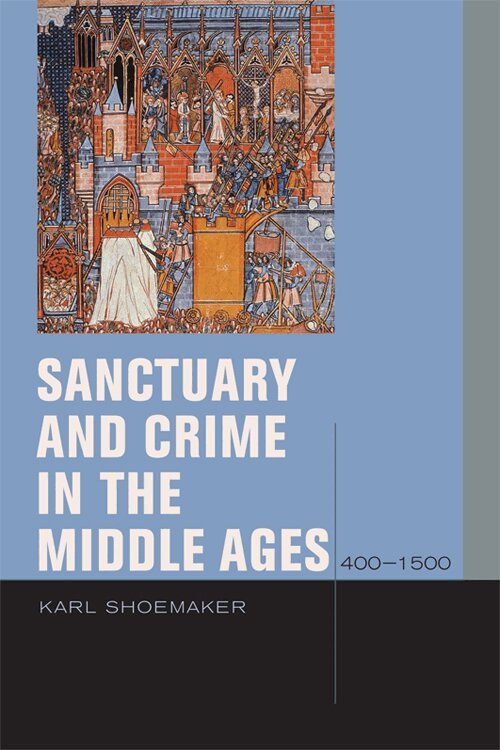
    Sanctuary and Crime in the Middle Ages, 400–1500

    AvKarl Shoemaker

    Inbunden, Engelska, 2011

    Del i serien Just Ideas

    1 050 kr

    Beställningsvara. Skickas inom 10-15 vardagar. Fri frakt över 249 kr.

    Beskrivning

    Sanctuary and Crime rethinks the history of sanctuary protections in the Western legal tradition. Until the sixteenth century, every major medieval legal tradition afforded protections to fugitive criminals who took sanctuary in churches. Sanctuary-seeking criminals might have been required to perform penance or go into exile, but they were guaranteed, at least in principle, immunity from corporal and capital punishment. In the sixteenth century, sanctuary protections were abolished throughout Europe, uprooting an ancient tradition and raising a new set of juridical arguments about law, crime and the power to punish.Sanctuary law has not received very much scholarly attention. According to the prevailing explanation among earlier generations of legal historians, sanctuary was an impediment to effective criminal law and social control, but was made necessary by rampant violence and weak political order in the medieval world. Contrary to the conclusions of the relatively scant literature on the topic, Sanctuary and Crime argues that the practice of sanctuary was not simply an instrumental device intended as a response to weak and splintered medieval political authority. Nor can sanctuary laws be explained as simple ameliorative responses to harsh medieval punishments and the specter of uncontrolled blood-feuds. This book seeks to integrate the history of sanctuary law with the history of criminal law in medieval Europe. It does so by first situating sanctuary law within the early Christian traditions of intercession and penance as well as late-imperial Roman law. The book then traces the transmission of Romano-Christian sanctuary legislation into the feuding traditions of early medieval Europe, showing how sanctuary law was an important emblem of Christian kingship and was integrated into a broad range of social, legal, ecclesiastical and political practices. By the late twelfth-century, sanctuary had been domesticated within the procedures of royal law in England. Unmoored from its taproots in penitential and intercessory practices, sanctuary became a central feature of the emergent law of felony in the early English common law. While sanctuary was widely recognized throughout late medieval Europe, medieval English records provide rich accounts of sanctuary in everyday medieval life and the book reflects the prominence of the English sources. The book concludes by examining the legal arguments in both English and Roman-canonical legal traditions that led to the restriction and abolition of sanctuary privileges in the sixteenth-century and which ushered in a new age of criminal law grounded in deterrence and a state-centered view of punishment and social control.

    Produktinformation

    • Utgivningsdatum:2011-04-01
    • Mått:152 x 229 x 25 mm
    • Vikt:522 g
    • Format:Inbunden
    • Språk:Engelska
    • Serie:Just Ideas
    • Antal sidor:292
    • Förlag:Fordham University Press
    • ISBN:9780823232680
    • Utmärkelser:Winner of John Nicholas Brown Prize 2015

    Utforska kategorier

    • Socialhistoria och kulturhistoria inom Historia och arkeologi
    • Medeltiden inom Historia och arkeologi

    Mer om författaren

    Karl Shoemaker is Associate Professor of History and Law at the University of Wisconsin–Madison.

    Recensioner i media

    "Shoemaker's excellent study elucidates the origins and successive transformations of sanctuary as a central institution of premodern criminal justice. A work of great sweep and acuity, Sanctuary and Crime effectively bridges the history of values, ideas and practices--legal, political, religious and social. Focusing first on early Continental developments and then on the Anglo-Saxon implementation and later English domestication and eventual abolition of sanctuary, Shoemaker has fashioned an intelligent analysis of the institution itself and an original and challenging argument regarding the evolution of criminal justice across a millennium and more." -- -Thomas A. Green University of Michigan "Shoemaker's manuscript provides an impressive reconsideration of a long neglected but very important topic in medieval history, the sanctuary given to criminals (and debtors) in churches." -- Thomas Hughes University of Miami "This excellent monograph provides a long-needed reinterpretation of sanctuary laws. Shoemaker's study shows remarkable range, covering over 1000 years and a variety of legal traditions. His work dovetails with other recent scholarship that explores the political logic of non-centralized governments." -- -Martha Newman University of Texas