• Fri frakt över 249 kr
  • •
  • Snabba leveranser
  • •
  • Billiga böcker
Kundservice

Du är på sajten för privatpersoner.

Företag, bibliotek eller offentlig verksamhet?

Du handlar på classic.bokus.com, där alla dina funktioner finns intakta.
Till classic.bokus.com
Bokus logotyp. Gå till startsidan.
  • Erbjudanden
  • Student
  • Topplistor
  • Barn & ungdom
  • Bokus Play
  • E-böcker
  • Ljudböcker
  • Pocketböcker
  • Spel & pussel

10% rabatt på allt med kod NYSTART10 →

Sidfot

Mina sidor

    Hjälp

    • Kundservice
    • Vanliga frågor och svar
    • Frakt och leverans
    • Retur vid ångerrätt
    • Reklamera vara
    • Betalning
    • Köpvillkor
    • Allmänna villkor
    • Information om webbplatsens tillgänglighet

    Om Bokus

    • Om oss
    • Pressrum
    • För studenter
    • För företag
    • För bibliotek och offentlig verksamhet
    • För leverantörer
    • Hållbarhet

    Populärt

    • Aktuella erbjudanden
    • Presentkort
    • Studentlitteratur
    • Nya böcker
    • Topplistor
    • Signerade böcker
    • Engelska böcker

    Inspiration

    • Boktips
    • BookTok
    • Populära bokserier
    • Barnbokskaraktärer
    • Populära författare
    Logotyp för Bokus
    Följ oss på Facebook (extern länk)Följ oss på Instagram (extern länk)Följ oss på YouTube (extern länk)Följ oss på TikTok (extern länk)
    bokus @ CookiesAnpassa cookiesIntegritetspolicyKöpvillkor
    Till Citymail hemsida (extern länk)Till Budbee hemsida (extern länk)Till Postnord hemsida (extern länk)Till Schenker hemsida (extern länk)Till Early Bird hemsida (extern länk)Till Walleys hemsida (extern länk)
    1. Filosofi och religion
    2. Filosofi
    3. Filosofiska discipliner

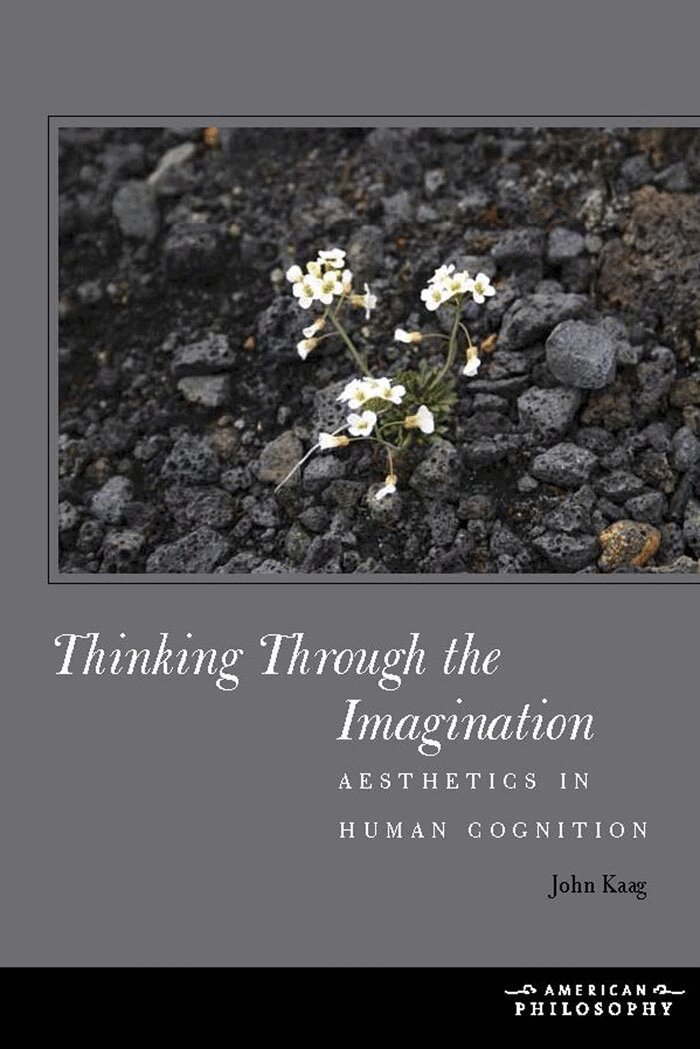
    Thinking Through the Imagination

    Aesthetics in Human Cognition

    AvJohn Kaag

    Inbunden, Engelska, 2014

    Del i serien American Philosophy

    1 227 kr

    Beställningsvara. Skickas inom 10-15 vardagar. Fri frakt över 249 kr.

    Fler format och utgåvor

    Häftad

    335 kr

    Beskrivning

    Use your imagination! The demand is as important as it is confusing. What is the imagination? What is its value? Where does it come from? And where is it going in a time when even the obscene mseems overdone and passé?This book takes up these questions and argues for the centrality of imagination in humanmcognition. It traces the development of the imagination in Kant's critical philosophy (particularly the Critique of Aesthetic Judgment) and claims that the insights of Kantian aesthetic theory, especially concerning the nature of creativity, common sense, and genius, influenced the development of nineteenth-century American philosophy.The book identifies the central role of the imagination in the philosophy of Peirce, a role often overlooked in analytic treatments of his thought. The final chapters pursue the observation made by Kant and Peirce that imaginative genius is a type of natural gift (ingenium) and must in some way be continuous with the creative force of nature. It makes this final turn by way of contemporary studies of metaphor, embodied cognition, and cognitive neuroscience.

    Produktinformation

    • Utgivningsdatum:2014-02-03
    • Mått:152 x 229 x 20 mm
    • Vikt:606 g
    • Format:Inbunden
    • Språk:Engelska
    • Serie:American Philosophy
    • Antal sidor:272
    • Förlag:Fordham University Press
    • ISBN:9780823254934

    Utforska kategorier

    • Filosofiska discipliner inom Filosofi och religion

    Mer om författaren

    John Kaag is Professor and Chair of Philosophy at the University of Massachusetts, Lowell. He is the author of Sick Souls, Healthy Minds: How William James Can Save Your Life (Princeton, 2020, Finalist, 2021 PROSE Award), Hiking with Nietzsche: On Becoming Who You Are (Farrar, Straus & Giroux, 2018, pbk Picador, 2019, NPR Book of the Year), American Philosophy: A Love Story (Farrar, Straus & Giroux, 2016, NPR Book of the Year, New York Times Editors' Choice), and Idealism, Pragmatism, and Feminism: The Philosophy of Ella Lyman Cabot (Lexington, 2013), and coauthor with Sarah Kreps of Drone Warfare (Polity, 2015, Choice Outstanding Title).

    Recensioner i media

    "Most impressive is the author's detailed and insightful presentation of Peirce's thoughts on the nature of imagination and the connection between imagination and inquiry. This alone is worth the price of admission." -- -F.A. Grabowski, Roger State University Choice "This important book deserves a wide audience, and should be of interest to scholars working on a variety of topics. Kaag effectively exposes the Kantian roots of pragmatism, especially the link between Kant and Peirce. Against that background he articulates a pragmatic theory of the imagination that underscores its character both as fully embodied and as vitally central to human cognition and inquiry. Kaag's own insightful account plays out in a conceptual space far removed from the dangerous extremes of either biological reductionism or what he himself labels a 'naive panpsychism.' The result is really quite impressive, a virtuoso philosophical performance." -- -Michael L. Raposa Lehigh University "This book is a giant step forward in understanding the interplay between imagination and inquiry in Peirce. Kaag brilliantly illuminates the influence of Kant's aesthetics and imagination for Peirce through Schiller with a discussion that ranges over literary analysis and cognitive and neural science as ways of explicating Peirce's logic and existential graphing. This is one of the best examples I know of handling Peirce's texts with both historical perspicuity and speculative insight." -- -Roger A. Ward Georgetown College "John Kaag's Thinking through the Imagination is a uniquely important contribution to the philosophy of imagination in at least six ways. First, it is the most comprehensive and detailed study ever of Charles S. Peirce's theory of imagination, although scholars have long recognized the importance of Peirce on this topic; this book is state of the art in Peirce scholarship. Second, it resets the philosophic discussion of imagination to a new default position, that of the American pragmatic tradition rather than the Kantian tradition, both of which Kaag discusses in detail. Third, although Kaag is primarily a philosopher setting forth his own position on imagination, he is also a careful historian of philosophy, working with letters and unpublished material as well as standard texts, and therefore speaks with full authority on the historical material of pragmatism and its relation to European philosophy. Fourth, he shows why Peirce is the pragmatist to watch on the subject of imagination, despite the greater fame of William James and John Dewey on the subject. Sixth, he is exactly right to place all this discussion in close connection with the studies of imagination in contemporary cognitive science, showing on the one hand that philosophers should have been following this science as Peirce would have done all along and on the other that cognitive scientists should have been learning from Peirce and the other pragmatists. This is a splendid contribution, not to be ignored by cognitive scientists, scholars of American philosophy, and philosophers and critics interested in imagination." -- Robert Neville Boston University

    Innehållsförteckning

    • Acknowledgments ix1 The Cultivation of the Imagination 12 Enlightening Thought: Kant and the Imagination 253 C. S. Peirce and the Growth of the Imagination 574 Abduction: Inference and Instinct 755 Imagining Nature 936 Ontology and Imagination: Peirce on Necessity and Agency 1207 The Evolution of the Imagination 1398 Emergence, Complexity, and Creativity 1659 Be Imaginative! Suggestion and Imperative 192Notes 211Bibliography 235Index 249