• Fri frakt över 249 kr
  • •
  • Snabba leveranser
  • •
  • Billiga böcker
Kundservice

Du är på sajten för privatpersoner.

Företag, bibliotek eller offentlig verksamhet?

Du handlar på classic.bokus.com, där alla dina funktioner finns intakta.
Till classic.bokus.com
Bokus logotyp. Gå till startsidan.
  • Erbjudanden
  • Nyheter
  • Student
  • Topplistor
  • Barn & ungdom
  • Bokus Play
  • E-böcker
  • Pocketböcker
  • Spel & pussel

Må bättre, för mindre! Upp till 50% rabatt på hälsoböcker

Sidfot

Mina sidor

    Hjälp

    • Kundservice
    • Vanliga frågor och svar
    • Frakt och leverans
    • Retur vid ångerrätt
    • Reklamera vara
    • Betalning
    • Köpvillkor
    • Allmänna villkor
    • Information om webbplatsens tillgänglighet

    Om Bokus

    • Om oss
    • Pressrum
    • För studenter
    • För företag
    • För bibliotek och offentlig verksamhet
    • För leverantörer
    • Hållbarhet

    Populärt

    • Aktuella erbjudanden
    • Presentkort
    • Studentlitteratur
    • Nya böcker
    • Topplistor
    • Signerade böcker
    • Engelska böcker

    Inspiration

    • Boktips
    • BookTok
    • Populära bokserier
    • Barnbokskaraktärer
    • Populära författare
    Logotyp för Bokus
    Följ oss på Facebook (extern länk)Följ oss på Instagram (extern länk)Följ oss på YouTube (extern länk)Följ oss på TikTok (extern länk)
    bokus @ CookiesAnpassa cookiesIntegritetspolicyKöpvillkor
    Till Citymail hemsida (extern länk)Till Budbee hemsida (extern länk)Till Postnord hemsida (extern länk)Till Schenker hemsida (extern länk)Till Early Bird hemsida (extern länk)Till Walleys hemsida (extern länk)
    1. Samhälle och politik
    2. Sociologi och antropologi
    3. Antropologi

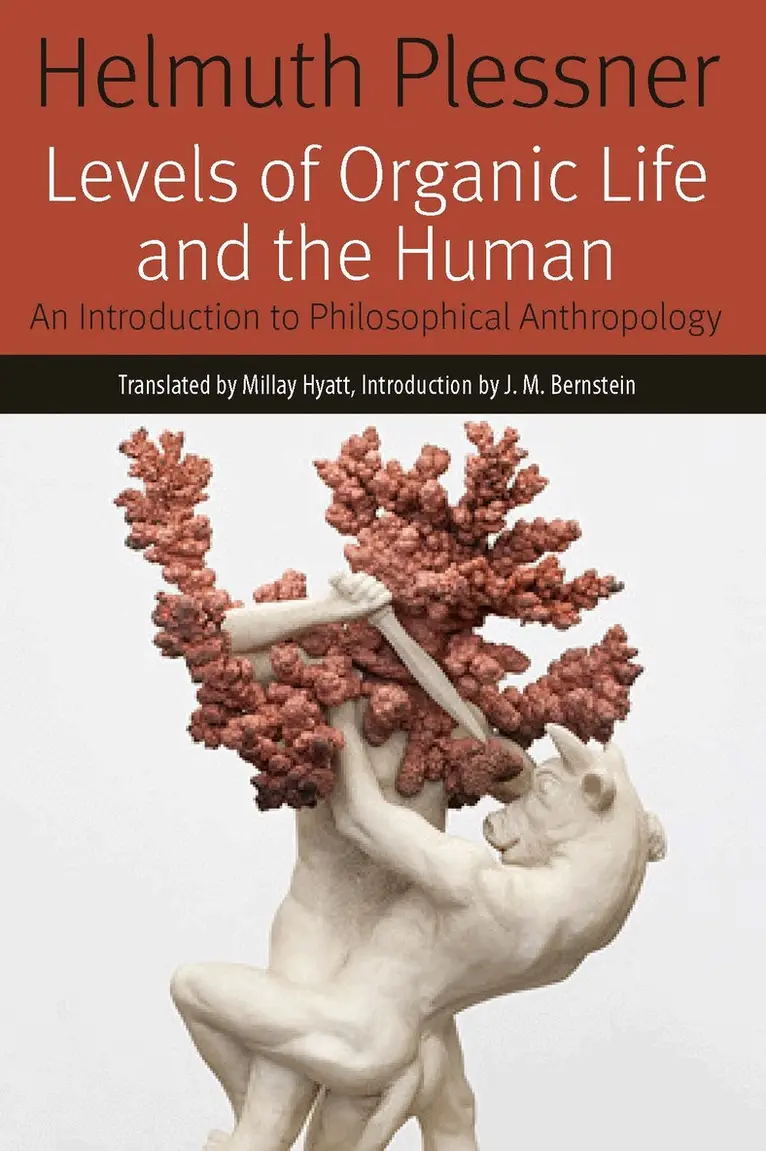
    Levels of Organic Life and the Human

    An Introduction to Philosophical Anthropology

    AvHelmuth Plessner

    Inbunden, Engelska, 2019

    Del i serien Forms of Living

    1 672 kr

    Beställningsvara. Skickas inom 10-15 vardagar. Fri frakt över 249 kr.

    Fler format och utgåvor

    Häftad

    430 kr

    Beskrivning

    The most important work by a key figure in German thought, Helmuth Plessner's Levels of Organic Life and the Human, originally published in 1928, appears here for the first time in English, accompanied by a substantial Introduction by J. M. Bernstein, after having served for decades as an influence on thinkers as diverse as Merleau-Ponty, Peter Berger, Habermas, and the new naturalists.The Levels, as it has long been known, draws on phenomenological, biological, and social scientific sources as part of a systematic account of nature, life, and human existence. The book considers non-living nature, plants, non-human animals, and human beings in turn as a sequence of increasingly complex modes of boundary dynamics—simply put, interactions between a thing's insides and surrounding world. On Plessner's unique account, living things are classed and analyzed by their "positionality," or orientation to and within an environment. "Life" is thereby phenomenologically defined, and its universal yet internally variable features such as metabolism, reproduction, and death are explained.The approach provides a foundation not only for philosophical biology but philosophical anthropology as well. According to Plessner's radical view, the human form of life is excentric—that is, the relation between body and environment is something to which humans themselves are positioned and can take a position. This "excentric positionality" enables human beings to take a stand outside the boundaries of their own body, a possibility with significant implications for knowledge, culture, religion, and technology.Plessner studied zoology and philosophy with Hans Driesch in the 1910s before embarking on a highly productive philosophical career. His work was initially obscured by the superficially similar views of Max Scheler and Martin Heidegger and by his forced exile during World War II. Only in recent decades, as scholarship has moved more squarely into engagement with issues like animality, embodiment, human dignity, social theory, the philosophy of technology, and the philosophy of nature, has the originality and depth of Plessner's vision been appreciated.A powerful and sophisticated account of embodiment, the Levels shows, with reference both to science and to philosophy, how life can be seen on its own terms to establish its own boundaries, and how, from the standpoint of life, the human establishes itself in relation to the nonhuman. As such, the book is not merely a historical monument but a source for invigorating a range of vital current conversations around the animal, posthumanism, the material turn, and the biology and sociology of cognition.This modern philosophical classic, long-awaited in English translation, is a key book both historically and for today's interest in understanding philosophy and social theory together with science, without reducing the former to the latter.

    Produktinformation

    • Utgivningsdatum:2019-07-02
    • Mått:152 x 229 x 31 mm
    • Vikt:877 g
    • Format:Inbunden
    • Språk:Engelska
    • Serie:Forms of Living
    • Antal sidor:448
    • Förlag:Fordham University Press
    • ISBN:9780823283996
    • Översättare:Millay Hyatt

    Utforska kategorier

    • Antropologi inom Samhälle och politik
    • Filosofiska discipliner inom Filosofi och religion

    Mer om författaren

    Helmuth Plessner (Author) Helmuth Plessner (1892–1985) was a German philosopher and sociologist. From 1953-59, he was president of the German Sociological Association. Three of his many books have appeared in English, Political Anthropology (Northwestern, 2018), The Limits of Community (Humanity Books, 1999) and Laughing and Crying (Northwestern, 1970).J. M. Bernstein (Introducer) J. M. Bernstein is University Distinguished Professor in Philosophy at The New School for Social Research in New York City.Millay Hyatt (Translator) Millay Hyatt is a writer and translator based in Berlin. Her dissertation, "No-Where and Now-Here: Utopia and Politics from Hegel to Deleuze," received the University of Southern California's doctoral research prize.

    Innehållsförteckning

    • Foreword from the Helmuth Plessner Society viiTranslator's Preface and Acknowledgments ixPreface to the First Edition (1928) xvPreface to the Second Edition (1965) xixIntroduction xxxviiJ. M. Bernstein1. Aim and Scope of the Study 1The Development of Intuitionist Lebensphilosophie in Opposition toExperience, 3 • Lebensphilosophie and the Theory of the Humanities, 11 • Working Plan for the Foundation of a Philosophy of the Human, 222. The Cartesian Objection and the Nature of the Problem 34Extension vs. Interiority and the Problem of Appearance, 34 •Appearance as Originating in Interiority, 38 • The Prior Givennessof Interiority and the Forward Displacement of Myself: The Propositionof Immanence 41 • Extension as Outer World; Interiority as InnerWorld, 46 • The Proposition of Representation and the Elementof Sensation, 51 • The Inaccessibility of Other I's according to thePrinciple of Sensualism, 55 • The Need for a Revision of the CartesianDichotomy in the Interest of a Science of Life, 58 • A MethodologicalReformulation of the Opening Question, 643. The Thesis 75The Question, 75 • The Dual Aspect in the Appearance of OrdinaryPerceptual Things, 76 • Against the Misinterpretation of This Analysis:A Closer Focus on the Subject Matter, 81 • The Dual Aspect of LivingPerceptual Things: Köhler contra Driesch, 84 • How Is Dual AspectivityPossible? The Nature of the Boundary, 93 • The Task of a Theory of theEssential Characteristics of the Organic, 99 • Definitions of Life, 104 •Nature and Object of a Theory of the Essential Characteristics of theOrganic, 1104. The Modes of Being of Vitality 115Essential Characteristics Indicating Vitality, 115 • The Positionality ofLiving Being and Its Spacelikeness, 118 • Living Being as Processand Type; the Dynamic Character of the Living Form; the Individuality of theLiving Thing, 123 • Living Process as Development, 129 • The Curve ofDevelopment: Aging and Death, 137 • The Individual Living Thing as aSystem, 144 • The Self-Regulation of the Individual Living Thingand the Harmonious Equipotentiality of Its Parts, 149 • Individual Living Thingsas Organized: The Dual Meaning of Organs, 154 • The Temporality ofLiving Being, 159 • The Positional Union of Space and Time and theNatural Place, 1685. The Organizational Modes of Living Being: Plants and Animals 172The Circle of Life, 172 • Assimilation—Dissimilation, 182 •Adaptedness and Adaptation, 186 • Reproduction, Heredity,Selection, 196 • The Open Form of Organization of the Plant, 202 •The Closed Form of Organization of the Animal, 2096. The Sphere of the Animal 219The Positionality of the Closed Form: Centrality and Frontality, 219 •The Coordination of Stimulus and Response in the Case of an InoperativeSubject (Decentralized Type of Organization), 227 • The Coordination ofStimulus and Response by a Subject (Centralized Type of Organization),231 • The Animal's Surrounding Field Organized into Complex Qualities andThings, 242 • Intelligence, 252 • Memory, 257 • Memory as the Unity ofResidue and Anticipation, 262 7. The Sphere of the Human 267The Positionality of the Excentric Form: "I" and Personhood, 267 •Outer World, Inner World, Shared World, 272 • The Fundamental Lawsof Anthropology: The Law of Natural Artificiality, 287 • The Law ofMediated Immediacy: Immanence and Expressivity, 298 • The Law ofthe Utopian Standpoint: Nullity and Transcendence, 316Appendix 323Glossary 337Notes 345Index 359