• Fri frakt över 249 kr
  • •
  • Snabba leveranser
  • •
  • Billiga böcker
Kundservice

Du är på sajten för privatpersoner.

Företag, bibliotek eller offentlig verksamhet?

Du handlar på classic.bokus.com, där alla dina funktioner finns intakta.
Till classic.bokus.com
Bokus logotyp. Gå till startsidan.
  • Erbjudanden
  • Nyheter
  • Student
  • Topplistor
  • Barn & ungdom
  • Bokus Play
  • E-böcker
  • Pocketböcker
  • Spel & pussel

10% rabatt på allt med kod NYSTART10 →

Sidfot

Mina sidor

    Hjälp

    • Kundservice
    • Vanliga frågor och svar
    • Frakt och leverans
    • Retur vid ångerrätt
    • Reklamera vara
    • Betalning
    • Köpvillkor
    • Allmänna villkor
    • Information om webbplatsens tillgänglighet

    Om Bokus

    • Om oss
    • Pressrum
    • För studenter
    • För företag
    • För bibliotek och offentlig verksamhet
    • För leverantörer
    • Hållbarhet

    Populärt

    • Aktuella erbjudanden
    • Presentkort
    • Studentlitteratur
    • Nya böcker
    • Topplistor
    • Signerade böcker
    • Engelska böcker

    Inspiration

    • Boktips
    • BookTok
    • Populära bokserier
    • Barnbokskaraktärer
    • Populära författare
    Logotyp för Bokus
    Följ oss på Facebook (extern länk)Följ oss på Instagram (extern länk)Följ oss på YouTube (extern länk)Följ oss på TikTok (extern länk)
    bokus @ CookiesAnpassa cookiesIntegritetspolicyKöpvillkor
    Till Citymail hemsida (extern länk)Till Budbee hemsida (extern länk)Till Postnord hemsida (extern länk)Till Schenker hemsida (extern länk)Till Early Bird hemsida (extern länk)Till Walleys hemsida (extern länk)
    1. Historia och arkeologi
    2. Historia
    3. Militärhistoria
    4. Särskilda krig och fälttåg

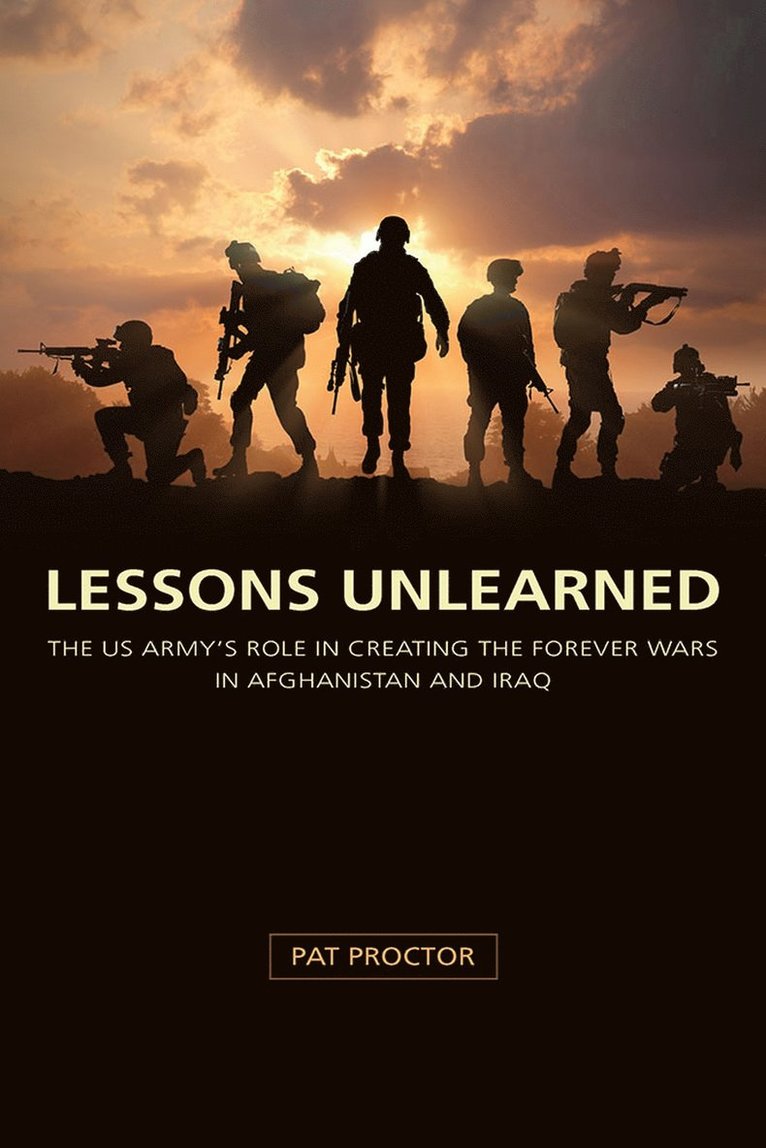
    Lessons Unlearned

    The U.S. Army's Role in Creating the Forever Wars in Afghanistan and Iraq

    AvPat Proctor

    Inbunden, Engelska, 2020

    Del i serien American Military Experience

    368 kr

    Beställningsvara. Skickas inom 5-8 vardagar. Fri frakt över 249 kr.

    Beskrivning

    Colonel Pat Proctor's long overdue critique of the Army's preparation and outlook in the all-volunteer era focuses on a national security issue that continues to vex in the twenty-first century: Has the Army lost its ability to win strategically by focusing on fighting conventional battles against peer enemies? Or can it adapt to deal with the greater complexity of counterinsurgent and information-age warfare?  In this blunt critique of the senior leadership of the U.S. Army, Proctor contends that after the fall of the Soviet Union, the U.S. Army stubbornly refused to reshape itself in response to the new strategic reality, a decision that saw it struggle through one low-intensity conflict after another-some inconclusive, some tragic-in the 1980s and 1990s, and leaving it largely unprepared when it found itself engaged-seemingly forever-in wars in Afghanistan and Iraq. The first book-length study to connect the failures of these wars to America's disastrous performance in the war on terror, Proctor's work serves as an attempt to convince Army leaders to avoid repeating the same mistakes.

    Produktinformation

    • Utgivningsdatum:2020-03-09
    • Mått:154 x 231 x 43 mm
    • Vikt:825 g
    • Format:Inbunden
    • Språk:Engelska
    • Serie:American Military Experience
    • Antal sidor:448
    • Förlag:University of Missouri Press
    • ISBN:9780826221940

    Utforska kategorier

    • Särskilda krig och fälttåg inom Historia och arkeologi
    • Markkrigföring inom Samhälle och politik
    • Modern militärhistoria inom Historia och arkeologi

    Mer om författaren

    Pat Proctor, Colonel, US Army, Ret., is a veteran of both the Iraq and the Afghanistan wars. He recently served as a chief of operations group at the Mission Command Training Program and currently is an Assistant Professor of History at Wichita State University. He is the author of Containment and Credibility: The Ideology and Deceptions that Plunged America into the Vietnam War. He lives in Leavenworth, Kansas.

    Recensioner i media

    A brutally honest, thought-provoking, and brilliant examination of the American military’s failure to adapt to post-Cold War realities and understand the challenges of the post-9/11 world; and a compelling warning against completely jettisoning hard-won lessons eventually learned in Iraq and Afghanistan while (understandably) shifting priorities to the potential of large-scale combat in an era of renewed great power rivalries." —David Petraeus, General, U.S. Army, Ret., former Commander of the Surge in Iraq, Coalition Forces in Afghanistan, U.S. Central Command, and former Director of the CIA"Dr. Proctor's critiques of the past are hard-hitting, but even for those of us who would not go quite so far, his clear-eyed emphasis on the importance of future stabilization and counterinsurgency missions is compelling in a world heading soon for 10 billion humans and many dozens of megacities—with enormous nontraditional threats of great potential consequence to American national security lurking within.” —Michael O’Hanlon, Senior Fellow at the Brookings Institution, and author of The Future of Land Warfare"Having done his homework thoroughly and having deployed widely in Iraq and Afghanistan, Colonel Pat Proctor has sallied forth to challenge U.S. Army doctrine. How does an organization prepare and perform to win both an unlikely major war and the every-day skirmishing called low-intensity conflicts? Proctor has the courage and intellectual firepower to challenge the status quo and to prescribe deep, real changes.” —Bing West, co-author with Jim Mattis of Call Sign Chaos: Learning to Lead" —Colonel (Retired) Pat Proctor has written an extremely thorough study of the history of the US Army from the fall of the Soviet Union to the present day, examining how the world's most professional and capable land force has struggled so mightily to succeed in two counterinsurgency campaigns. His conclusion—that the Army failed to prepare for the wars in Iraq and Afghanistan despite considerable evidence that these were the kind of wars it was going to fight in this century—rings true and is informed by his own experience during so much of that time period. Highly recommended." —John Nagl, Headmaster at The Haverford School, author of Knife Fights: A Memoir of Modern War in Theory and Practice"Will contribute to very important debates about the future of the Army." —Richard A. Lacquement Jr., United States Army War College, author of Shaping American Military Capabilities after the Cold War.