• Fri frakt över 249 kr
  • •
  • Snabba leveranser
  • •
  • Billiga böcker
Kundservice

Du är på sajten för privatpersoner.

Företag, bibliotek eller offentlig verksamhet?

Du handlar på classic.bokus.com, där alla dina funktioner finns intakta.
Till classic.bokus.com
Bokus logotyp. Gå till startsidan.
  • Erbjudanden
  • Student
  • Topplistor
  • Barn & ungdom
  • Bokus Play
  • E-böcker
  • Ljudböcker
  • Pocketböcker
  • Spel & pussel

Upp till 25% på utvalda nyheter →

Sidfot

Mina sidor

    Hjälp

    • Kundservice
    • Vanliga frågor och svar
    • Frakt och leverans
    • Retur vid ångerrätt
    • Reklamera vara
    • Betalning
    • Köpvillkor
    • Allmänna villkor
    • Information om webbplatsens tillgänglighet

    Om Bokus

    • Om oss
    • Pressrum
    • För studenter
    • För företag
    • För bibliotek och offentlig verksamhet
    • För leverantörer
    • Hållbarhet

    Populärt

    • Aktuella erbjudanden
    • Presentkort
    • Studentlitteratur
    • Nya böcker
    • Topplistor
    • Signerade böcker
    • Engelska böcker

    Inspiration

    • Boktips
    • BookTok
    • Populära bokserier
    • Barnbokskaraktärer
    • Populära författare
    Logotyp för Bokus
    Följ oss på Facebook (extern länk)Följ oss på Instagram (extern länk)Följ oss på YouTube (extern länk)Följ oss på TikTok (extern länk)
    bokus @ CookiesAnpassa cookiesIntegritetspolicyKöpvillkor
    Till Citymail hemsida (extern länk)Till Budbee hemsida (extern länk)Till Postnord hemsida (extern länk)Till Schenker hemsida (extern länk)Till Early Bird hemsida (extern länk)Till Walleys hemsida (extern länk)
    1. Naturvetenskap och teknik
    2. Matematik och naturvetenskap
    3. Matematik
    4. Matematisk statistik

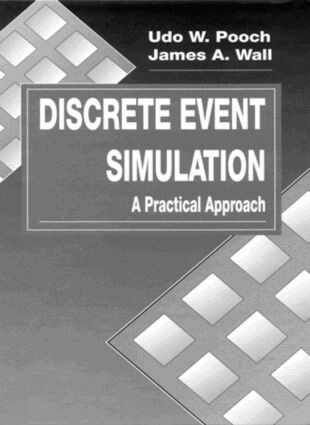
    Discrete Event Simulation

    A Practical Approach

    AvUdo W. Pooch,James A. Wall

    Inbunden, Engelska, 1992

    Del i serien Computer Science & Engineering

    1 506 kr

    Beställningsvara. Skickas inom 5-8 vardagar. Fri frakt över 249 kr.

    Beskrivning

    Discrete Event Simulation is a process-oriented text/reference that utilizes an eleven-step model to represent the simulation process from problem formulation to implementation and documentation. The book presents the necessary level of detail required to fully develop a model that produces meaningful results and considers the tools necessary to interpret those results. Sufficient background information is provided so that the underlying concepts of simulation are understood.Major topics covered in Discrete Event Simulation include probability and distributional theory, statistical estimation and inference, the generation of random variates, verification and validation techniques, time management methods, experimental design, and programming language considerations. The book also examines distributed simulation and issues related to distributing the physical process over a network of tightly coupled processors. Topics covered in this area include deadlock, synchronization, rollback, event management, and communication processes.Fully worked examples and numerous practical exercises have been drawn from the engineering disciplines and computer science, although they have been structured so that they will be useful as well to other disciplines such as economics, business administration, and management science. The presentation of techniques and methods in Discrete Event Simulation make it an ideal text/reference for all practitioners of discrete event simulation.

    Produktinformation

    • Utgivningsdatum:1992-12-21
    • Mått:156 x 234 x 30 mm
    • Vikt:960 g
    • Format:Inbunden
    • Språk:Engelska
    • Serie:Computer Science & Engineering
    • Antal sidor:432
    • Förlag:Taylor & Francis Inc
    • ISBN:9780849371745

    Utforska kategorier

    • Matematisk statistik inom Naturvetenskap och teknik
    • Nätverk och kommunikation inom Data och IT
    • 3D-grafik och modellering inom Data och IT

    Innehållsförteckning

    • BASIC CONCEPTS AND TERMINOLOGY. Concept of a System. System Methodology. Advantages and Disadvantages of Simulation. Simulation Terminology. PROBABILITY CONCEPTS IN SIMULATION. Probability. Set Theory, Compound Events. Conditional Probability, Independent Events. Discrete Distributions. Continuous Distributions. RANDOM VARIABLES AND PROBABILITY DISTRIBUTIONS. Functions of a Random Variable. Moments. Generating Functions. Multivariate Distributions. DETAILED ANALYSIS OF COMMON PROBABILITY DISTRIBUTIONS. Bernoulli Distribution. Binomial Distribution. Geometric Distribution. Poisson Distribution. Uniform Distribution. Normal Distribution. Exponential Distribution. Chi-Square Distribution. Student's t-Distribution. F-Distribution. STATISTICS AND RANDOM SAMPLES. Descriptive Statistics and Frequency Diagrams. Statistics and Sampling Distributions. Method of Least Squares. Estimation. Confidence Interval Estimates. STATISTICAL TESTS. Tests of Hypotheses. Student's t-Test. The F-Test. The Chi-Square Goodness-of-Fit Test. The Kolmogorov-Smirnov Test. GENERATION OF RANDOM NUMBERS. Pseudorandom Numbers. Algorithms for Generating Pseudorandom Numbers. Testing and Validating Pseudorandom Sequences. Generation of Nonuniform Variates. DISCRETE SYSTEM SIMULATION. Simulation Terminology. Time Management Methods. Object Generation. Queue Management and List Processing. Collecting and Recording Simulation Data. MODEL VALIDATION. Evaluation of the Simulation Model. Validation Description. Sampling Methods. THE DESIGN OF SIMULATION EXPERIMENTS. Completely Randomized Design. Randomized Complete Block Design. Factorial Design. Network Simulation Model Performance Analysis. ESTIMATION OF MODEL PARAMETERS. Optimization of Response Surfaces. Heuristic Search. Complete Enumeration. Random Search. Steepest Ascent (Descent). Coordinate or Single-Variable Search. Parallel Tangent Search. Conjugate Direction Search. OUTPUT ANALYSIS. Analysis of Simulation Results. Estimation and Confidence Limits