• Fri frakt över 249 kr
  • •
  • Snabba leveranser
  • •
  • Billiga böcker
Kundservice

Du är på sajten för privatpersoner.

Företag, bibliotek eller offentlig verksamhet?

Du handlar på classic.bokus.com, där alla dina funktioner finns intakta.
Till classic.bokus.com
Bokus logotyp. Gå till startsidan.
  • Erbjudanden
  • Nyheter
  • Student
  • Topplistor
  • Barn & ungdom
  • Bokus Play
  • E-böcker
  • Pocketböcker
  • Spel & pussel

10% rabatt på allt med kod: NYSTART10 →

Sidfot

Mina sidor

    Hjälp

    • Kundservice
    • Vanliga frågor och svar
    • Frakt och leverans
    • Retur vid ångerrätt
    • Reklamera vara
    • Betalning
    • Köpvillkor
    • Allmänna villkor
    • Information om webbplatsens tillgänglighet

    Om Bokus

    • Om oss
    • Pressrum
    • För studenter
    • För företag
    • För bibliotek och offentlig verksamhet
    • För leverantörer
    • Hållbarhet

    Populärt

    • Aktuella erbjudanden
    • Presentkort
    • Studentlitteratur
    • Nya böcker
    • Topplistor
    • Signerade böcker
    • Engelska böcker

    Inspiration

    • Boktips
    • BookTok
    • Populära bokserier
    • Barnbokskaraktärer
    • Populära författare
    Logotyp för Bokus
    Följ oss på Facebook (extern länk)Följ oss på Instagram (extern länk)Följ oss på YouTube (extern länk)Följ oss på TikTok (extern länk)
    bokus @ CookiesAnpassa cookiesIntegritetspolicyKöpvillkor
    Till Citymail hemsida (extern länk)Till Budbee hemsida (extern länk)Till Postnord hemsida (extern länk)Till Schenker hemsida (extern länk)Till Early Bird hemsida (extern länk)Till Walleys hemsida (extern länk)
    1. Naturvetenskap och teknik
    2. Teknik och industri
    3. Tillverkningsteknik

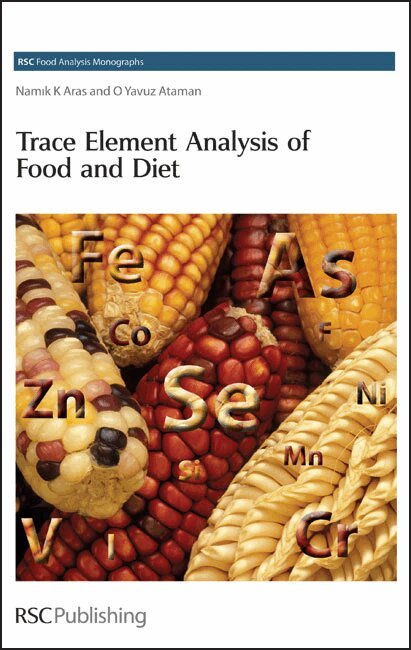
    Trace Element Analysis of Food and Diet

    AvNamik K Aras,O Yavuz Ataman

    Inbunden, Engelska, 2006

    Del i serien RSC Food Analysis Monographs

    2 500 kr

    Beställningsvara. Skickas inom 5-8 vardagar. Fri frakt över 249 kr.

    Beskrivning

    Trace element analysis has a key role to play in quality control of food and diet. This timely book introduces the subject in a practical way - from sampling and the techniques available for trace analysis, to procedures for specific elements and data analysis. Beginning with a brief introduction and discussion of statistical evaluation of data, the subsequent chapter looks at trace analysis in general, with its essentials and terminology. Another section introduces sampling and preparation of foodstuffs such as wheat, potato, vegetables and milk. This is followed by descriptions of the various spectrometric techniques (atomic absorption, atomic emission, atomic fluorescence) that are available. Plasma techniques for both optical emission and mass spectrometry are presented, as are nuclear activation analysis and X-ray methods. A comparison of the various analytical techniques is provided, and a separate chapter handles speciation analysis. Finally, procedures for determining essential and toxic elements such as arsenic, iron, selenium and zinc are suggested, using several recent references. Detailed explanations and a simple format will appeal to laboratory technicians and graduate students, as well as more experienced researchers. Comprehensive coverage, coupled with illustrations and a guide to relevant literature and manufacturers, will make Trace Element Analysis of Food and Diet a valuable source of information for anyone working on analysis of trace elements in food, diet or other biological or environmental samples - particularly food engineers, agricultural scientists and government testing agency employees.

    Produktinformation

    • Utgivningsdatum:2006-04-04
    • Mått:156 x 234 x 21 mm
    • Vikt:686 g
    • Format:Inbunden
    • Språk:Engelska
    • Serie:RSC Food Analysis Monographs
    • Antal sidor:362
    • Förlag:Royal Society of Chemistry
    • ISBN:9780854045761

    Utforska kategorier

    • Tillverkningsteknik inom Naturvetenskap och teknik

    Mer om författaren

    Middle East Technical University, Retired Turkish Academy of Sciences, Member Ankara, Turkey

    Recensioner i media

    You really do need all the help you can get - and this book offers a lot of help. It is aimed at technicians and graduate students who are working in the field of trace element determination, but are not trained analytical chemists.So should you buy the book? Well I already had a copy before the review copy arrived.

    Innehållsförteckning

    • Part One: Operational Developments in Chemistry;Chapter 1: The Use of Polymer-assisted Solution-phase Synthesis and Automation for the High-throughput Preparation of Biologically Active Compounds;1: Introduction;2: PASP Synthesis Approaches to Biologically Active Compounds;3: Automated PASP Synthesis of Biologically Active Molecules;4: Flow Chemistry and Automation in the Synthesis of Drug-Like Molecules;5: Conclusion;6: References;Chapter 2: Accelerated Chemistry: Microwave, Sonochemical, and Fluorous Phase Techniques;1: Introduction;2: Microwave Enhanced Chemistry;3: Sonochemistry as a Means to Accelerate Synthesis;4: Fluorous Phase Techniques;5: Conclusion;6: References;Part Two: Conceptual Advances in Synthesis;Chapter 3: Biosynthesis of "Unnatural" Natural Products;1: Introduction;2: Type I Polyketide Synthases;3: Type II Polyketide Synthases;4: Type III Polyketide Synthase;5: Conclusions;6: Acknowledgements;7: References;Chapter 4: Combinatorial Synthetic Design: the Balance of Novelty and Familiarity;1: Biological Macromolecules - Strength in Numbers;2: Oligomer Synthesis - Improving on Mother Nature;3: Random, Discovery, or Prospecting Libraries - the Quest for the Universal Scaffold;4: Privileged Scaffolds - Look Where the Light is Brightest;5: The Decoration or Synthesis of Novel Scaffolds - Aid for the Underprivileged;6: Target Class Libraries - Diversity with a Purpose;7: Peptide and Nucleotide Libraries Redux;8: Lead Discovery or Drug Discovery - Size Does Matter;9: Natural Product Scaffolds for Combinatorial Chemistry - Why Re-invent the Wheel?;10: From Natural Products to Natural Product-like Libraries - Hubris or Progress?;11: Lead Discovery and Combinatorial Chemistry - What Have we Learned?;12: References;Chapter 5: Compound Collections: Acquisition, Annotation, and Access;1: Introduction;2: Commercial Offerings;3: Companies Providing Non-proprietry, Non-parallel Synthesised Libraries (Shared-pool/"Collected Collections");4: Companies Providing In-house Designed, Parallel Synthesised Libraries;5: Compound Selection and Database Filtering;6: Substructure Similarity/Dissimilarity;7: Pharmacophore Analysis;8: Lipinski Rule-of-Five (LRoF);9: Topological Polar Surface Area (tPSA) and Blood-Brain-Barrier Permeability (LogBB);10: Solubility;11: Examples of the Use of Chemical Annotation and Pharmacophore based lead-hopping;12: Compound Acquisition;13: References;Chapter 6: Chemical Diversity: Definition and Quantification;1: Introduction;2: Diversity Metrics;3: Molecular Description;4: Dimensionality Reduction;5: Subset Selection and Classification;6: Conclusion;7: Abbreviations;8: References;Part Three: Mining: Turning a Hit into a Lead;Chapter 7: Focused Libraries: the Evolution in Strategy from Large Diversity Libraries to the Focused Library Approach;1: Introduction;2: A Synergistic, Multidisciplinary Approach to Library Conception;3: Library Design Concepts;4: Focused libraries;5: Summary;6: References;Chapter 8:Translating Peptides into Small Molecules;1: Peptides as Drugs: The Good, the Bad and the Ugly;2: Origin of Biologically Active Peptides;3: General Strategy for Translating Peptides into Small Molecules;4: Tailoring Peptide Sequences for Their Translation into Small Molecules;5: Transformation of peptide Ligands into Small Molecules Using Computational Approaches;6: References;Part Four: Operational Developments in Screening;Chapter 9:High Density Plates, Microarrays, Microfluidics;1: Functional High-density Well Plates for High-throughput Assays;2: Parallel Liquid Handling of Low-volume Samples;3: Microarray Assays on Chips;4: Prospects for Multi-Parameter Assays;5: References;Chapter 10: Fluorescence Technologies for the Investigation of Chemical Libraries;1: Introduction;2: Dissociation Enhanced Lanthanide Fluoroimmunoassay (DELFIA);3: Enzyme Fragment Complementation (EFC);4: Fluorescence Polarization (FP);5: Fluorescence Correlation Spectroscopy (FCS);6: Amplified Luminescent Proximity Homogeneous Assay (Alphascreen);7: Fluorescence Resonance Energy Transfer (FRET);8: Bioluminescence Resonance Energy Transfer (BRET);9: Homogeneous Time Resolved Fluorescence (HTRF);10: Conclusion;11: References;Chapter 11: The Use of Genetically Engineered Cell-based Assays in in-vitro Drug Discovery;1: Introduction;2: Genetic Engineering for Cell-based Assays;3: Reporter-based Assays;4: Assays to Measure Intracellular Calcium;5: Assays to Monitor Protein-Protein Interactions;6: Conclusions and Outlook;7: References;Chapter 12: NMR Based Screening, a Powerful Tool in Fragment-based Drug Discovery;1: Introduction;2: NMR Screening: General Aspects;3: Ligand- vs Traget-detected Methods;4: Incorporation of NMR into the Drug Discovery Process;5: Representative Case Studies;6: Conclusion;7: References;Chapter 13: Screening Chemical Microarrays: Methods and Applications;1: Introduction;2: Screening of Chemical Microarrays;3: Applications of Chemical Microarrays;4: Conclusion;5: References;Part Five: Conceptual Advances in Lead Evaluation;Chapter 14: Screen/Counter-screen: Early Assessment of Selectivity;1: Introduction;2: Approaches Used for Selection of Drug Candidates;3: Summary;4: References;Chapter 15: Concepts for in-vitro Profiling - Drug Activity, Selectivity and Liability;1: Introduction;2: Physico Chemical Parameters;3: Permeability;4: Metabolism;5: Protein Binding;6: Toxicity;7: Investigation of Compound Selectivity;8: Conclusion and Outlook;9: Reference;Chapter 16: In silico Surrogates for in vivo Properties: Profiling for ADME and Toxicological Behavior;1: In silico Surrogates for in vivo Properties;2: Estimation of Biopharmaceutical Properties;3: Estimation of Pharmacokinetic Properties;4: Estimation of Toxicological Properties;5: Integration of Surrogate Data and Estimations with Physiological Simulation;6: References;Chapter 17: Use of High Content Screening in Chemical Optimization;1: Introduction;2: HCS Systems;3: Examples Show the Power of HCS;4: Summary