• Fri frakt över 249 kr
  • •
  • Snabba leveranser
  • •
  • Billiga böcker
Kundservice

Du är på sajten för privatpersoner.

Företag, bibliotek eller offentlig verksamhet?

Du handlar på classic.bokus.com, där alla dina funktioner finns intakta.
Till classic.bokus.com
Bokus logotyp. Gå till startsidan.
  • Erbjudanden
  • Nyheter
  • Student
  • Topplistor
  • Barn & ungdom
  • Bokus Play
  • E-böcker
  • Pocketböcker
  • Spel & pussel

10% rabatt på allt med kod NYSTART10 →

Sidfot

Mina sidor

    Hjälp

    • Kundservice
    • Vanliga frågor och svar
    • Frakt och leverans
    • Retur vid ångerrätt
    • Reklamera vara
    • Betalning
    • Köpvillkor
    • Allmänna villkor
    • Information om webbplatsens tillgänglighet

    Om Bokus

    • Om oss
    • Pressrum
    • För studenter
    • För företag
    • För bibliotek och offentlig verksamhet
    • För leverantörer
    • Hållbarhet

    Populärt

    • Aktuella erbjudanden
    • Presentkort
    • Studentlitteratur
    • Nya böcker
    • Topplistor
    • Signerade böcker
    • Engelska böcker

    Inspiration

    • Boktips
    • BookTok
    • Populära bokserier
    • Barnbokskaraktärer
    • Populära författare
    Logotyp för Bokus
    Följ oss på Facebook (extern länk)Följ oss på Instagram (extern länk)Följ oss på YouTube (extern länk)Följ oss på TikTok (extern länk)
    bokus @ CookiesAnpassa cookiesIntegritetspolicyKöpvillkor
    Till Citymail hemsida (extern länk)Till Budbee hemsida (extern länk)Till Postnord hemsida (extern länk)Till Schenker hemsida (extern länk)Till Early Bird hemsida (extern länk)Till Walleys hemsida (extern länk)
    1. Historia och arkeologi
    2. Historia
    3. Europas historia

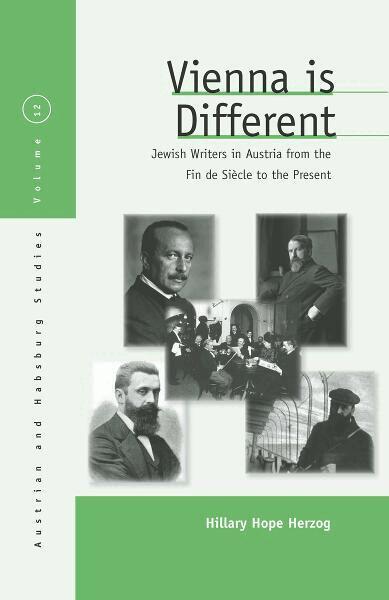
    Vienna Is Different

    Jewish Writers in Austria from the Fin-de-Siècle to the Present

    AvHillary Hope Herzog

    Inbunden, Engelska, 2011

    Del i serien Austrian and Habsburg Studies

    2 140 kr

    Beställningsvara. Skickas inom 5-8 vardagar. Fri frakt över 249 kr.

    Fler format och utgåvor

    E-bok

    362 kr

    Häftad

    588 kr

    Beskrivning

    Assessing the impact of fin-de-siècle Jewish culture on subsequent developments in literature and culture, this book is the first to consider the historical trajectory of Austrian-Jewish writing across the 20th century. It examines how Vienna, the city that stood at the center of Jewish life in the Austrian Empire and later the Austrian nation, assumed a special significance in the imaginations of Jewish writers as a space and an idea. The author focuses on the special relationship between Austrian-Jewish writers and the city to reveal a century-long pattern of living in tension with the city, experiencing simultaneously acceptance and exclusion, feeling “unheimlich heimisch” (eerily at home) in Vienna.

    Produktinformation

    • Utgivningsdatum:2011-10-01
    • Mått:152 x 229 x 20 mm
    • Vikt:535 g
    • Format:Inbunden
    • Språk:Engelska
    • Serie:Austrian and Habsburg Studies
    • Antal sidor:298
    • Förlag:Berghahn Books
    • ISBN:9780857451811

    Utforska kategorier

    • Europas historia inom Historia och arkeologi
    • Sociala grupper och identitet inom Samhälle och politik
    • Litteraturvetenskap inom Skönlitteratur

    Mer om författaren

    Hillary Hope Herzog is Associate Professor of German Studies at the University of Kentucky, where she works in twentieth-century German literature, Austrian Studies, and the field of medicine and literature. She is co-editor of Rebirth of a Culture: Jewish Identity and Jewish Writing in Germany and Austria Today (with Todd Herzog and Benjamin Lapp, Berghahn 2008) and the Journal of Austrian Studies.

    Recensioner i media

    “This thoroughly researched, lucid book offers a broad, insightful discussion of a complex subject. Steven Beller is Herzog's immediate scholarly predecessor, yet Herzog goes beyond the excellent work of her predecessors…Her choices of the writings to discuss are thoughtful and sometimes unexpected…Posing challenging questions while keeping the city always in view, Herzog concludes that though this rich tapestry of artists and viewpoints is irreducible, there are similarities and verities to reveal. This is the book's unique contribution. Highly recommended.” • Choice“The strength of Vienna is Different lies in its combination of historical contextualization with individual case studies…[It] constitutes an informative guide to the continuities in Austrian Jewish literature during the long twentieth century and will be an excellent handbook for students in the field.” • Modern Language Review“This work is on the cutting edge of renewed interest in Jewish Austria. It is a comprehensive road map of a culture uprooted but replanted and blossoming anew into the twenty-first century. This is recommended reading for the scholar of Austrian literary history.” • Journal of Austrian Studies“Herzog’s book is an excellent study of Viennese Jewish writers—one that not only provides an excellent overview for use in the classroom, but that is also a fine piece of scholarship that reveals how “Vienna is different” from other European metropolises in the fascinating ways its contemporary Jewish authors reference the city’s vibrant literary tradition and cultural legacy.” • Austrian History Yearbook“It is worth noting that Herzog gives the reader the necessary historical background to each chapter and sets her writers in their historical contexts. Furthermore, each writer is introduced with a short biographical background on their life and work…In addition to being a well-written and well-constructed book, Herzog’s study contributes not only to our understanding of the tradition of the Austrian-Jewish literature but also reminds us some of its forgotten protagonists, among them Felix Salten, the author of Bambi, a work whose fame far outstrips its author’s.” • European History Quarterly“In tracing a tradition of Jewish writing in Vienna from the fin de siècle to the present, Herzog's book forms an important contribution to our understanding of Austrian literature and culture of the twentieth century. By focusing her analyses on the ways in which these writers conceptualized their identities as Jews, Herzog illuminates the complicated, yet continually changing relationships between Jewish writers and the city of Vienna.” • H-Judaic“…meticulously researched and clearly presented…Each chapter begins with a brief, well-informed overview of the period and the experiences of Jews in Austria during that time…This informative work successfully probes the engagement of an impressive range of writers with both their own self-identifications and Vienna. Sensitive and nuanced, it will serve scholars and others as the go-to guide for exploring issues of Jewishness in Austrian literature.” • Habsburg, H-Net Reviews “[A]n impressive account of the origins and development of what is now a tradition of Jewish writers in Vienna. The author does a very good job of presenting the very large subject she has taken on and of putting the turn-of-the-century writers within a chronological context that brings out how a ‘tradition’ of Jewish writers in Vienna has developed over the last century…This is an impressive contribution, with a welcome approach.” • Steven Beller, Washington D.C.“[A]n important, extremely well constructed and original inquiry and a major contribution to scholarship on Jewish writing and its authors’ literary reactions to the Austrian capital... In a systematic approach and within the proper historical context Herzog uncovers the panorama of Jewish-Austrian writing with Vienna as its focus…Comprehensive and thorough, it conveys a wealth of information on individual authors, their time, and the changing cultural environment.” • Dagmar C. G. Lorenz, University of Illinois at Chicago

    Innehållsförteckning

    • IntroductionThe Historical Continuity of the Viennese Jewish ExperienceChapter 1. The Fin de SiècleThe Jewish Immigrant Experience in ViennaThe Jewish Confrontation with a New Political ClimateJewish Cultural ResponsesArthur SchnitzlerAdolf DessauerFelix SaltenStefan ZweigHugo von HofmannsthalKarl KrausTheodor HerzlRichard Beer-HofmannConclusionChapter 2. Jewish Vienna Between the World WarsJewish Identity and World War IA New Jewish Identity CrisisRising Anti-SemitismThe Beginning of the EndJews and the AnschlussJewish Cultural Responses in the Interwar YearsArthur SchnitzlerFelix SaltenStefan ZweigJoseph RothKarl KrausHugo BettauerElias CanettiVeza CanettiConclusionChapter 3. Jews and the Second RepublicThe Immediate Postwar SituationThe Second RepublicAustrian Jews and the Second RepublicJewish Identity after 1945Ilse AichingerFriedrich TorbergHilde SpielConclusionChapter 4. Viennese Jews from Waldheim to Haider and BeyondThe Waldheim AffairJewish Writers and Vienna after WaldheimContemporary Viennese Jewish WritingRuth BeckermannRobert SchindelDoron RabinoviciRobert MenasseEva MenasseElfriede JelinekConclusionConclusionBibliography