• Fri frakt över 249 kr
  • •
  • Snabba leveranser
  • •
  • Billiga böcker
Kundservice

Du är på sajten för privatpersoner.

Företag, bibliotek eller offentlig verksamhet?

Du handlar på classic.bokus.com, där alla dina funktioner finns intakta.
Till classic.bokus.com
Bokus logotyp. Gå till startsidan.
  • Erbjudanden
  • Nyheter
  • Student
  • Topplistor
  • Barn & ungdom
  • Bokus Play
  • E-böcker
  • Pocketböcker
  • Spel & pussel

10% rabatt på allt med kod NYSTART10 →

Sidfot

Mina sidor

    Hjälp

    • Kundservice
    • Vanliga frågor och svar
    • Frakt och leverans
    • Retur vid ångerrätt
    • Reklamera vara
    • Betalning
    • Köpvillkor
    • Allmänna villkor
    • Information om webbplatsens tillgänglighet

    Om Bokus

    • Om oss
    • Pressrum
    • För studenter
    • För företag
    • För bibliotek och offentlig verksamhet
    • För leverantörer
    • Hållbarhet

    Populärt

    • Aktuella erbjudanden
    • Presentkort
    • Studentlitteratur
    • Nya böcker
    • Topplistor
    • Signerade böcker
    • Engelska böcker

    Inspiration

    • Boktips
    • BookTok
    • Populära bokserier
    • Barnbokskaraktärer
    • Populära författare
    Logotyp för Bokus
    Följ oss på Facebook (extern länk)Följ oss på Instagram (extern länk)Följ oss på YouTube (extern länk)Följ oss på TikTok (extern länk)
    bokus @ CookiesAnpassa cookiesIntegritetspolicyKöpvillkor
    Till Citymail hemsida (extern länk)Till Budbee hemsida (extern länk)Till Postnord hemsida (extern länk)Till Schenker hemsida (extern länk)Till Early Bird hemsida (extern länk)Till Walleys hemsida (extern länk)
    1. Historia och arkeologi
    2. Historia
    3. Historia: särskilda händelser och ämnen
    4. Socialhistoria och kulturhistoria

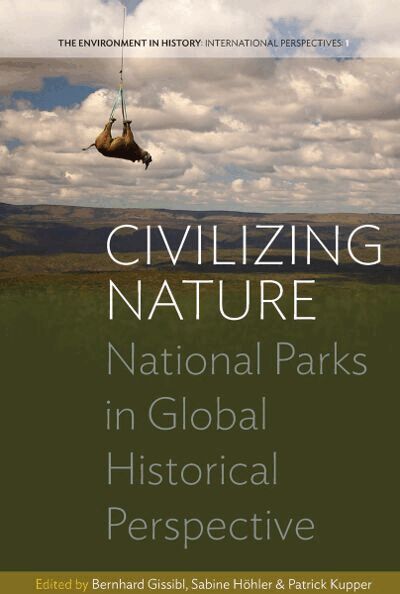
    Civilizing Nature

    National Parks in Global Historical Perspective

    AvBernhard Gissibl,Sabine Höhler

    Inbunden, Engelska, 2012

    Del i serien Environment in History: International Perspectives

    1 916 kr

    Beställningsvara. Skickas inom 5-8 vardagar. Fri frakt över 249 kr.

    Beskrivning

    National parks are one of the most important and successful institutions in global environmentalism. Since their first designation in the United States in the 1860s and 1870s they have become a global phenomenon. The development of these ecological and political systems cannot be understood as a simple reaction to mounting environmental problems, nor can it be explained by the spread of environmental sensibilities. Shifting the focus from the usual emphasis on national parks in the United States, this volume adopts an historical and transnational perspective on the global geography of protected areas and its changes over time. It focuses especially on the actors, networks, mechanisms, arenas, and institutions responsible for the global spread of the national park and the associated utilization and mobilization of asymmetrical relationships of power and knowledge, contributing to scholarly discussions of globalization and the emergence of global environmental institutions and governance.

    Produktinformation

    • Utgivningsdatum:2012-11-01
    • Mått:152 x 229 x 21 mm
    • Vikt:581 g
    • Format:Inbunden
    • Språk:Engelska
    • Serie:Environment in History: International Perspectives
    • Antal sidor:304
    • Förlag:Berghahn Books
    • ISBN:9780857455253

    Utforska kategorier

    • Socialhistoria och kulturhistoria inom Historia och arkeologi
    • Miljövetenskap och miljöpolitik inom Naturvetenskap och teknik

    Mer om författaren

    Bernhard Gissibl is Postdoctoral Researcher at the Leibniz-Institute of European History in Mainz. His PhD dissertation explored the history of hunting and wildlife conservation in colonial Tanzania and is forthcoming with Berghahn under the title The Nature of German Imperialism. Conservation and the Politics of Wildlife in colonial East Africa.

    Recensioner i media

    “This book makes a unique contribution to the conservation literature by enhancing one's understanding and appreciation of the cultural meaning of nature conservation through the lens of national park development. […] Highly recommended.” · Choice“The book meets its aim of moving conservation scholarship in a new direction by providing analysis of the ‘national’’ (and not just the ‘park’) part of national parks.” · The Public Historian“The essays in Civilizing Nature are generally very good in outlining and analyzing institutions, governments, and the roles of NGOs, scientists, and stakeholders within and regarding national parks around the globe.” · Journal of Tourism History“This volume impresses with a well written, fascinating and remarkably multi-facetted story about one of the globally most successful nature conservation policies. It shows clearly that the future of environmental and nature conservation work lies in comparative global history that leaves enough room for local specificities and actors, without losing sight of larger processes.” · Sehepunkte“Civilizing Nature is a seminal work of outstanding scholars in their fields…a critically important addition to academic library Environmental Studies.” · Midwest Book Review“For those fascinated by the notion and practice of national parks, it is probably best to start with the abstracts to the thirteen chapters…[that] convey the truly global scope of the present volume… The editors are to be congratulated for their strong cast of contributors and the‘fine essays that represent the fruits of cutting-edge research.” · Environment and History“[This volume] brings together an appealing array of scholars to describe and discuss how the term ‘national park’ has been perceived and used worldwide. While taking readers on a whirlwind tour of places—20-odd parks in more than 16 countries in 13 chapters—it explores ideas of ‘territorialization’ ‘nationalism,’ and ‘globalization’ in an ecological milieu and, in turn, puts ‘wilderness,’ ‘nature,’ and ‘preservation’ in much-needed political and cultural context…Overall, the work leaves cultural geographers informed and inspired to continue studying and contributing to discussions of reservation, politics, ecology, and history in the context of national parks.” · Journal of Cultural Geography"With an intellectual coherence often missing in the revised proceedings of conferences, Civilizing Nature is a path‐breaking work in its field of comparative national park history. Both editors and contributors must be commended on the outcome. It is also a valuable contribution to environmental history more broadly and a useful addition to the study of twentieth‐century global history." · Ian Tyrrell, Environment and Nature in New Zealand“The editors are to be congratulated on having put together such a strong cast of contributors and on having extracted such fine essays that represent the fruits of cutting-edge research on national park history. I feel strongly that the future of environmental history lies in global and comparative studies of this sort and this volume offers a model in being both genuinely global and genuinely comparative.” · Peter Coates, University of Bristol“This book is very worthwhile, and likely to be of interest to readers interesting in conservation and environmental studies more widely. The way that the manuscript is organised into themes is very sensible and helps the reader draw some of the connections between apparently disparate cases.” · Rosaleen Duffy, University of Manchester

    Innehållsförteckning

    • PrefaceList of Tables, Maps and IllustrationsList of AbbreviationsAcknowledgementsIntroduction: Towards a Global History of National ParksBernhard Gissibl, Sabine Höhler, Patrick KupperPART I: PARKS AND EMPIRESChapter 1. Unpacking Yellowstone: The American National Park in Global PerspectiveKaren JonesChapter 2. How National Were the First National Parks? Comparative Perspectives from the British Settler SocietiesMelissa Harper and Richard WhiteChapter 3. Imperial Preservation and Landscape Reclamation: National Parks and Natural Reserves in French Colonial AfricaCaroline FordChapter 4. From Colonial Imposition to National Icon: Malaysia's Taman Negara National ParkJeyamalar Kathirithamby-WellsChapter 5. A Bavarian Serengeti: Space, race and time in the entangled history of nature conservation in East Africa and GermanyBernhard GissiblPART II: ORGANIZATIONS AND NETWORKS Chapter 6. Translating Yellowstone: Early European National Parks, Weltnaturschutz and the Swiss ModelPatrick KupperChapter 7. Framing the Heritage of Mankind: National Parks on the International AgendaAnna-Katharina WöbseChapter 8. Global Values, Local Politics: Inuit Internationalism and the Establishment of Northern Yukon National ParkBrad MartinChapter 9. Demarcating Wilderness and Disciplining Wildlife: Radiotracking Large Carnivores in Yellowstone and ChitwanNational ParksEtienne BensonPART III: NATIONS AND NATURESChapter 10. A Revolutionary Civilization: National Parks, Transnational Exchanges, and the Construction of Modern MexicoEmily WakildChapter 11. Parks without Wilderness, Wilderness without Parks? Assigning National Park status to Dutch Man-made Landscapes and Colonial Game ReservesHenny van der WindtChapter 12. Globalizing Nature: National Parks, Tiger Reserves, and Biosphere Reserves in Independent IndiaMichael LewisChapter 13. Slovenia’s Triglav National Park: From Imperial Borderland to National EthnoscapeCarolin Firouzeh RoederEpilogue: National Parks, Civilization and GlobalizationJane CarruthersSelect Bibliography