• Fri frakt över 249 kr
  • •
  • Snabba leveranser
  • •
  • Billiga böcker
Kundservice

Du är på sajten för privatpersoner.

Företag, bibliotek eller offentlig verksamhet?

Du handlar på classic.bokus.com, där alla dina funktioner finns intakta.
Till classic.bokus.com
Bokus logotyp. Gå till startsidan.
  • Erbjudanden
  • Student
  • Topplistor
  • Barn & ungdom
  • Bokus Play
  • E-böcker
  • Ljudböcker
  • Pocketböcker
  • Spel och pussel

Pocketfynda! Hundratals böcker för 49 kr/st →

Sidfot

Mina sidor

    Hjälp

    • Kundservice
    • Vanliga frågor och svar
    • Frakt och leverans
    • Retur vid ångerrätt
    • Reklamera vara
    • Betalning
    • Köpvillkor
    • Allmänna villkor
    • Information om webbplatsens tillgänglighet

    Om Bokus

    • Om oss
    • Pressrum
    • För studenter
    • För företag
    • För bibliotek och offentlig verksamhet
    • För leverantörer
    • Hållbarhet

    Populärt

    • Aktuella erbjudanden
    • Presentkort
    • Studentlitteratur
    • Nya böcker
    • Topplistor
    • Signerade böcker
    • Engelska böcker

    Inspiration

    • Boktips
    • BookTok
    • Barnbokskaraktärer
    • Populära författare
    Logotyp för Bokus
    Följ oss på Facebook (extern länk)Följ oss på Instagram (extern länk)Följ oss på YouTube (extern länk)Följ oss på TikTok (extern länk)
    bokus @ CookiesAnpassa cookiesIntegritetspolicyKöpvillkor
    Till Citymail hemsida (extern länk)Till Budbee hemsida (extern länk)Till Postnord hemsida (extern länk)Till Schenker hemsida (extern länk)Till Early Bird hemsida (extern länk)Till Walleys hemsida (extern länk)
    1. Ekonomi och Ledarskap
    2. Nationalekonomi
    3. Ekonomisk politik

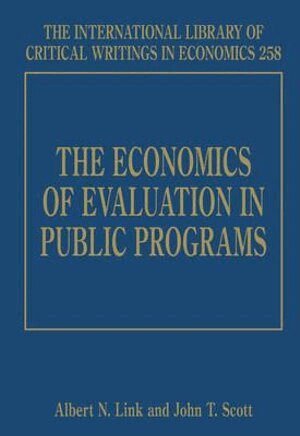
    Economics of Evaluation in Public Programs

    AvAlbert N. Link,John T. Scott

    Inbunden, Engelska, 2011

    Del 258 i serien The International Library of Critical Writings in Economics series

    4 349 kr

    Beställningsvara. Skickas inom 5-8 vardagar. Fri frakt över 249 kr.

    Beskrivning

    This research collection illustrates the wide range of methodologies and methods available for the evaluation of public programs. All these methods address the benefits of the programs and most compare the benefits to costs, but the types of benefits and their measures vary greatly across the studies and across the different types of public programs. The key articles presented here explore these different approaches and offer many examples of actual evaluations of public programs across different public policy settings. Professor Link and Professor Scott have provided an authoritative original introduction, which elucidates this diversity of approaches and settings and challenges scholars to contemplate an evaluation in terms of its theoretical foundation.

    Produktinformation

    • Utgivningsdatum:2011-11-30
    • Mått:169 x 244 x undefined mm
    • Format:Inbunden
    • Språk:Engelska
    • Serie:The International Library of Critical Writings in Economics series
    • Förlag:Edward Elgar Publishing Ltd
    • ISBN:9780857933416

    Utforska kategorier

    • Ekonomisk politik inom Ekonomi och Ledarskap
    • Offentlig förvaltning inom Samhälle och politik

    Mer om författaren

    Edited by Albert N. Link, Professor Emeritus and former Virginia Batte Phillips Distinguished Professor, University of North Carolina at Greensboro, US and John T. Scott, Professor of Economics, Dartmouth College, US

    Innehållsförteckning

    • Contents:AcknowledgementsIntroduction Thoughts about the Diversity of Evaluations Albert N. Link and John T. Scott PART I CRITICAL DISCUSSION AND COMMENTARY ABOUT EVALUATION METHODS1. William J. Baumol (1968), ‘On the Social Rate of Discount’2. Arthur Maass (1966), ‘Benefit-Cost Analysis: Its Relevance to Public Investment Decisions’3. Amartya Sen (2000), ‘The Discipline of Cost-Benefit Analysis’PART II PROGRAM ASSESSMENT 4. Luke Georghiou and David Roessner (2000), ‘Evaluating Technology Programs: Tools and Methods’5. Paul A. David, David Mowery and W. Edward Steinmueller (1992), 'Analysing the Economic Payoffs from Basic Research’6. F. Narin and Kimberly S. Hamilton (1996), ‘Bibliometric Performance Measures’ 7. Barry Bozeman and Gordon Kingsley (1997), ‘R&D Value Mapping: A New Approach to Case Study-Based Evaluation’PART III PROGRAM EVALUATION A Agriculture 8. Zvi Griliches (1958), ‘Research Costs and Social Returns: Hybrid Corn and Related Innovations’9. David N. Bengston (1985), ‘Economic Evaluation of Agricultural Research: An Assessment’B Modernization and Quality 10. Irwin Feller and Jon P. Nelson (1999), ‘The Microeconomics of Manufacturing Modernization Programs’11. Albert N. Link and John T. Scott (2006), ‘An Economic Evaluation of the Baldrige National Quality Program’C Energy and Environment 12. Gideon Fishelson (1979), ‘Measuring the Benefits from an Innovation: An Application to Energy’13. Michael Gallaher and K. Casey Delhotal (2005), ‘Modeling the Impact of Technical Change on Emissions Abatement Investments in Developing Countries’D Transportation 14. Robert William Fogel (1962), ‘A Quantitative Approach to the Study of Railroads in American Economic Growth: A Report of Some Preliminary Findings’15. Ian W.H. Parry and Kenneth A. Small (2009), ‘Should Urban Transit Subsidies be Reduced?’E Support of National Infrastructure 16. Gregory Tassey (2008), ‘Modeling and Measuring the Economic Roles of Technology Infrastructure’17. Laurence J. Kotlikoff, Kent Smetters and Jan Walliser (2007), ‘Mitigating America’s Demographic Dilemma by Pre-Funding Social Security’F Information Technology 18. Michael P. Gallaher and Brent R. Rowe (2006), ‘The Costs and Benefits of Transferring Technology Infrastructures Underlying Complex Standards: The Case of IPv6’19. Albert N. Link and John T. Scott (2005), ‘Evaluating Public Sector R&D Programs: The Advanced Technology Program’s Investment in Wavelength References for Optical Fiber Communications’20. David P. Leech and John T. Scott (2008), ‘Intelligent Machine Technology and Productivity Growth’ 21. Albert N. Link and John T. Scott (2001), ‘Public/Private Partnerships: Stimulating Competition in a Dynamic Market’G Health Care 22. Burton A. Weisbrod (1981), ‘Benefit–Cost Analysis of a Controlled Experiment: Treating the Mentally Ill’23. Ted R. Miller, Maury S. Galbraith and Bruce A. Lawrence (1998), ‘Costs and Benefits of a Community Sobriety Checkpoint Program’24. Michael T. French, Kathryn E. McCollister, Stanley Sacks, Karen McKendrick and George De Leon (2002), ‘Benefit-Cost Analysis of a Modified Therapeutic Community for Mentally Ill Chemical Abusers’25. Bert M. Coursey and Albert N. Link (1998), ‘Evaluating Technology-based Public Institutions: The Case of Radiopharmaceutical Standards Research at the National Institute of Standards and Technology’26. Joshua T. Cohen, Peter J. Neumann and Milton C. Weinstein (2008), ‘Does Preventive Care Save Money? Health Economics and the Presidential Candidates’H Local Public Goods 27. Steven C. Deller (1990), ‘An Application of a Test for Allocative Efficiency in the Local Public Sector’28. Stephanie Riegg Cellini, Fernando Ferreira and Jesse Rothstein (2010), ‘The Value of School Facility Investments: Evidence from a Dynamic Regression Discontinuity Design’