• Fri frakt över 249 kr
  • •
  • Snabba leveranser
  • •
  • Billiga böcker
Kundservice

Du är på sajten för privatpersoner.

Företag, bibliotek eller offentlig verksamhet?

Du handlar på classic.bokus.com, där alla dina funktioner finns intakta.
Till classic.bokus.com
Bokus logotyp. Gå till startsidan.
  • Erbjudanden
  • Nyheter
  • Student
  • Topplistor
  • Barn & ungdom
  • Bokus Play
  • E-böcker
  • Pocketböcker
  • Spel & pussel

10% rabatt på allt med kod NYSTART10 →

Sidfot

Mina sidor

    Hjälp

    • Kundservice
    • Vanliga frågor och svar
    • Frakt och leverans
    • Retur vid ångerrätt
    • Reklamera vara
    • Betalning
    • Köpvillkor
    • Allmänna villkor
    • Information om webbplatsens tillgänglighet

    Om Bokus

    • Om oss
    • Pressrum
    • För studenter
    • För företag
    • För bibliotek och offentlig verksamhet
    • För leverantörer
    • Hållbarhet

    Populärt

    • Aktuella erbjudanden
    • Presentkort
    • Studentlitteratur
    • Nya böcker
    • Topplistor
    • Signerade böcker
    • Engelska böcker

    Inspiration

    • Boktips
    • BookTok
    • Populära bokserier
    • Barnbokskaraktärer
    • Populära författare
    Logotyp för Bokus
    Följ oss på Facebook (extern länk)Följ oss på Instagram (extern länk)Följ oss på YouTube (extern länk)Följ oss på TikTok (extern länk)
    bokus @ CookiesAnpassa cookiesIntegritetspolicyKöpvillkor
    Till Citymail hemsida (extern länk)Till Budbee hemsida (extern länk)Till Postnord hemsida (extern länk)Till Schenker hemsida (extern länk)Till Early Bird hemsida (extern länk)Till Walleys hemsida (extern länk)
    1. Historia och arkeologi
    2. Historia
    3. Europas historia

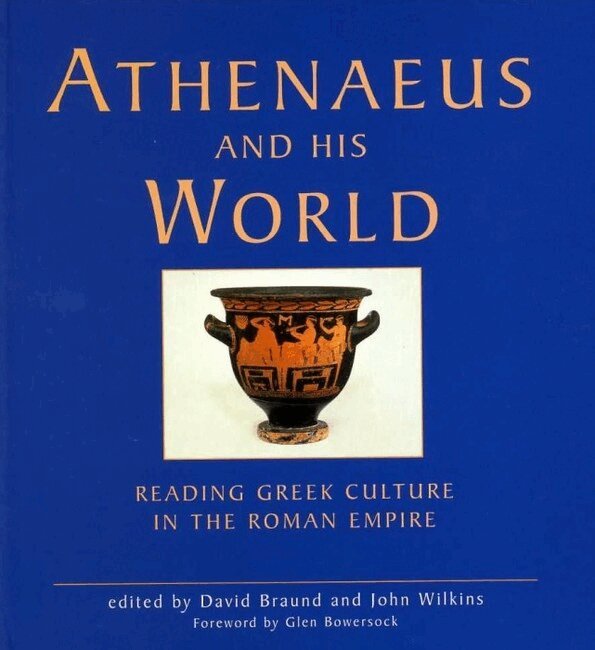
    Athenaeus and his World

    Reading Greek Culture in the Roman Empire

    AvDavid Braund,John Wilkins

    Inbunden, Engelska, 2000

    2 324 kr

    Beställningsvara. Skickas inom 5-8 vardagar. Fri frakt över 249 kr.

    Beskrivning

    An international team of literary specialists explore Athenaeus' work as a whole, and in its own right. Almost all classicists and ancient historians make use of Athenaeus; 'Athenaeus and his World' is the first sustained attempt to understand and explore his work as a whole, and in its own right. The work emerges as no mere compendium of earlier texts, but as a vibrant work of complex structure and substantial creativity. The book makes sense of the massive and polyphonous Deipnosophistae, the quarry upon which classicists and ancient historians depend for their knowledge of much ancient literature, particularly Comedy, and also the source of much of the data used by modern historians for the social history of the classical and Hellenistic worlds. The 41 chapters; written by an international team of literary specialists and historians, each tackle a significant feature, and the book is divided into seven sections, each prefaced by introductory remarks from the editors.

    Produktinformation

    • Utgivningsdatum:2000-11-01
    • Mått:210 x 235 x undefined mm
    • Format:Inbunden
    • Språk:Engelska
    • Antal sidor:648
    • Förlag:Liverpool University Press
    • Medarbetare:Glen Bowersock
    • ISBN:9780859896610

    Utforska kategorier

    • Europas historia inom Historia och arkeologi
    • Forntidens historia inom Historia och arkeologi
    • Filosofi inom Filosofi och religion

    Mer om författaren

    David Braund is Professor of Ancient History, and head of the Classics and Ancient History department at the University of Exeter. His particular specialism lies in the Black Sea region, especially Russia, Ukraine and Georgia, and he speaks Russian and Georgian fluently. His books include The Administration of the Roman Empire (Exeter, 1988); Georgia in Antiquity: A History of Transcaucasian Georgia, 550 BC-AD 562 (Oxford, 1994); Ruling Roman Britain: Kings, Queens, Governors and Emperors from Caesar to Agricola (Routledge, 1996). John Wilkins is Professor at the University of Exeter. He is a specialist in the history of food in Greco-Roman culture, with current interests in literature (especially comic drama) and medicine (especially nutrition). His books include Food in Antiquity: Studies in Ancient Society and Culture (Exeter, 1996).

    Recensioner i media

    ...those interested in particular themes in the Deipnosophistae will therefore want to browse the contents of several sections. Fortunately this is made easy by the editors' introductory remarks to each section, which summarise each chapter's main arguments as well as defining its place within the section and in Athenian scholarship. These remarks provide valuable orientation in a collection of this scope. Scholia Reviews ns 13, 35 From the team that brought you Food in Antiquity, and in matching format, Athenaeus has everything: lots of food, buckets of otherwise unknown texts, material on dining customs in late antiquity, and a considerable body of material on sex ... This volume should go some way towards a broader understanding. Petits Propos Culinaires No. 66 Ce magnifique ouvrage ... Mais les amateurs de musique, tout comme les lecteurs d'Homere et de Platon, auront egalement beaucoup a glaner dans cet ouvrage qui, sans nul doute, marque une etape nouvelle et incontournable dans le renouveau des etudes sur Athenee. Revue des Etudes Greques, No. 114 Although Athenaeus' magnum opus is so crucial a text for our knowledge of classical literature and society, his own work has received astonishingly little interest among scholars. In response to this palpable oversight, the editors some years ago organised an international conference to celebrate and explore Athenaeus and his legacy. This weighty volume includes most of the papers from that conference ... Each contributor is an expert in his specialist field and so offers a uniquely scholarly insight into Athenaeus, his sources and reliability ... Each contribution is backed up by a wealth of scholarly notes and a helpful general bibliography ... There is something for everyone here, whether scholar or just interested Hellenist. It might even make you turn to Athenaeus himself and start reading him. The Anglo-Hellenic Review, No. 25, Spring As the first major book on the Deipnosophistae, Athenaeus and His World provides a pleasingly varied introduction to an under-explored monument. Times Literary Supplement

    Innehållsförteckning

    • Foreword (Glen Bowersock, Princeton)Section I: General IntroductionIntroductory remarks1. David Braund (Exeter): Learning, luxury and empire: Athenaeus’ Roman patron2. John Wilkins (Exeter): Dialogue and Comedy: the structure of the DeipnosophistaeSection II: Text, Transmission and TranslationIntroductory remarks3. Geoffrey Arnott (Leeds): Athenaeus and the Epitome: texts, manuscripts and early editions4. Rosemary Bancroft-Marcus (Oxford): A dainty dish to set before a king: Natale Conti and his translation of Athenaeus’ DeipnosophistaeSection III: Athenaeus the Reader and his WorldIntroductory remarks5. Dorothy Thompson (Cambridge): Athenaeus’ Egyptian background6. Christian Jacob (Paris): Athenaeus the Librarian7. Yun Lee Too (Columbia): The Walking Library of Athenaeus: The Performance of Cultural Memories8. Ewen Bowie (Oxford): Athenaeus’ knowledge of early Greek elegiac and iambic poetry9. Keith Sidwell (Cork): Athenaeus, Lucian and fifth-century comedy10. Giuseppe Zecchini (Milan): Athenaeus and Harpocration: historiographical relationships11 Frank Walbank (Cambridge): Athenaeus and Polybius12 Christopher Pelling (Oxford): Fun with fragments: Athenaeus and the historians13 Karim Arafat (London): The recalcitrant mass: Athenaeus and Pausanias14 John Davies (Liverpool): Athenaeus’ use of public documents15 Ruth Webb (Princeton): Picturing the past: uses of ekphrasis in the Deipnosophistae and other works of the Second Sophistic16 Maria Gambato (Padua): The female king: some aspects of representation of eastern kings in the Deipnosophistae17 Keith Hopwood (Lampeter): Cultural politics in Smyrna, city of the sophistsSection IV: Structural OverviewsIntroductory remarks18 Lucia Rodriguez-Noriega Guillén (Oviedo): Are the 15 books of the Deipnosophistae an excerpt?19 Luciana Romeri (Paris): The Logodeipnon: Athenaeus between banquet and anti-banquet20 Paola Ceccarelli (L’Aquila): Athenaeus and dance21 James Davidson (London): Pleasure and Pedantry in Athenaeus22 Tim Whitmarsh (Cambridge): The politics and poetics of parasitism: Athenaeus on parasites and flatterers23 Graham Anderson (Kent): The banquet of belles-lettres: Athenaeus and the comic symposium24 Antonia Marchiori (Padua): Between Ichthyophagists and Syrians: features of fish-eating in Athenaeus’ Deipnosophistae Books Seven and EightSection V: Key AuthorsIntroductory Remarks25 Malcolm Heath (Leeds): Do heroes eat fish? Athenaeus on the Homeric lifestyle26 Michael Trapp (London): Plato in the Deipnosophistae27 Maria Broggiato (London): Athenaeus, Crates and Attic glosses; a problem of attribution28 Andrew Dalby (Cambridge): The anecdotists (with the fragments of Lynceus)Section VI: SympoticaIntroductory remarks29 Silvia Milanezi (Grenoble): Laughter as dessert: on Athenaeus’ Book Fourteen, 613-61630 Richard Stoneman (London/Exeter): You are what you eat: diet and philosophical diaita in Athenaeus’ Deipnosophistae31 Dwora Gilula (Jerusalem): Stratonicus, the witty harpist32 Andrew Barker (Birmingham): Athenaeus on music33 Elizabetta Villari (Genoa): Aristoxenus in Athenaeus34 Roger Brock (Leeds) and Hanneke Wirtjes (Oxford): Athenaeus on Greek wine35 Konstantinos Niafas (Brussels/Exeter): Athenaeus and the cult of Dionysos Orthos; Deipn. 2. 3836 Rebecca Flemming (London): Physicians at the feast: the place of medical knowledge at Athenaeus’ dining-table37 Danielle Gourevitch (Paris): Doctors at supper: Hicesius’ fish and chips38 Jean-Nicolas Corvisier (Arras): Athenaeus, medicine and demography39 Madeleine Henry (Iowa): Athenaeus, the Ur-PornographerSection VII: The other AthenaeusIntroductory remarks40 David Braund (Exeter): Athenaeus, On the Kings of Syria41 John Wilkins (Exeter): Athenaeus and the Fishes of ArchippusEpilogueBibliographyIndex locorumIndex of Subjects