• Fri frakt över 249 kr
  • •
  • Snabba leveranser
  • •
  • Billiga böcker
Kundservice

Du är på sajten för privatpersoner.

Företag, bibliotek eller offentlig verksamhet?

Du handlar på classic.bokus.com, där alla dina funktioner finns intakta.
Till classic.bokus.com
Bokus logotyp. Gå till startsidan.
  • Erbjudanden
  • Nyheter
  • Student
  • Topplistor
  • Barn & ungdom
  • Bokus Play
  • E-böcker
  • Pocketböcker
  • Spel & pussel

10% rabatt på allt med kod: NYSTART10 →

Sidfot

Mina sidor

    Hjälp

    • Kundservice
    • Vanliga frågor och svar
    • Frakt och leverans
    • Retur vid ångerrätt
    • Reklamera vara
    • Betalning
    • Köpvillkor
    • Allmänna villkor
    • Information om webbplatsens tillgänglighet

    Om Bokus

    • Om oss
    • Pressrum
    • För studenter
    • För företag
    • För bibliotek och offentlig verksamhet
    • För leverantörer
    • Hållbarhet

    Populärt

    • Aktuella erbjudanden
    • Presentkort
    • Studentlitteratur
    • Nya böcker
    • Topplistor
    • Signerade böcker
    • Engelska böcker

    Inspiration

    • Boktips
    • BookTok
    • Populära bokserier
    • Barnbokskaraktärer
    • Populära författare
    Logotyp för Bokus
    Följ oss på Facebook (extern länk)Följ oss på Instagram (extern länk)Följ oss på YouTube (extern länk)Följ oss på TikTok (extern länk)
    bokus @ CookiesAnpassa cookiesIntegritetspolicyKöpvillkor
    Till Citymail hemsida (extern länk)Till Budbee hemsida (extern länk)Till Postnord hemsida (extern länk)Till Schenker hemsida (extern länk)Till Early Bird hemsida (extern länk)Till Walleys hemsida (extern länk)
    1. Filosofi och religion
    2. Religion och tro
    3. Religion: allmänt

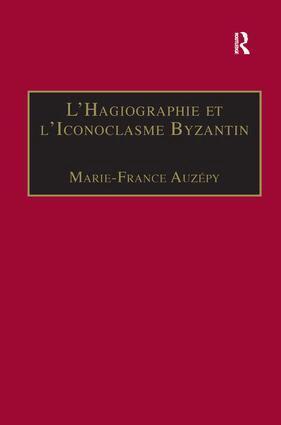
    L’Hagiographie et l’Iconoclasme Byzantin

    Le cas de la Vie d’Étienne le Jeune

    AvMarie-France Auzépy

    Inbunden, Franska, 1999

    Del i serien Birmingham Byzantine and Ottoman Studies

    750 kr

    Beställningsvara. Skickas inom 5-8 vardagar. Fri frakt över 249 kr.

    Fler format och utgåvor

    E-bok

    926 kr

    E-bok

    926 kr

    Beskrivning

    The period of Byzantine Iconoclasm remains in many ways a 'Dark Age'. With this volume Marie-France Auzépy continues her fundamental re-examination of one of the key sources for the time, the Life of Stephen the Younger. Previously in this series she has published a new edition, translation and commentary on the text; the present work aims to establish a solid methodology for reading a hagiographical text as a historical source, and includes a systematic literary analysis to illuminate how the author treated his subject matter. Amongst other conclusions, this study shows how the historical presentation of the period was consciously shaped by the patriarchate of Constantinople in the years 787-815, in order to affirm the independence of the Church from imperial power.

    Produktinformation

    • Utgivningsdatum:1999-12-24
    • Mått:156 x 234 x 29 mm
    • Vikt:840 g
    • Format:Inbunden
    • Språk:Franska
    • Serie:Birmingham Byzantine and Ottoman Studies
    • Antal sidor:368
    • Förlag:Taylor & Francis Ltd
    • ISBN:9780860788126

    Utforska kategorier

    • Religion: allmänt inom Filosofi och religion
    • Biografier inom Biografier
    • Kristendom inom Filosofi och religion

    Mer om författaren

    Marie-France Auzépy

    Recensioner i media

    ’...Auzépy’s conclusions are significant...no future study of Iconoclasm should ignore her work.’ Speculum (April 2002) '...explores as never before the historiography of the first period of iconoclasm, not only making clear what we knew already...but also with great learning exploring ways, both literary and historical, in which one of our most important sources for eighth-century Byzantium can be made to bring light to bear on a period in which much must remain obscure.' Journal of Theological Studies '... magisterial... Auzépy’s persuasive findings deepen Byzantinists' grasp of iconoclasm's complex history and offer a rich case study for bridging hagiography and historiography. No research library should be without this volume or Auzépy’s critical edition (with French translation, in the same series).' Religious Studies Review '... Auzépy's monographs are a great step forward.' Byzantine and Modern Greek Studies 'Marie-France Auzépy's book is iconoclastic, one has to admit, but it paints a renewed picture of the Empire and the Church over a good three quarter of a century (730-809). Her historical approach is first rate. Moreover, the demonstration is exciting: there is nothing more edifying than hagiography by such a pen.' Le Moyen Age

    Innehållsförteckning

    • Contents: Introduction; Première Partie: Hagiographie et Propagande; Introduction; Un auteur très présent: Prologue et épilogue (§2, §77, §78); Vous et moi, nous; Nous et eux; Les marques d’énonciation organisatrices de la narration; Les marques d’émotion: interjections et interrogations; Conclusion; Les lois du genre: Vita et Passio: La Vita; La Passio; Une Passio de l’habit monastique; Conclusion; La narration: Catégories narratives et composition: Récit, discours; histoire; La Vita: du bon usage de l’Histoire; La Passio: le conflit; Conclusion; Le récit: temps et consécution: Le temps; Les actions; Conclusion; Le style: épithètes et comparaisons: Les épithètes; Les comparaisons; Conclusion; L’etablissement du modéle hagiographique: La vie d’Étienne; L’intervention de l’hagiographe; L’établissement d’un modèle; Deuxième partie: stratigraphie de l’hagiographie: Introduction: Un patchwork: La répartition des remplois; L’actualisation des remplois; La prédominance des Actes de Nicée II: Les concordances entre la Vie d’Étienne le Jeune et les Actes; La place des remplois des Actes dans la Vie d’Étienne le Jeune; Conclusion; Un texte polémique: L’Adversus Constantinum Caballinum: Les correspondances entre la Vie d’Étienne le Jeune et les deux versions de l’Adversus CC; La relation entre la Vie d’Étienne le Jeune et la version longue de l’Adversus CC; Conclusion; Les homélies d’André de Crète: Les dossier de Patapios; L’enkômion de Thérapôn; Conclusion; Les autres textes hagiographiques; Cyrille de Scythopolis et la Vie d’Euthyme; La Narratio du Pseudo Nil d’Ancyre; L’influence de pièces de l’hagiographie perse; Conclusion; Les textes liturgiques; L’Office de la Prise d’Habit; Les hymnes; Conclusion; Les remplois digégétiques: la Vie d’Auxence; Vie d’Auxence et Vie d’Etienne le Jeune: les deux récits; Le deux personnages; Conclusion; Influences et milieu