• Fri frakt över 249 kr
  • •
  • Snabba leveranser
  • •
  • Billiga böcker
Kundservice

Du är på sajten för privatpersoner.

Företag, bibliotek eller offentlig verksamhet?

Du handlar på classic.bokus.com, där alla dina funktioner finns intakta.
Till classic.bokus.com
Bokus logotyp. Gå till startsidan.
  • Erbjudanden
  • Nyheter
  • Student
  • Topplistor
  • Barn & ungdom
  • Bokus Play
  • E-böcker
  • Pocketböcker
  • Spel & pussel

10% rabatt på allt med kod NYSTART10 →

Sidfot

Mina sidor

    Hjälp

    • Kundservice
    • Vanliga frågor och svar
    • Frakt och leverans
    • Retur vid ångerrätt
    • Reklamera vara
    • Betalning
    • Köpvillkor
    • Allmänna villkor
    • Information om webbplatsens tillgänglighet

    Om Bokus

    • Om oss
    • Pressrum
    • För studenter
    • För företag
    • För bibliotek och offentlig verksamhet
    • För leverantörer
    • Hållbarhet

    Populärt

    • Aktuella erbjudanden
    • Presentkort
    • Studentlitteratur
    • Nya böcker
    • Topplistor
    • Signerade böcker
    • Engelska böcker

    Inspiration

    • Boktips
    • BookTok
    • Populära bokserier
    • Barnbokskaraktärer
    • Populära författare
    Logotyp för Bokus
    Följ oss på Facebook (extern länk)Följ oss på Instagram (extern länk)Följ oss på YouTube (extern länk)Följ oss på TikTok (extern länk)
    bokus @ CookiesAnpassa cookiesIntegritetspolicyKöpvillkor
    Till Citymail hemsida (extern länk)Till Budbee hemsida (extern länk)Till Postnord hemsida (extern länk)Till Schenker hemsida (extern länk)Till Early Bird hemsida (extern länk)Till Walleys hemsida (extern länk)
    1. Filosofi och religion
    2. Religion och tro
    3. Andra religioner och trosföreställningar
    4. Östasiatiska religioner

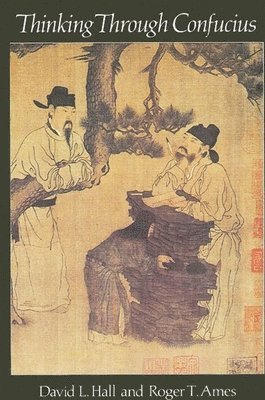
    Thinking Through Confucius

    AvDavid L. Hall,Roger T. Ames

    Häftad, Engelska, 1987

    488 kr

    Beställningsvara. Skickas inom 5-8 vardagar. Fri frakt över 249 kr.

    Beskrivning

    Thinking Through Confucius critically interprets the conceptual structure underlying Confucius' philosophical reflections. It also investigates "thinking," or "philosophy" from the perspective of Confucius. Perhaps the philosophical question of our time is "what is philosophy". The authors suggest that an examination of the Chinese philosophy may provide an alternative definition of philosophy that can be used to address some of the pressing issues of the Western cultural tradition. This book finds an appropriate language for the interpretation of traditional Chinese philosophical thought - a language which is relatively free from the bias and presuppositions of Western philosophy.

    Produktinformation

    • Utgivningsdatum:1987-10-15
    • Mått:152 x 229 x 29 mm
    • Vikt:499 g
    • Format:Häftad
    • Språk:Engelska
    • Antal sidor:416
    • Förlag:State University of New York Press
    • ISBN:9780887063770

    Utforska kategorier

    • Östasiatiska religioner inom Filosofi och religion
    • Filosofiska discipliner inom Filosofi och religion

    Mer om författaren

    David L. Hall is Professor of Philosophy at the University of Texas, and author of The Civilization of Experience: A Whiteheadian Theory of Culture; The Uncertain Phoenix: Adventures Toward a Post-Cultural Sensibility; and Eros and Irony: A Prelude to Philosophical Anarchism. Roger T. Ames , Professor of Philosophy at the University of Hawaii, is author of The Art of Rulership: A Study of Ancient Chinese Political Thought, a translator of classical Chinese texts, and assistant editor of Philosophy East and West.

    Recensioner i media

    "What I like most about this work is two-fold: the rigor and novelty of its methodological conception and the cogency and inciveness of its execution." — Lik Kuen Tong"This is a daring book. It develops an unconventional interpretation of Confucius, one which the authors claim is truer to the traditional texts than anything ever written in English (including Wiley and Fingarette). The authors build their case from a close reading of the key Chinese terms of Confucian texts. This painstakingly detailed analysis is always readable, never too technical for a reader who knows no Chinese, but convincing by its thoroughness and its sensitivity." — George Allan

    Innehållsförteckning

    • Foreword by Robert Cummings NevillePrefaceWade-Giles/Pinyin Conversion TableApologiaSome Uncommon Assumptions1 An Immanental Cosmos2 Conceptual Polarity3 Tradition as Interpretive ContextI "At fifteen my heart-and-mind were set upon learning...."1 The Conditions of Thinking2 Learning (hsüeh)3 Reflecting (ssu)4 Realizing (chih)4.1 Living up to One's Word (hsin)5 An Illustration: The Book of SongsII "... at thirty I took my stance...."1 Personal Articulation: Some Alternatives2 The Mutuality of Ritual Action (li) and Signification (yi )2.1 Ritual Action (li)2.2 Signification (yi)3 The Authoritative Person3.1 Jen as Authoritative Person3.2 Jen and Person Making4 An Illustration: Po I and Shu Ch'iIII "... at forty I was no longer of two minds... "1 The Primacy of Aesthetic Order1.1 The Aesthetics of Praxis2 The Masses (min)2.1 Min and Jen 2.2 Individual Absoluteness and Individual Relativity3 Effecting Sociopolitical Order (cheng )3.1 Cheng and Cheng 3.2 Law and Ritual Action: Hsing, Fa and Li 3.3 Shame (ch'ih) and Guilt (tsui)4 The Exemplary Person: Chün Tzu 4.1 The Chün Tzu as ModelIV "... at fifty I realized the ming of t'ien... "1 The Question of Confucius' Cosmology2 T'ien and T'ien Ming 2.1 The Historical Development of T'ien 2.2 T'ien and Transcendence2.3 T'ien Ming 3 Te 3.1 A Characterization of Te from Early Literature3.2 Te A Philosophic Reconstruction4 Tao 4.1 Confucius' Understanding of Tao 4.2 Tao and Transcendence5 T'ien-jen 5.1 Field and Focus5.2 Confucian Religiousness6 Confucian Cosmology as Ars ContextualisV "... at sixty my ear was attuned... "1 The Centrality of Communication2 Sage (sheng jen ): A Philological and Literary Analysi3 The Sage and the Ordering of Names (cheng ming)3.1 The Aesthetic Character of Classical Chinese3.2 Cheng Ming : The Ordering of Names3.3 The Sage as Virtuoso4 Shu : The Unifying Thread4.1 Shu as "Deference"4.2 The Language of Deference5 The Sage as Master of Communication5.1 Allusive Analogy5.2 Thinking as AttunementVI "... and at seventy I could give my heart-and-mind free rein without overstepping the mark."1 The Failings of Confucius2 Opportunities for Engagement3 Invitation to a FutureEndnotesBibliography of Works CitedFinding List for Passages from the AnalectsIndex