• Fri frakt över 249 kr
  • •
  • Snabba leveranser
  • •
  • Billiga böcker
Kundservice

Du är på sajten för privatpersoner.

Företag, bibliotek eller offentlig verksamhet?

Du handlar på classic.bokus.com, där alla dina funktioner finns intakta.
Till classic.bokus.com
Bokus logotyp. Gå till startsidan.
  • Erbjudanden
  • Nyheter
  • Student
  • Topplistor
  • Barn & ungdom
  • Bokus Play
  • E-böcker
  • Pocketböcker
  • Spel & pussel

10% rabatt på allt med kod: NYSTART10 →

Sidfot

Mina sidor

    Hjälp

    • Kundservice
    • Vanliga frågor och svar
    • Frakt och leverans
    • Retur vid ångerrätt
    • Reklamera vara
    • Betalning
    • Köpvillkor
    • Allmänna villkor
    • Information om webbplatsens tillgänglighet

    Om Bokus

    • Om oss
    • Pressrum
    • För studenter
    • För företag
    • För bibliotek och offentlig verksamhet
    • För leverantörer
    • Hållbarhet

    Populärt

    • Aktuella erbjudanden
    • Presentkort
    • Studentlitteratur
    • Nya böcker
    • Topplistor
    • Signerade böcker
    • Engelska böcker

    Inspiration

    • Boktips
    • BookTok
    • Populära bokserier
    • Barnbokskaraktärer
    • Populära författare
    Logotyp för Bokus
    Följ oss på Facebook (extern länk)Följ oss på Instagram (extern länk)Följ oss på YouTube (extern länk)Följ oss på TikTok (extern länk)
    bokus @ CookiesAnpassa cookiesIntegritetspolicyKöpvillkor
    Till Citymail hemsida (extern länk)Till Budbee hemsida (extern länk)Till Postnord hemsida (extern länk)Till Schenker hemsida (extern länk)Till Early Bird hemsida (extern länk)Till Walleys hemsida (extern länk)
    1. Samhälle och politik
    2. Samhälle och kultur
    3. Sociala grupper och identitet
    4. Genusvetenskap

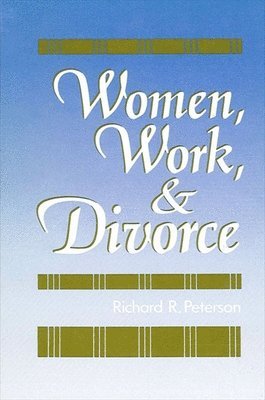
    Women, Work, and Divorce

    AvRichard R. Peterson

    Häftad, Engelska, 1989

    Del i serien SUNY series in the Sociology of Work and Organizations

    382 kr

    Tillfälligt slut

    Beskrivning

    This book considers how women cope with the economic hardship which accompanies divorce, using national longitudinal data on a generation of women in the United States. These women came of age at a time when they were expected to give priority to family roles over work roles. Yet by the time many of them were divorced in the 1970s, with the climate of changing perceptions of gender roles, women were expected to work, and were unprepared for the economic disruption caused by divorce. Peterson analyzes the experiences of women drawing upon sociological and economic approaches to the study of labor market outcomes, and of life-cycle events. He shows how over the long term most divorced women can make at least a partial recovery, but divorced women with children have a more difficult time making work adjustments, and experience greater economic deprivation. Given the continuing high rates of divorce, Peterson's findings highlight the importance of work rather than marriage for women's economic security.

    Produktinformation

    • Utgivningsdatum:1989-03-16
    • Mått:153 x 229 x 10 mm
    • Vikt:272 g
    • Format:Häftad
    • Språk:Engelska
    • Serie:SUNY series in the Sociology of Work and Organizations
    • Antal sidor:179
    • Förlag:State University of New York Press
    • ISBN:9780887068591

    Utforska kategorier

    • Genusvetenskap inom Samhälle och politik

    Mer om författaren

    Richard R. Peterson is Assistant Director of the Center for Applied Social Science Research at New York University.

    Recensioner i media

    "Many have speculated about reasons for labor market participation differences and wage differences between women with different marital statuses. Divorced women rather than married women have higher rates of participation and higher wages...Peterson's careful analysis that employs national data provides the explanation. The analysis is absolutely first rate. There are some unexpected results: there is a polarization of divorced women; children have less impact on earnings than expected; divorce improves the position of women who work...the book has important findings, some of which will be controversial." — Judith Blau, University of North Carolina at Chapel Hill

    Innehållsförteckning

    • List of Tables List of Figures Acknowledgments1. Women, Work, and Divorce 1.1 Introduction1.2 The Effect of Divorce on Women's Economic Well-Being1.3 The Effect of Divorce on Women's Position in the Labor Market1.4 Models of Women's Labor Market Outcomes: Individualist Approaches1.5 Models of Women's Labor Market Outcomes: Labor Market Segmentation Approaches1.6 Overview of the Study2. Data and Measurement Issues 2.1 The National Longitudinal Surveys of Mature Women2.2 Sample Attrition, 1967-19772.3 Description of Measures Employed in the Study2.4 Analytic Issues3. Overview of the Economic Effects of Divorce 3.1 Labor Supply3.2 Personal Income3.3 Economic Well-Being3.4 Summary4. Labor Supply 4.1 Introduction: Economic Models of Labor Supply4.2 Effects of Marital History on Labor Force Participation4.3 Explanatory Models of Labor Force Participation4.4 Effects of Marital History on Annual Hours4.5 Explanatory Models of Annual Hours4.6 Summary of Findings on Labor Supply5. Personal Income 5.1 Effects of Marital History on Annual Earnings5.2 Explanatory Models of Annual Earnings5.3 Effects of Marital History on Hourly Wage5.4 Explanatory Models of Hourly Wage5.5 Discussion of Findings on Personal Income6. Determinants of Economic Well-Being Among Divorced Women 6.1 Introduction: Developments of a Life-Course Model6.2 Explanatory Model of Income/Needs Ratio6.3 Explanatory Model of Poverty Status6.4 Explanatory Model of Public Assistance Status6.5 Discussion of Findings on Economic Well-Being7. Conclusion 7.1 Individualist and Structural Explanations of Labor Market Outcomes7.2 Work-Family Linkages over the Life Course7.3 The Long-Term Consequences of Divorce7.4 Changing Gender Roles - A Generation in TransitionAppendix A: Description of Variables Employed in the Analysis A.1 Dependent VariablesA.2 RaceA.3 Labor Market Segmentation VariablesA.4 Human Capital VariablesA.5 Family Role VariablesA.6 Work Orientation MeasureAppendix B: Descriptive Statistics for Variables Employed in the Analysis Appendix C: Descriptive Statistics for Variables by Marital History Appendix D: Corrections for Selection BiasD.1 Selection Bias with Respect to Labor Force ParticipationD.2 Selection Bias with Respect to Marital HistoryNotes Bibliography Index