• Fri frakt över 249 kr
  • •
  • Snabba leveranser
  • •
  • Billiga böcker
Kundservice

Du är på sajten för privatpersoner.

Företag, bibliotek eller offentlig verksamhet?

Du handlar på classic.bokus.com, där alla dina funktioner finns intakta.
Till classic.bokus.com
Bokus logotyp. Gå till startsidan.
  • Erbjudanden
  • Nyheter
  • Student
  • Topplistor
  • Barn & ungdom
  • Bokus Play
  • E-böcker
  • Pocketböcker
  • Spel & pussel

10% rabatt på allt med kod NYSTART10 →

Sidfot

Mina sidor

    Hjälp

    • Kundservice
    • Vanliga frågor och svar
    • Frakt och leverans
    • Retur vid ångerrätt
    • Reklamera vara
    • Betalning
    • Köpvillkor
    • Allmänna villkor
    • Information om webbplatsens tillgänglighet

    Om Bokus

    • Om oss
    • Pressrum
    • För studenter
    • För företag
    • För bibliotek och offentlig verksamhet
    • För leverantörer
    • Hållbarhet

    Populärt

    • Aktuella erbjudanden
    • Presentkort
    • Studentlitteratur
    • Nya böcker
    • Topplistor
    • Signerade böcker
    • Engelska böcker

    Inspiration

    • Boktips
    • BookTok
    • Populära bokserier
    • Barnbokskaraktärer
    • Populära författare
    Logotyp för Bokus
    Följ oss på Facebook (extern länk)Följ oss på Instagram (extern länk)Följ oss på YouTube (extern länk)Följ oss på TikTok (extern länk)
    bokus @ CookiesAnpassa cookiesIntegritetspolicyKöpvillkor
    Till Citymail hemsida (extern länk)Till Budbee hemsida (extern länk)Till Postnord hemsida (extern länk)Till Schenker hemsida (extern länk)Till Early Bird hemsida (extern länk)Till Walleys hemsida (extern länk)
    1. Data och IT
    2. Systemvetenskap och AI

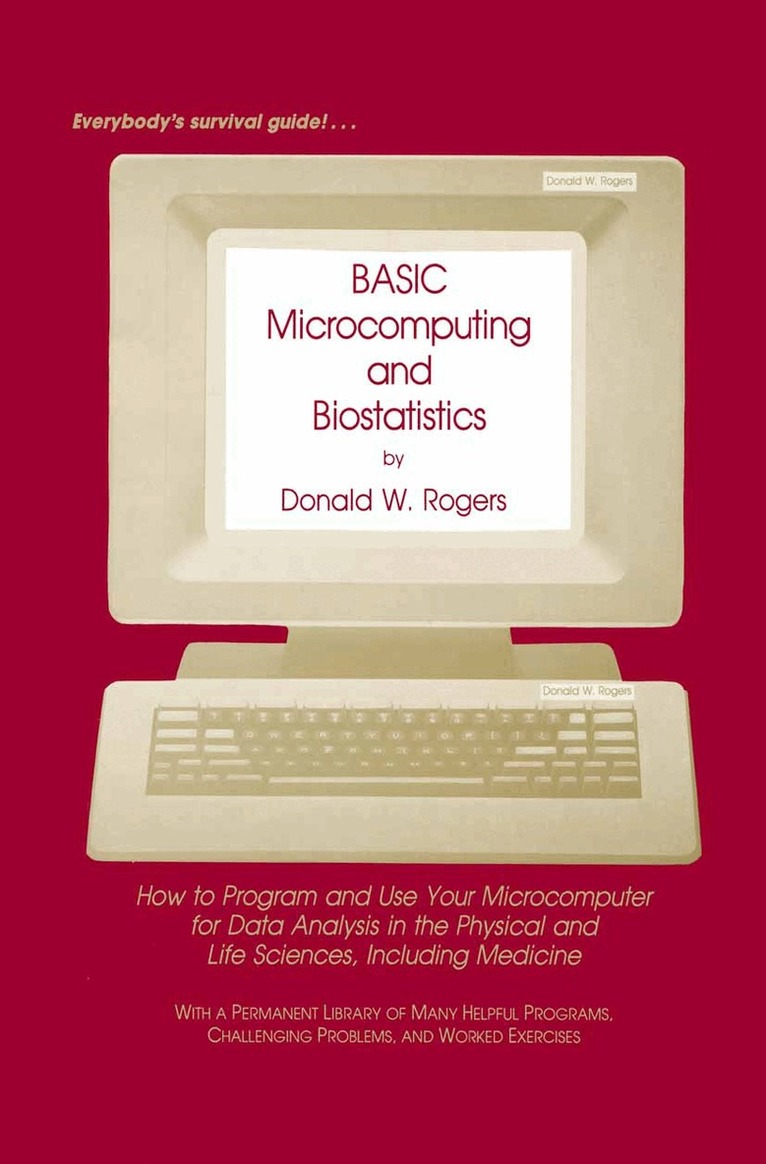
    BASIC Microcomputing and Biostatistics

    How to Program and Use Your Microcomputer for Data Analysis in the Physical and Life Sciences, Including Medicine

    AvDonald W. Rogers

    Inbunden, Engelska, 1983

    1 086 kr

    Beställningsvara. Skickas inom 10-15 vardagar. Fri frakt över 249 kr.

    Fler format och utgåvor

    E-bok

    1 413 kr

    Häftad

    1 086 kr

    Beskrivning

    BASIC Microcomputing and Biostatistics is designed as the first practical "how to" guide to both computer programming in BASIC and the statis­ tical data processing techniques needed to analyze experimental, clinical, and other numerical data. It provides a small vocabulary of essential com­ puter statements and shows how they are used to solve problems in the bio­ logical, physical, and medical sciences. No mathematical background be­ yond algebra and an inkling of the principles of calculus is assumed. All more advanced mathematical techniques are developed from "scratch" before they are used. The computing language is BASIC, a high-level lan­ guage that is easy to learn and widely available using time-sharing com­ puter systems and personal microcomputers. The strategy of the book is to present computer programming at the outset and to use it throughout. BASIC is developed in a way reminiscent of graded readers used in human languages; the first programs are so sim­ ple that they can be read almost without an introduction to the language. Each program thereafter contains new vocabulary and one or more con­ cepts, explained in the text, not used in the previous ones. By gradual stages, the reader can progress from programs that do nothing more than count from one to ten to sophisticated programs for nonlinear curve fitting, matrix algebra, and multiple regression. There are 33 working programs and, except for the introductory ones, each performs a useful function in everyday data processing problems encountered by the experimentalist in many diverse fields.

    Produktinformation

    • Utgivningsdatum:1983-09-12
    • Mått:155 x 235 x 18 mm
    • Vikt:587 g
    • Format:Inbunden
    • Språk:Engelska
    • Antal sidor:276
    • Upplaga:1983
    • Förlag:Humana Press Inc.
    • ISBN:9780896030152

    Utforska kategorier

    • Systemvetenskap och AI inom Data och IT
    • Biologi inom Naturvetenskap och teknik
    • Naturvetenskap:allmänt inom Naturvetenskap och teknik

    Innehållsförteckning

    • 1. Introduction to the Computer.- Computer Memory.- Data Processing.- Control.- Kinds of Computers.- Batch Processing and Time Sharing.- When Not to Use the Computer.- Problems.- 2. Understanding Experimental Error and Averages.- Significant Figures.- Sources of Errors.- Truncation Errors.- Propagation of Errors.- Euler’s Theorem and Variations.- Geometrical Interpretation of Euler’s Theorem.- Measures of Central Tendency.- The Means of Means.- Problems.- 3. Understanding Experimental Data Dispersion.- The Average Deviation.- The Mean Deviation Independent of the Sign.- Population Parameters and Sample Statistics.- The Standard Deviation.- Relative Standard Deviation.- Grouped Data and Frequency Distributions.- Cumulative Frequency Distributions.- Application: Dose-Response Curve.- Frequency Grouping and Pictorial Representation of Continuous Data.- Quartiles and Percentiles.- Skewness and Kurtosis.- Problems.- 4. Understanding Probability.- Simultaneous and Equally Acceptable Probabilities.- Application: Heredity.- The Urn Problem: Dependent Probabilities.- Conditional Probabilities.- Bayes’ Theorem.- Application of Bayes’ Theorem: Diagnosis.- Permutations.- Combinations.- The Binomial Coefficient.- Problems.- 5. Determining Probability Distributions.- Tree Diagrams.- Application: Heredity.- Modal and Mean Scores.- The Binomial Distribution.- Effect of p on the Binomial Distribution.- Mean Occurrences for Data Groups of N.- Application: Evaluation of a New Treatment.- Problems.- 6. Using the Poisson Distribution.- Application: Disintegration of Radioactive Nuclei.- Mean, Variance, and Standard Deviation for the Poisson Distribution.- Computer Graphics.- Problems.- 7. Using the Normal Distribution.- Relative Areas by Computer Graphics.- Normalization of theGaussian Distribution.- The Mean, Variance, and Standard Deviation of the Gaussian Distribution.- The Standard Normal Deviate, z.- Computer Integration.- Tabulated Areas Under the Normal Curve.- The Most Common Areas and Limits on z.- One- and Two-Tailed Tests.- Problems.- 8. Determining Probabilities: How to Apply the Chi Square Test and the Student’s t-Test.- Chi Square Detection of a Biased Coin.- Degrees of Freedom.- The Central Limit Theorem.- Situations in Which the Population Mean Is Known But Not Its Standard Deviation.- Determination of Confidence Limits When No Population Parameters Are Known.- Confidence Limits.- The Difference Between Means.- Problems.- 9. Finding Linear Functions: The Principle of Least Squares.- Linear Functions.- Least Squares Treatment of Linear Functions Passing Through the Origin.- The Correlation Coefficient.- Applications.- Least Squares with Two Minimization Parameters.- Simultaneous Equations.- Solution of Simultaneous Equations by Cramer’s Rule.- The Determinant of the Coefficients.- Cramer’s Rule.- Solution of the Normal Equations for Linear Curve Fitting by Cramer’s Rule.- Problems.- 10. Fitting Nonlinear Curves.- Boyle’s Law.- Exponential Decay.- Second-Order Reaction Kinetics.- Enzyme-Catalyzed Reactions.- Unlimited Population Growth.- Limited Population Growth.- Nearly Linear Functions.- Problems.- 11. Solving Simultaneous Equations.- Simultaneous Equations in Matrix Form.- Matrix Algebra.- Simultaneous Equations by Matrix Inversion.- Simultaneous Analysis.- Multiple Regression.- Least Squares Treatment of Multiple Regression.- Problems.- Answers to Problems.