• Fri frakt över 249 kr
  • •
  • Snabba leveranser
  • •
  • Billiga böcker
Kundservice

Du är på sajten för privatpersoner.

Företag, bibliotek eller offentlig verksamhet?

Du handlar på classic.bokus.com, där alla dina funktioner finns intakta.
Till classic.bokus.com
Bokus logotyp. Gå till startsidan.
  • Erbjudanden
  • Nyheter
  • Student
  • Topplistor
  • Barn & ungdom
  • Bokus Play
  • E-böcker
  • Pocketböcker
  • Spel & pussel

10% studentrabatt med kod TERM26

Sidfot

Mina sidor

    Hjälp

    • Kundservice
    • Vanliga frågor och svar
    • Frakt och leverans
    • Retur vid ångerrätt
    • Reklamera vara
    • Betalning
    • Köpvillkor
    • Allmänna villkor
    • Information om webbplatsens tillgänglighet

    Om Bokus

    • Om oss
    • Pressrum
    • För studenter
    • För företag
    • För bibliotek och offentlig verksamhet
    • För leverantörer
    • Hållbarhet

    Populärt

    • Aktuella erbjudanden
    • Presentkort
    • Studentlitteratur
    • Nya böcker
    • Topplistor
    • Signerade böcker
    • Engelska böcker

    Inspiration

    • Boktips
    • BookTok
    • Populära bokserier
    • Barnbokskaraktärer
    • Populära författare
    Logotyp för Bokus
    Följ oss på Facebook (extern länk)Följ oss på Instagram (extern länk)Följ oss på YouTube (extern länk)Följ oss på TikTok (extern länk)
    bokus @ CookiesAnpassa cookiesIntegritetspolicyKöpvillkor
    Till Citymail hemsida (extern länk)Till Budbee hemsida (extern länk)Till Postnord hemsida (extern länk)Till Schenker hemsida (extern länk)Till Early Bird hemsida (extern länk)Till Walleys hemsida (extern länk)
    1. Naturvetenskap och teknik
    2. Matematik och naturvetenskap
    3. Naturvetenskap:allmänt
    4. Populärvetenskap

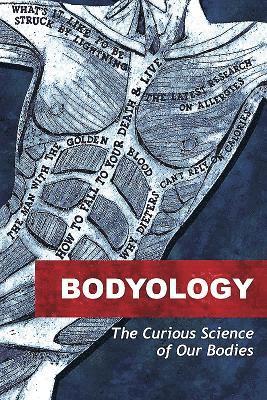
    Bodyology

    The Curious Science of Our Bodies

    AvRose George,Rhodri Marsden

    Häftad, Engelska, 2018

    180 kr

    Beställningsvara. Skickas inom 5-8 vardagar. Fri frakt över 249 kr.

    Beskrivning

    Ever wondered what it’s like to be hit by lightning or to lose your sense of smell? Heard about the woman saved by bee stings — or the window cleaner who survived a 400ft fall?Originally written for the Wellcome charity, 16 stories by leading science writers explore the mysteries of the human body. Learn about everything from diets to allergies, hair colour to rare blood, and from allergies to remote surgery.Contents What’s it like to be struck by lightning? - Charlotte Huff Why do we colour hair? - Rebecca Guenard The man with the golden blood - Penny Bailey Why dieters can’t rely on calories - Cynthia Graber 3D printers can now make body parts - Ian Birrell How to fall from a skyscraper and live to tell the tale - Neil Steinberg The quest to explain miscarriages - Holly Cave Can the power of thought outwit ageing? - Jo Marchant Seeking a ‘cure’ for male baldness - Rhodri Marsden How bee stings saved a woman’s life - Christie Wilcox The global trend for ‘kangaroo’ babies - Lena Corner What it means to lose your sense of smell - Emma Young The doctor aiming to end eye pain - Bryn Nelson Could allergies be a defence against noxious chemicals? - Carl Zimmer Why pharma may be going slow on the male pill - Andy Extance How virtual reality headsets aid remote surgery - Jo Marchant Shhh! What exactly is the menopause? - Rose George ExtractWhat it's like to be struck by lightning?Sometimes they’ll keep the clothing, the strips of shirt or trousers that weren’t cut away and discarded by the doctors and nurses. They’ll tell and retell their story at family gatherings and online, sharing pictures and news reports of survivals like their own or far bigger tragedies. The video of a tourist hit on a Brazilian beach or the Texan struck dead while out running. The 65 people killed during four stormy days in Bangladesh.Only by piecing together the bystander reports, the singed clothing and the burnt skin can survivors start to construct their own picture of the possible trajectory of the electrical current, one that can approach 200 million volts and travel at one-third of the speed of light.In this way, Jaime Santana’s family have stitched together some of what happened that Saturday afternoon in April 2016, through his injuries, burnt clothing and, most of all, his shredded broad-brimmed straw hat. “It looks like somebody threw a cannonball through it,” says Sydney Vail, a trauma surgeon in Phoenix, Arizona, who helped care for Jaime after he arrived by ambulance, his heart having been shocked several times along the way as paramedics struggled to stabilise its rhythm.Jaime had been horse-riding with his brother-in-law and two others in the mountains behind his brother-in-law’s home outside Phoenix, a frequent weekend pastime. Dark clouds had formed, heading in their direction, so the group had started back.They had nearly reached the house when it happened, says Alejandro Torres, Jaime’s brother-in-law. He paces out the area involved, the landscape dotted with small creosote bushes just behind his acre of property. In the distance, the desert mountains rise, rippled chocolate-brown peaks against the horizon.The riders had witnessed quite a bit of lightning as they neared Alejandro’s house, enough that they had commented on the dramatic zigzags across the sky. But scarcely a drop of rain had fallen as they approached the horse corrals, just several hundred feet from the back of the property.Alejandro doesn’t think he was knocked out for long. When he regained consciousness, he was lying face down on the ground, sore all over. His horse was gone.The two other riders appeared shaken but unharmed. Alejandro went looking for Jaime, who he found on the other side of his fallen horse. Alejandro brushed against the horse’s legs as he walked passed. They felt hard, like metal, he says, punctuating his English with some Spanish.He reached Jaime: “I see smoke coming up – that’s when I got scared.” Flames were coming off of Jaime’s chest.

    Produktinformation

    • Utgivningsdatum:2018-04-26
    • Mått:129 x 198 x 21 mm
    • Vikt:260 g
    • Format:Häftad
    • Språk:Engelska
    • Antal sidor:272
    • Förlag:Canbury Press
    • ISBN:9780995497863

    Utforska kategorier

    • Populärvetenskap inom Naturvetenskap och teknik
    • Hälsa inom Hälsa och familj

    Mer om författaren

    Top science writers report for Mosaic Science, a project founded by the health charity Wellcome to promote high-quality science writing.Mosaic has published dozens of stories exploring the science people care about. Canbury Press has curated these long-form stories into two books, Bodyology: The Curious Science of Our Bodies (ISBN  9780995497863) and Brainology: The Curious Science of Our Minds  (ISBN 9781912454006).The leading authors who contributed to Brainology are: John Walsh, Sam Wong, Geoff Watts, Linda Geddes, Olivia Solon, Jo Marchant, Andrea Volpe, Srinath Perur, Will Storr, Lucy Maddox, Shayla Love, Gaia Vince, Jo Marchant, John Osborne, Alex O'Brien, Emma Young

    Recensioner i media

    'It's a good sign when you pick up a book intending to read one chapter and end up reading three. It's very moreish. This is because it's made up of short, self-contained articles, originally published on a website. Often an edited collection of articles by different authors suggests a boring read, but here the articles are good pieces of journalism with plenty to interest the reader. The topics are all vaguely human body related, but thankfully not all medical (not my favourite subject) - so, for example, as well as stories of a person cured of Lyme disease by bee stings or a piece on miscarriages we get topics like the effects on the body of being struck by lightning or falling from a high place. Even some more explicitly health-related matters, such as the impact of losing your sense of smell, were engaging enough to get me past my medical squeamishness.'

    Innehållsförteckning

    • INTRODUCTION. All of the stories in this book were first published by Mosaic (mosaicscience.com), created by Wellcome, a global charitable foundation dedicated to improving human health. They are republished here under a Creative Commons licence. Some edits have been made, including to the headlines1. WHAT'S IT LIKE TO BE STRUCK BY LIGHTNING? By piecing together bystander reports, the singed clothing and the burnt skin can survivors start to construct their own picture of the possible trajectory of an electrical current that can approach 200 million volts and travel at a third of the speed of light2. WHY AND HOW WE COLOUR HAIR. Humans have dyed for thousands of years, experimenting with ever-changing, often vicious, formulas to achieve a new hair colour. Along with ammonia, hair dye formulas contain hydrogen peroxide, a bleaching agent. Peroxide reacts with the melanin, removing natural colour3. THE MAN WITH THE GOLDEN BLOOD. On the trail of rare blood, who gives it and why? Some blood can be as rare as 1 in 100 million. The majority of the 342 blood group antigens belong to one of 35 blood group systems. Finding a donor and getting rare blood to a patient in crisis can be a desperate race4. WHY DIETERS CAN'T RELY ON CALORIES. More than two-thirds of American adults are overweight or obese. One in three are attempting to lose weight by dieting. Yet there is ample evidence that diets rarely lead to sustained weight loss. Because a calorie isn’t just a calorie – and that's the problem5. COULD 3D PRINTERS MAKE BODY PARTS? Stories of lives devastated by conflict or disease are all too common across low-income countries. Lack of an arm or leg can be tough anywhere, but for people in poorer parts of the planet, with so much less support and infrastructure, it is especially challenging6. HOW TO FALL 400FT AND LIVE TO TELL THE TALE. Alcides Moreno was a window washer in New York City when he fell from the 47-storey Solow Tower. Falls are the second leading cause of death by injury in the US, after car accidents. Yet we are more fearful of terror attacks, shark bites and Ebola outbreaks7. MISCARRIAGE: THE RACE TO PROTECT PREGNANCIES. The unspecified genetic abnormalities that are said to underlie most miscarriages have various possible causes. The risk of random genetic faults in the fetus seems to increase with the age of the mother. There are several other potential causes8. CAN MEDITATION OUTWIT AGEING? Whereas Western biomedicine has traditionally shunned the study of personal emotions, a team led by a Nobel Prize-winning biochemist at the University of California, San Francisco, is engaged in serious studies hinting that meditation might slow ageing and lengthen life9. SEEKING A 'CURE' FOR MALE BALDNESS. Androgenetic alopecia is the medical term for inherited hair loss, and while it affects both men and women, it’s men whose anxieties tend to be targeted by the hair loss industry. It’s estimated to be worth at least $1.5 billion a year worldwide10. HOW BEE STINGS SAVED A WOMAN'S LIFE. ‘I moved to California to die.’ Ellie Lobel was 27 when she was bitten by a tick and contracted Lyme disease. She had 15 years of pain and disability. And she was not yet 45 when she decided to give up fighting for survival. A swarm of Africanised bees saved her11. THE GLOBAL TREND FOR 'KANGAROO' BABIES. Kangaroo Mother Care (KMC) is the brainchild of Colombian paediatrician Edgar Rey, who introduced it to the Instituto Materno Infantil in 1978. It was an idea born out of desperation. Death rates and infection levels dropped immediately12. WHAT IT'S LIKE TO LOSE YOUR SENSE OF SMELL. People who can no longer smell – following an accident or illness – report a strong sense of loss, with impacts on their lives they could never have imagined. Smell is not ranked highly among our senses – until it's gone (as many with Covid have found)13. THE DOCTOR AIMING TO END SEVERE EYE PAIN. At 82, Boston ophthalmologist Perry Rosenthal has become the nerve centre of a small but growing network of researchers and clinicians seeking out new explanations for the often jarring disconnect between brutal symptoms and a lack of clear signs14. ALLERGIES — A DEFENCE AGAINST NOXIOUS CHEMICALS? Allergens include latex, gold, pollen, penicillin, insect venom, peanuts, papayas, jellyfish stings, perfume, eggs, house mites, pecans, salmon, beef and nickel. Why? At Yale School of Medicine, Ruslan Medzhitov has a theory15. WHY BIG PHARMA MAY BE GOING SLOW ON THE MALE PILL. Researchers are as confident as they can be that they’re close to overcoming the scientific barriers. Now, the multimillion-dollar question seems to be: Who is actually going to make the male pill happen?16. HOW VIRTUAL REALITY IS AIDING REMOTE SURGERY. A 54-year-old surgeon at Panamerican University in Mexico City, he’s on a mission to bring virtual reality into the operating room, using the high-tech distraction technique to carry out surgeries normally requiring powerful painkillers and sedatives17. SHHH! BUT WHAT EXACTLY IS THE MENOPAUSE? A few things science doesn’t know about the menopause: what it’s for, how it works and how best to treat it. After the age of 40, the ovaries begin to secrete less oestrogen, and... this causes 'the body to behave differently'. One woman investigatedACKNOWLEDGEMENTS. The stories in this book were originally published by Wellcome on mosaicscience.com. Canbury Press thanks: Charlotte Huff, Chrissie Giles, Rob Reddick, Francine Almash, Charlie Hall, Rebecca Guenard, Peta Bell, Kirsty Strawbridge, Penny Bailey, Madeleine Penny, Lowri Daniels plus