E-bok, Engelska, 2023
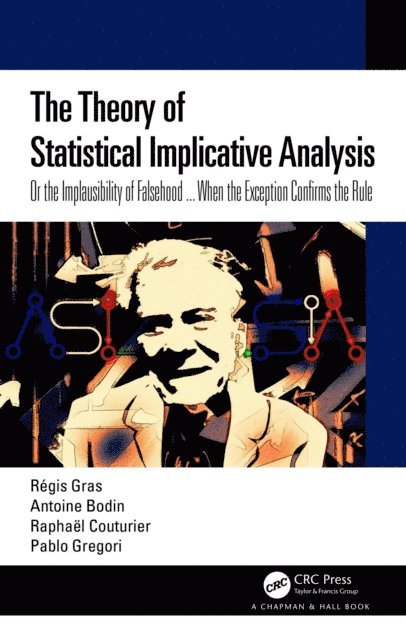
Theory of Statistical Implicative Analysis
Av Pablo Gregori, Raphael Couturier, Antoine Bodin, Regis Gras
1000 kr
Läs direkt i Bokus Reader – eller ladda ned till din enhet (PDF kräver ofta zoom och scroll på små skärmar).
Beskrivning
This book summarizes the methods and concepts of Statistical Implicative Analysis (SIA), created by Régis Gras in the 1980s to study, in a new way, the behavioural responses of French pupils to mathematics tests. Using a multidimensional, non-symmetrical data analysis method, SIA crosses a set of subjects or objects with a set of variables. It effectively complements traditional correlational and psychometric methods.
SIA, through its various extensions, is today presented as a broad Artificial Intelligence method aimed at extracting trends and possible causalities in the form of rules, from a set of variables. It is based on the unlikeliness of the existence of these relationships, i.e. on the relative weakness of their counter-examples compared to what chance alone would produce. It establishes a dual topological relationship between the set of subjects and the set of variables. Many applications of this approach, driving forces or crucibles for the development of SIA, have concerned and still concern various fields such as didactics, evaluation and assessment, psychology, sociology, medicine, biology, economics, art history, and others.
Key Features:
- Presents the foundations and representations of SIA
- Provides extensions of variable sets and subjects
- Includes a bonus exercise
Produktinformation
- Utgivningsdatum: 2023-11-29
- Språk: Engelska
- Filformat: PDF
- Kopieringsskydd: LCP
- ISBN: 9781003813026
- Förlag: CRC Press
Utforska kategorier
Betyg & recensioner
0 recensioner
Inga recensioner tillgängliga.