• Fri frakt över 249 kr
  • •
  • Snabba leveranser
  • •
  • Billiga böcker
Kundservice

Du är på sajten för privatpersoner.

Företag, bibliotek eller offentlig verksamhet?

Du handlar på classic.bokus.com, där alla dina funktioner finns intakta.
Till classic.bokus.com
Bokus logotyp. Gå till startsidan.
  • Erbjudanden
  • Nyheter
  • Student
  • Topplistor
  • Barn & ungdom
  • Bokus Play
  • E-böcker
  • Pocketböcker
  • Spel & pussel

Må bättre, för mindre! Upp till 50% rabatt på hälsoböcker

Sidfot

Mina sidor

    Hjälp

    • Kundservice
    • Vanliga frågor och svar
    • Frakt och leverans
    • Retur vid ångerrätt
    • Reklamera vara
    • Betalning
    • Köpvillkor
    • Allmänna villkor
    • Information om webbplatsens tillgänglighet

    Om Bokus

    • Om oss
    • Pressrum
    • För studenter
    • För företag
    • För bibliotek och offentlig verksamhet
    • För leverantörer
    • Hållbarhet

    Populärt

    • Aktuella erbjudanden
    • Presentkort
    • Studentlitteratur
    • Nya böcker
    • Topplistor
    • Signerade böcker
    • Engelska böcker

    Inspiration

    • Boktips
    • BookTok
    • Populära bokserier
    • Barnbokskaraktärer
    • Populära författare
    Logotyp för Bokus
    Följ oss på Facebook (extern länk)Följ oss på Instagram (extern länk)Följ oss på YouTube (extern länk)Följ oss på TikTok (extern länk)
    bokus @ CookiesAnpassa cookiesIntegritetspolicyKöpvillkor
    Till Citymail hemsida (extern länk)Till Budbee hemsida (extern länk)Till Postnord hemsida (extern länk)Till Schenker hemsida (extern länk)Till Early Bird hemsida (extern länk)Till Walleys hemsida (extern länk)
    1. Ekonomi och Ledarskap
    2. Nationalekonomi

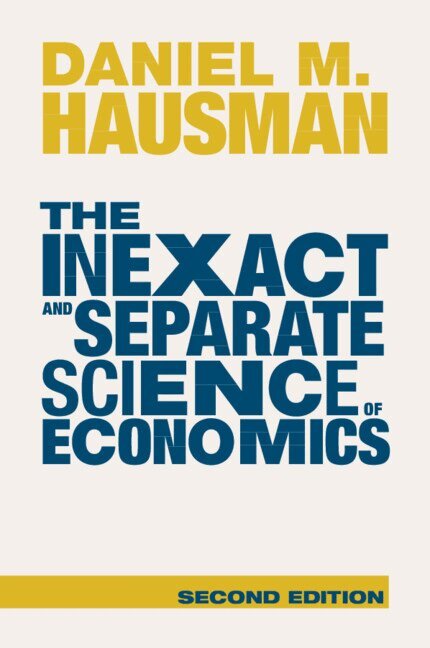
    The Inexact and Separate Science of Economics

    AvDaniel M. Hausman

    Häftad, Engelska, 2023

    482 kr

    Beställningsvara. Skickas inom 10-15 vardagar. Fri frakt över 249 kr.

    Fler format och utgåvor

    Inbunden

    1 482 kr

    Beskrivning

    Is economics a science? What distinguishes it from other sciences, both natural and social? Like many of the natural sciences, its theories are mathematically complex. Yet, like the social sciences, its 'laws' are largely everyday generalizations. Can such generalizations, which are far from universal truths, constitute a science? Does economics have a distinctive method? The first edition answered these and other questions about the scientific status of economics and its underlying methodology. In this fully updated new edition, Dan Hausman reflects on developments in both economics and the philosophy of economics over the last thirty years. It includes a new chapter on the methodology of macroeconomics, an updated discussion on the use of models, and new discussions causal inference and behavioural economics and their implications for theory appraisal. It is the perfect choice for a new generation of students studying the methodology of modern economics.

    Produktinformation

    • Utgivningsdatum:2023-06-08
    • Mått:151 x 228 x 28 mm
    • Vikt:790 g
    • Format:Häftad
    • Språk:Engelska
    • Antal sidor:552
    • Upplaga:2
    • Förlag:Cambridge University Press
    • ISBN:9781009320276

    Utforska kategorier

    • Nationalekonomi inom Ekonomi och Ledarskap
    • Filosofiska discipliner inom Filosofi och religion

    Mer om författaren

    Daniel M. Hausman is the author of seven books and nearly 200 essays on issues at the boundaries between economics and philosophy. With Michael McPherson, he is the co-founder and former editor of the journal, Economics and Philosophy. In 2009, Hausman was elected to the American Academy of Arts and Sciences.

    Innehållsförteckning

    • Part I. Introduction: Content, Structure and Strategy of Mainstream Economics: 1. Rationality, preferences and utility theory; 2. Demand and consumer choice; 3. Theory of the firm and general equilibrium; 4. Equilibrium theory and normative economics; 5. Equilibrium theory and macroeconomic models; 6. Models and theories in economics; 7. The structure and strategy of economics; 8. Overlapping generations: a case study; Part II. Theory Assessment: 9. Inexactness in economic theory; 10. Mill's deductive method and the assessment of economic hypotheses; 11. Methodological revolution; 12. Karl Popper, Imre Lakatos: Falsificationism and research programs; 13. The inexact deductive method; 14. Casting off dogmatism: the case of preference reversals; Part III. Conclusion: 15. Economic methodology; 16. Conclusions.