• Fri frakt över 249 kr
  • •
  • Snabba leveranser
  • •
  • Billiga böcker
Kundservice

Du är på sajten för privatpersoner.

Företag, bibliotek eller offentlig verksamhet?

Du handlar på classic.bokus.com, där alla dina funktioner finns intakta.
Till classic.bokus.com
Bokus logotyp. Gå till startsidan.
  • Erbjudanden
  • Nyheter
  • Student
  • Topplistor
  • Barn & ungdom
  • Bokus Play
  • E-böcker
  • Pocketböcker
  • Spel & pussel

10% studentrabatt med kod TERM26

Sidfot

Mina sidor

    Hjälp

    • Kundservice
    • Vanliga frågor och svar
    • Frakt och leverans
    • Retur vid ångerrätt
    • Reklamera vara
    • Betalning
    • Köpvillkor
    • Allmänna villkor
    • Information om webbplatsens tillgänglighet

    Om Bokus

    • Om oss
    • Pressrum
    • För studenter
    • För företag
    • För bibliotek och offentlig verksamhet
    • För leverantörer
    • Hållbarhet

    Populärt

    • Aktuella erbjudanden
    • Presentkort
    • Studentlitteratur
    • Nya böcker
    • Topplistor
    • Signerade böcker
    • Engelska böcker

    Inspiration

    • Boktips
    • BookTok
    • Populära bokserier
    • Barnbokskaraktärer
    • Populära författare
    Logotyp för Bokus
    Följ oss på Facebook (extern länk)Följ oss på Instagram (extern länk)Följ oss på YouTube (extern länk)Följ oss på TikTok (extern länk)
    bokus @ CookiesAnpassa cookiesIntegritetspolicyKöpvillkor
    Till Citymail hemsida (extern länk)Till Budbee hemsida (extern länk)Till Postnord hemsida (extern länk)Till Schenker hemsida (extern länk)Till Early Bird hemsida (extern länk)Till Walleys hemsida (extern länk)
    1. Juridik
    2. Särskilda rättsområden
    3. Miljö-, transport- och planeringsrätt
    4. Miljörätt

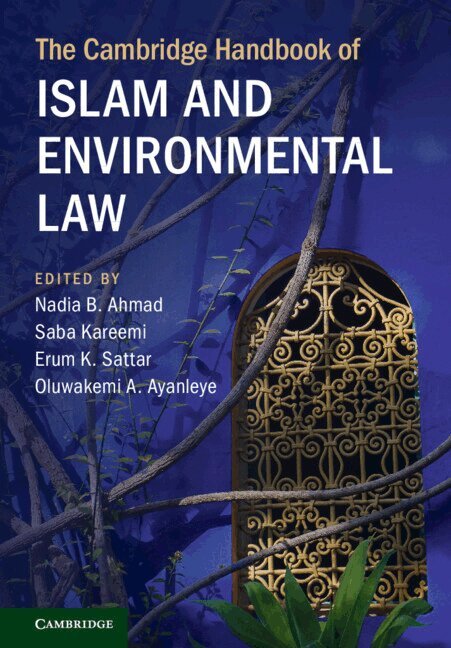
    The Cambridge Handbook of Islam and Environmental Law

    AvNadia B. Ahmad,Saba Kareemi

    Inbunden, Engelska, 2026

    Del i serien Cambridge Law Handbooks

    1 721 kr

    Beställningsvara. Skickas inom 10-15 vardagar. Fri frakt över 249 kr.

    Beskrivning

    Environmental challenges require diverse legal approaches. In this comprehensive handbook, global scholars examine the nexus of Islam and environmental law as a significant yet understudied framework for contemporary governance. Spanning fourteen centuries of legal development, Islamic environmental jurisprudence offers sophisticated approaches to stewardship, resource management, and climate policy. Chapters include detailed case studies of Pakistan's constitutional courts and Malaysia's environmental legislation, Gulf economic transitions, and water-governance innovations, all demonstrating how Islamic legal principles inform real-world environmental solutions. Each contribution provides a nuanced analysis of how traditional concepts adapt to contemporary contexts across diverse Muslim-majority nations. Timely and innovative, this handbook is an ideal resource for environmental law scholars, comparative legal researchers, policy analysts, and development practitioners working in multicultural contexts.

    Produktinformation

    • Utgivningsdatum:2026-05-14
    • Mått:183 x 260 x 25 mm
    • Vikt:918 g
    • Format:Inbunden
    • Språk:Engelska
    • Serie:Cambridge Law Handbooks
    • Antal sidor:368
    • Förlag:Cambridge University Press
    • ISBN:9781009332088

    Utforska kategorier

    • Miljörätt inom Juridik
    • Rättsvetenskap inom Juridik

    Mer om författaren

    Nadia B. Ahmad is a professor of law at Barry University and Ph.D. candidate at the Yale School of the Environment, where she served as a Kerry Fellow. Co-chair of the American Bar Association's Environmental Justice Task Force and co-author of Environmental Justice: Law, Policy, and Regulation, she specializes in energy siting, environmental protection and climate justice advocacy. Saba Kareemi is a Pakistani Canadian legal scholar and lawyer specializing in Islamic law, corporate law, and constitutional law. She has taught at the Asian Institute of Management in the Philippines, Pakistan College of Law, and Westminster International University in Tashkent. She holds an LL.M. from the University of Toronto and LLB from the International Islamic University, Islamabad. Erum K. Sattar is a lecturer at Tufts University with degrees from Harvard Law School and the University of London and is a member of the bar of England and Wales and the Honourable Society of Lincoln's Inn. Her interdisciplinary research examines the impact of water governance and trans-boundary water sharing on food production, livelihoods and migration requiring legal and institutional adaptation structures globally. Her scholarly articles and book chapters have appeared in leading academic publications. Oluwakemi A. Ayanleye is a law lecturer at Olabisi Onabanjo University, Nigeria, specializing in Islamic finance and sharia legal systems. She has published extensively on Islamic finance regulation, presented at Harvard Law School, and received TETFund research grants. Her interdisciplinary expertise spans Islamic law, intellectual property, and international trade law.

    Innehållsförteckning

    • Introduction Nadia Ahmad, Saba Kareemi, Oluwakemi Ayanleye and Erum Sattar; 1. Islamic policy of environmental conservation 1,500 years old – yet thoroughly modern Mohamed Arafa; 2. Acknowledging environmental externalities in Islamic legal critiques of corporate personhood Saba Kareemi; 3. Reconciling Islamic ethics, fossil fuel dependence, and climate change in the Middle East Saleem Ali; 4. Environmental stewardship in Islamic law: principles, institutions, and ecological governance in the Muslim world Mohammad Arafa; 5. Human dignity and environmental outcomes in Pakistan James May and Erin Daly; 6. Oil and institutional stasis in the Persian Gulf Mehran Kamrava; 7. Militarism, climate emissions and Islamic environmental ethics Nadia Ahmad; 8. An overview of the classical Islamic coastal and marine environmental law Hasan Khalilieh; 9. Property rights for landless agricultural workers and the flexibility of Hanafi land law jurisprudence: a solution for rural displacement? Erum Sattar; 10. A history of the Hima conservation system Lutfallah Gari; 11. The right to water in Islamic thought and manifestation in Islamic-Iranian cities Hooshmand Alizadeh and Golshan Hemati; 12. Intellectual property and the protection of the environment in Nigeria: lessons from Sharia Oluwakemi Ayanleye; 13. Implementing Islamic law to protect the environment: insights from Singapore, Malaysia, and Indonesia Shazny Ramlan; 14. Redefining Islamic 'good life:' environmental Maqasid in the post-carbon world Wardah Alkatiri; 15. Islamic legal perspectives on Genetically Modified Food (GMF) Anke Iman Bouzenita; 16. Shiekh Asim Farooq vs. Federation of Pakistan Jawad Hassan; 17. Al-Meezan: a covenant for the Earth İbrahim Özdemir; 18. Towards environmental sustainability: a reflection on Islamic Epistemologies and models for sustainable development Nematullah Azizi; 19. Arabic treatises on environmental pollution Lutfallah Gari; 20. Islamic environmental law revisited as a sub-discipline of environmental justice: empowering community-led compliance in Muslim countries Ridoan Karim; 21. Animal rights in Islam Sarra Tlili; 22. Islamic finance and environmental law Dalal Aassouli and Damilola S. Olawuyi; 23. Fossil divestment / geoengineering Imam Saffet Abid Catovic; 24. The protection of the basic natural resources and man under Islamic law: a new tool for sustainable development and greening of the environment Mohamed Arafa; 25. Faith based approaches to environmental law Nadia Ahmad; 26. Charting the future of Islamic environmental law in an age of planetary crisis Nadia Ahmad, Saba Kareemi, Oluwakemi Ayanleye and Erum Sattar.