• Fri frakt över 249 kr
  • •
  • Snabba leveranser
  • •
  • Billiga böcker
Kundservice

Du är på sajten för privatpersoner.

Företag, bibliotek eller offentlig verksamhet?

Du handlar på classic.bokus.com, där alla dina funktioner finns intakta.
Till classic.bokus.com
Bokus logotyp. Gå till startsidan.
  • Erbjudanden
  • Nyheter
  • Student
  • Topplistor
  • Barn & ungdom
  • Bokus Play
  • E-böcker
  • Pocketböcker
  • Spel & pussel

Må bättre, för mindre! Upp till 50% rabatt på hälsoböcker

Sidfot

Mina sidor

    Hjälp

    • Kundservice
    • Vanliga frågor och svar
    • Frakt och leverans
    • Retur vid ångerrätt
    • Reklamera vara
    • Betalning
    • Köpvillkor
    • Allmänna villkor
    • Information om webbplatsens tillgänglighet

    Om Bokus

    • Om oss
    • Pressrum
    • För studenter
    • För företag
    • För bibliotek och offentlig verksamhet
    • För leverantörer
    • Hållbarhet

    Populärt

    • Aktuella erbjudanden
    • Presentkort
    • Studentlitteratur
    • Nya böcker
    • Topplistor
    • Signerade böcker
    • Engelska böcker

    Inspiration

    • Boktips
    • BookTok
    • Populära bokserier
    • Barnbokskaraktärer
    • Populära författare
    Logotyp för Bokus
    Följ oss på Facebook (extern länk)Följ oss på Instagram (extern länk)Följ oss på YouTube (extern länk)Följ oss på TikTok (extern länk)
    bokus @ CookiesAnpassa cookiesIntegritetspolicyKöpvillkor
    Till Citymail hemsida (extern länk)Till Budbee hemsida (extern länk)Till Postnord hemsida (extern länk)Till Schenker hemsida (extern länk)Till Early Bird hemsida (extern länk)Till Walleys hemsida (extern länk)
    1. Juridik
    2. Rättsvetenskap
    3. Rättshistoria

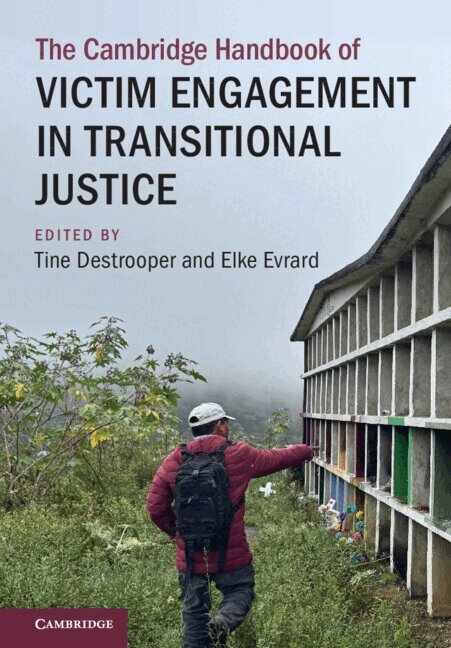
    The Cambridge Handbook of Victim Engagement in Transitional Justice

    AvTine Destrooper,Elke Evrard

    Inbunden, Engelska, 2026

    Del i serien Cambridge Law Handbooks

    1 721 kr

    Beställningsvara. Skickas inom 10-15 vardagar. Fri frakt över 249 kr.

    Beskrivning

    How have victims shaped - and reshaped - transitional justice? This volume introduces a novel framework for tracing and interpreting the evolving trajectories of victim-survivor engagement across different phases of grassroots activism, institutional participation, and various forms of resistance. Drawing on a diverse range of empirical case studies from across the globe, the handbook provides both a historical analysis of victims' evolving roles in (formal, informal, and everyday) transitional justice processes and a comparative perspective on the realities of victim engagement today - highlighting increasingly intersecting justice struggles and the porous boundaries of transitional justice. Written for students, scholars, practitioners, and policymakers in transitional justice, human rights, international law, peacebuilding, and social movements, this interdisciplinary resource draws on innovative, on-the-ground practices and the protagonism of victims to foster conceptual and methodological innovation for a forward-looking reimagination of victim-led justice after large-scale violence.

    Produktinformation

    • Utgivningsdatum:2026-03-05
    • Mått:183 x 260 x 23 mm
    • Vikt:817 g
    • Format:Inbunden
    • Språk:Engelska
    • Serie:Cambridge Law Handbooks
    • Antal sidor:346
    • Förlag:Cambridge University Press
    • ISBN:9781009671422

    Utforska kategorier

    • Rättshistoria inom Juridik
    • Folkrätt inom Juridik

    Mer om författaren

    Tine Destrooper is Professor of Transitional Justice at Ghent University. She has published extensively in various leading journals and recently edited Transitional Justice in Aparadigmatic Contexts (with Line Gissel and Kerstin Carlson). Her work has been supported by two European Research Council grants and two Marie Skłodowska-Curie Fellowships, and she was recently a Fulbright Fellow at Columbia University. Elke Evrard is a postdoctoral researcher at Ghent University. Her research on transitional justice has appeared in leading peer-reviewed journals. She contributes to scholarly and public engagement through invited lectures, teaching, and her role as managing editor of the Journal of Human Rights Practice. She was recently awarded a grant by the Research Foundation – Flanders.

    Innehållsförteckning

    • Introduction: tracing victim engagement across different spaces and moments in time Tine Destrooper and Elke Evrard; Part I. Generations of Victim Engagement: 1. Seeking the missing: relatives' and activists' protagonism in the search for Chile's disappeared Mauricio Carrasco and Cath Collins; 2. Victimhood, agency and the mobilisation of empathy Cheryl Lawther; 3. Victim engagement in reparations and the role of conflict-related classifications Thorsten Bonacker; 4. Exploring relational agency in collective mobilization for justice: Saturday Mothers Movement in Turkey Güneş Daşlı; 5. Searching for the disappeared: victim participation, recognition and procedural justice – lessons learnt from Colombia and El Salvador Mina Rauschenbach and Briony Jones; 6. Formal participation, de facto exclusion? The impact of transitional justice standardisation in Uganda for affected communities and victims Thomas Obel Hansen; 7. Why now, to what end and how? A victim-oriented examination of the ICC Office of the prosecutor's policy on complementarity and cooperation Miracle Chinwenmeri Uche; 8. Beyond the extraordinary chambers in the courts of Cambodia: tracing the nexus between Buddhist justice and formal transitional justice approaches Fangyi Li; 9. Truth processes and victim participation in the United States of America: an examination of Maryland and California Brianne McGonigle Leyh; 10. Reparations as resistance Luke Moffett; 11. storying participation: memoir, victim engagement, and 'quiet' transitional justice Lauren Dempster and Kevin Hearty; 12. Victim mobilisation as transformative local process after mass violence: families of the missing in Nepal Simon Robins and Ram Kumar Bhandari; 13. Breaking the mould? Social movements and the 'ideal victim' of conflict-related sexual and gender-based violence in Colombia's transitional justice Daniela Suárez Vargas; 14. Archives of desire: listening to bottom-up consultations on the design of transitional justice mechanisms in Sri Lanka Chulani Kodikara; Part II. Intersecting Justice Struggles and How to Understand Them: 15. Intersecting injustices: diasporic (dis-)engagement in Syrian justice struggles Mina Ibrahim, Maria Hartmann and Susanne Buckley-Zistel; 16. Lots to gain and little to lose: mobilising transitional justice as a means to connect various justice struggles in the Democratic Republic of the Congo Kim Baudewijns; 17. Bridging the gap: transitional justice, victims, and business and human rights in Colombia Marta Paricio Montesinos; 18. Relational justice through meaningful participation in reparations processes Pamina Firchow and Lisa J. Laplante; 19. Victim's bottom-up participation through theatre of the oppressed in an aparadigmatic transitional justice context: The Case of Afghanistan Huma Saeed; 20. Participatory research in postwar El Salvador: co-creation of community history books with civil war survivors and local youth Adriana Alas, Amanda Grzyb and María Helia Rivera Castillo; 21 Technology for justice in Latin America: a (partial) account of the awkward interaction between technology and human rights in the quest for justice Michael Reed-Hurtado; Concluding thoughts: a future outlook on the study and practice of victim engagement in transitional justice Elke Evrard and Tine Destrooper.