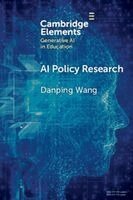
Häftad, Engelska, 2026
AI Policy Research
Av Danping Wang
246 kr
Kommande
Beskrivning
AI policy is proliferating in universities worldwide, yet AI policy research remains heavily descriptive, cataloguing institutional responses without examining the capacities required to make policy well. This Element argues that the missing capacity is AI policy literacy, the institutional capability to interrogate AI policy as text, discourse, and practice, and to attend to how authority, inequality, and time shape what governance can achieve. Drawing on policy sciences, applied linguistics, and decolonial thought, it develops a six-dimension framework for AI policy literacy. It also demonstrates that AI policies are simultaneously language policies, and that the absence of AI policy research in language education is creating deeper digital divides and knowledge injustices. Treating AI as cognitive infrastructure rather than a tool to be regulated, this Element proposes technodiversity as the orienting principle for governance aligned with universities' educational and social purposes. This title is also available as Open Access on Cambridge Core.
Produktinformation
- Utgivningsdatum: 2026-10-31
- Vikt: 250 g
- Format: Häftad
- Språk: Engelska
- Serie: Elements in Generative AI in Education
- Antal sidor: 75
- Förlag: Cambridge University Press
- ISBN: 9781009746755
Betyg & recensioner
0 recensioner
Inga recensioner tillgängliga.