• Fri frakt över 249 kr
  • •
  • Snabba leveranser
  • •
  • Billiga böcker
Kundservice

Du är på sajten för privatpersoner.

Företag, bibliotek eller offentlig verksamhet?

Du handlar på classic.bokus.com, där alla dina funktioner finns intakta.
Till classic.bokus.com
Bokus logotyp. Gå till startsidan.
  • Erbjudanden
  • Nyheter
  • Student
  • Topplistor
  • Barn & ungdom
  • Bokus Play
  • E-böcker
  • Pocketböcker
  • Spel & pussel

10% rabatt på allt med kod NYSTART10 →

Sidfot

Mina sidor

    Hjälp

    • Kundservice
    • Vanliga frågor och svar
    • Frakt och leverans
    • Retur vid ångerrätt
    • Reklamera vara
    • Betalning
    • Köpvillkor
    • Allmänna villkor
    • Information om webbplatsens tillgänglighet

    Om Bokus

    • Om oss
    • Pressrum
    • För studenter
    • För företag
    • För bibliotek och offentlig verksamhet
    • För leverantörer
    • Hållbarhet

    Populärt

    • Aktuella erbjudanden
    • Presentkort
    • Studentlitteratur
    • Nya böcker
    • Topplistor
    • Signerade böcker
    • Engelska böcker

    Inspiration

    • Boktips
    • BookTok
    • Populära bokserier
    • Barnbokskaraktärer
    • Populära författare
    Logotyp för Bokus
    Följ oss på Facebook (extern länk)Följ oss på Instagram (extern länk)Följ oss på YouTube (extern länk)Följ oss på TikTok (extern länk)
    bokus @ CookiesAnpassa cookiesIntegritetspolicyKöpvillkor
    Till Citymail hemsida (extern länk)Till Budbee hemsida (extern länk)Till Postnord hemsida (extern länk)Till Schenker hemsida (extern länk)Till Early Bird hemsida (extern länk)Till Walleys hemsida (extern länk)
    1. Naturvetenskap och teknik
    2. Matematik och naturvetenskap
    3. Matematik
    4. Matematisk statistik

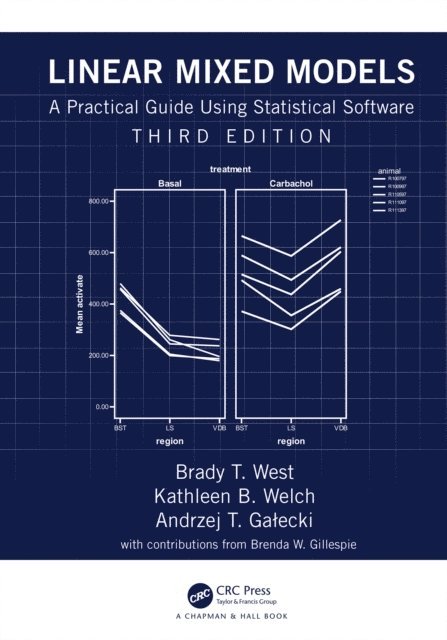
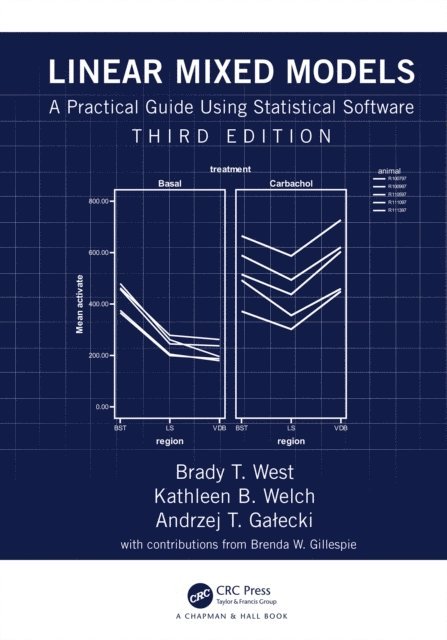
    Linear Mixed Models

    A Practical Guide Using Statistical Software

    AvBrady T. West,Kathleen B. Welch

    Inbunden, Engelska, 2022

    1 467 kr

    Beställningsvara. Skickas inom 10-15 vardagar. Fri frakt över 249 kr.

    Beskrivning

    Highly recommended by JASA, Technometrics, and other leading statistical journals, the first two editions of this bestseller showed how to easily perform complex linear mixed model (LMM) analyses via a variety of software programs. Linear Mixed Models: A Practical Guide Using Statistical Software, Third Edition continues to lead readers step-by-step through the process of fitting LMMs. The third edition provides a comprehensive update of the available tools for fitting linear mixed-effects models in the newest versions of SAS, SPSS, R, Stata, and HLM. All examples have been updated, with a focus on new tools for visualization of results and interpretation. New conceptual and theoretical developments in mixed-effects modeling have been included, and there is a new chapter on power analysis for mixed-effects models.Features:•Dedicates an entire chapter to the key theories underlying LMMs for clustered, longitudinal, and repeated measures data•Provides descriptions, explanations, and examples of software code necessary to fit LMMs in SAS, SPSS, R, Stata, and HLM•Contains detailed tables of estimates and results, allowing for easy comparisons across software procedures•Presents step-by-step analyses of real-world data sets that arise from a variety of research settings and study designs, including hypothesis testing, interpretation of results, and model diagnostics•Integrates software code in each chapter to compare the relative advantages and disadvantages of each package•Supplemented by a website with software code, datasets, additional documents, and updatesIdeal for anyone who uses software for statistical modeling, this book eliminates the need to read multiple software-specific texts by covering the most popular software programs for fitting LMMs in one handy guide. The authors illustrate the models and methods through real-world examples that enable comparisons of model-fitting options and results across the software procedures.

    Produktinformation

    • Utgivningsdatum:2022-06-24
    • Mått:178 x 254 x 36 mm
    • Vikt:980 g
    • Format:Inbunden
    • Språk:Engelska
    • Antal sidor:490
    • Upplaga:3
    • Förlag:Taylor & Francis Ltd
    • ISBN:9781032019321

    Utforska kategorier

    • Matematisk statistik inom Naturvetenskap och teknik
    • Affärsapplikationer inom Data och IT

    Mer om författaren

    Brady T. West is a research professor in the Survey Methodology Program, located within the Survey Research Center at the Institute for Social Research (ISR) on the University of Michigan-Ann Arbor (U-M) campus. He earned his PhD from the Michigan Program in Survey and Data Science (formerly the Michigan Program in Survey Methodology) in 2011. Before that, he received an MA in Applied Statistics from the U-M Statistics Department in 2002, being recognized as an Outstanding First-year Applied Masters student, and a BS in Statistics with Highest Honors and Highest Distinction from the U-M Statistics Department in 2001. His current research interests include total survey error / total data quality, responsive and adaptive survey design, interviewer effects, survey paradata, the analysis of complex sample survey data, and multilevel regression models for clustered and longitudinal data. He has developed short courses on statistical analysis using SAS, SPSS, R, Stata, and HLM, and regularly consults on the use of procedures in these software packages for the analysis of longitudinal and clustered data. The author or co-author of more than 180 peer-reviewed publications and three edited volumes on survey methodology, he is also a co-author of a book entitled Applied Survey Data Analysis (with Steven Heeringa and Patricia Berglund), the second edition of which was published by Chapman Hall in 2017. He lives in Dexter, Michigan with his wife Laura, his son Carter, and his daughter Everleigh.Kathy Welch is a retired former senior statistician and statistical software consultant at CSCAR (Consulting for Statistics, Computing & Analytics Research) at the University of Michigan, Ann Arbor. She received a B.A. in sociology (1969), an M.P.H. in epidemiology and health education (1975), and an M.S. in biostatistics (1984) from the University of Michigan (UM). During her career, she regularly consulted on the use of SAS, SPSS, Stata, and HLM for analysis of clustered and longitudinal data, taught a course on statistical software packages in the University of Michigan Department of Biostatistics, and taught short courses on SAS software. She also co-developed and co-taught a course on analysis of data from clustered and longitudinal studies at the School of Public Health at the University of Michigan.Andrzej Galecki is a research professor in the Division of Geriatric Medicine, Department of Internal Medicine, and Institute of Gerontology at the University of Michigan Medical School, and in the Department of Biostatistics at the University of Michigan School of Public Health. He received a M.Sc. in applied mathematics (1977) from the Technical University of Warsaw, Poland, and an M.D. (1981) from the Medical Academy of Warsaw. In 1985 he earned a Ph.D. in epidemiology from the Institute of Mother and Child Care in Warsaw (Poland). Since 1990, Dr. Galecki has collaborated with researchers in gerontology and geriatrics. His research interests lie in the development and application of statistical methods for analyzing correlated and over-dispersed data. He developed the SAS macro NLMEM for nonlinear mixed-effects models, specified as a solution of ordinary differential equations. His research (Galecki, 1994) on a general class of covariance structures for two or more within-subject factors is considered to be one of the very first approaches to the joint modeling of multiple outcomes. Examples of these structures have been implemented in SAS proc mixed and the MIXED command in SPSS. In 2015 he was selected as a Fellow of the American Statistical Association. He is also a co-author of more than 120 publications.Brenda Gillespie is the associate director of CSCAR (Consulting for Statistics, Computing & Analytics Research) and a research associate professor of Biostatistics at the University of Michigan, Ann Arbor. She received an A.B. in mathematics (1972) from Earlham College in Richmond, Indiana, an M.S. in statistics (1975) from The Ohio State University, and earned a Ph.D. in statistics (1989) from Temple University in Philadelphia, Pennsylvania. Dr. Gillespie has collaborated extensively with researchers in health-related fields, and has worked with mixed models as the primary statistician on the Collaborative Initial Glaucoma Treatment Study (CIGTS), the Dialysis Outcomes Practice Pattern Study (DOPPS), the Scientific Registry of Transplant Recipients (SRTR), the University of Michigan Dioxin Study, and at the Complementary and Alternative Medicine Research Center at the University of Michigan.

    Recensioner i media

    ". . . this book is perfect for readers who are looking for a quick reference to all kinds of situations in which LMMs are to be used. In the opinion of the reviewer, either this book or the Gałecki and Burzykowski (2013) book are a must for the practical statistician working with R. And the reviewer finds it helpful to have both on the shelf. For readers with a great need to incorporate novel data visualization approaches in their analyses and the need to improve result interpretation, the third edition is clearly superior to the second edition."~ Andreas Ziegler, Biometrics Journal"This book will definitively help researchers and statisticians reach a deeper understanding of linear mixed models and provides them with the resources to perform a proper analysis whatever their statistical software of choice."~ Célia Touraine, ISCB Book Reviews

    Innehållsförteckning

    • 1. Introduction2. Linear Mixed Models: An Overview3. Two-Level Models for Clustered Data: The Rat Pup Example4. Three-Level Models for Clustered Data5. Models for Repeated-Measures Data: The Rat Brain Example6. Random Coe□cient Models for Longitudinal Data: The Autism Example7. Models for Clustered Longitudinal Data: The Dental Veneer Example8. Models for Data with Crossed Random Factors: The SAT Score Example9. Power Analysis and Sample Size Calculations for Linear Mixed ModelsA. Statistical Software ResourcesB. Calculation of the Marginal Covariance MatrixC. Acronyms / Abbreviations