• Fri frakt över 249 kr
  • •
  • Snabba leveranser
  • •
  • Billiga böcker
Kundservice

Du är på sajten för privatpersoner.

Företag, bibliotek eller offentlig verksamhet?

Du handlar på classic.bokus.com, där alla dina funktioner finns intakta.
Till classic.bokus.com
Bokus logotyp. Gå till startsidan.
  • Erbjudanden
  • Student
  • Topplistor
  • Barn & ungdom
  • Bokus Play
  • E-böcker
  • Ljudböcker
  • Pocketböcker
  • Spel och pussel

Skapa nya rutiner – hälsoböcker upp till 50% →

Sidfot

Mina sidor

    Hjälp

    • Kundservice
    • Vanliga frågor och svar
    • Frakt och leverans
    • Retur vid ångerrätt
    • Reklamera vara
    • Betalning
    • Köpvillkor
    • Allmänna villkor
    • Information om webbplatsens tillgänglighet

    Om Bokus

    • Om oss
    • Pressrum
    • För studenter
    • För företag
    • För bibliotek och offentlig verksamhet
    • För leverantörer
    • Hållbarhet

    Populärt

    • Aktuella erbjudanden
    • Presentkort
    • Studentlitteratur
    • Nya böcker
    • Topplistor
    • Signerade böcker
    • Engelska böcker

    Inspiration

    • Boktips
    • BookTok
    • Barnbokskaraktärer
    • Populära författare
    Logotyp för Bokus
    Följ oss på Facebook (extern länk)Följ oss på Instagram (extern länk)Följ oss på YouTube (extern länk)Följ oss på TikTok (extern länk)
    bokus @ CookiesAnpassa cookiesIntegritetspolicyKöpvillkor
    Till Citymail hemsida (extern länk)Till Budbee hemsida (extern länk)Till Postnord hemsida (extern länk)Till Schenker hemsida (extern länk)Till Early Bird hemsida (extern länk)Till Walleys hemsida (extern länk)
    1. Juridik
    2. Särskilda rättsområden
    3. IT-rätt och kommunikationsrätt

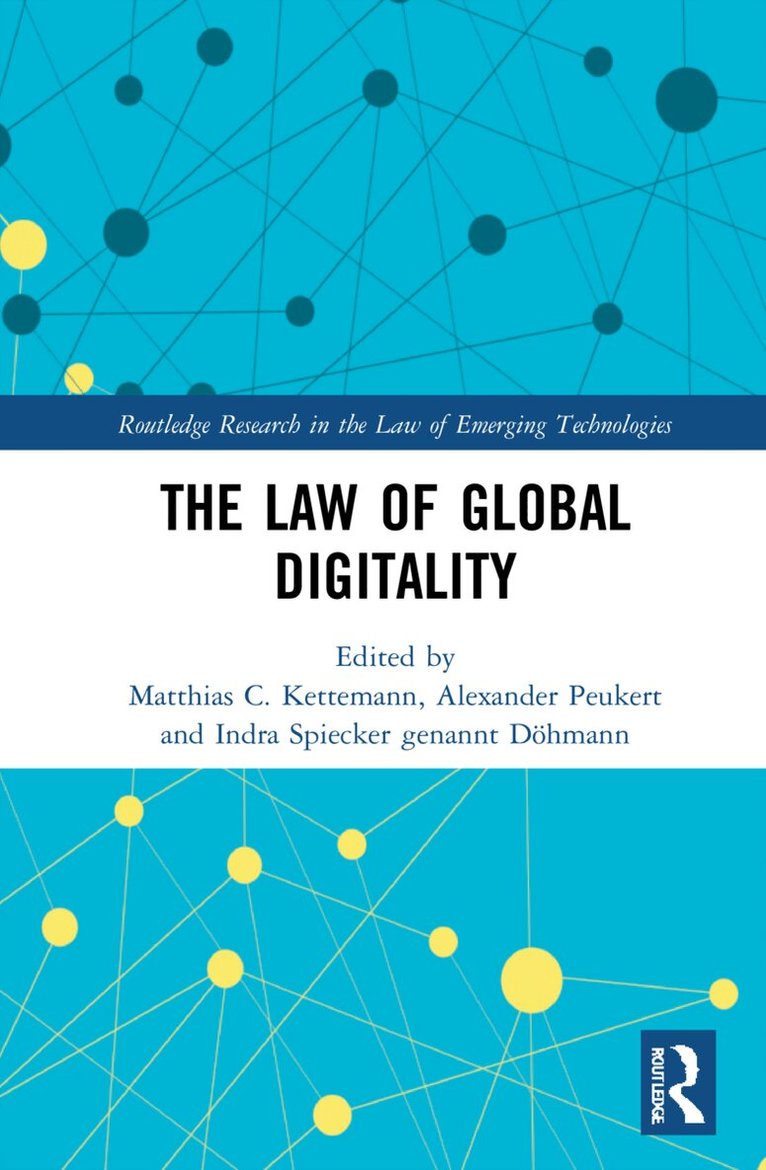
    Law of Global Digitality

    AvMatthias C. Kettemann,Alexander Peukert

    Inbunden, Engelska, 2022

    Del i serien Routledge Research in the Law of Emerging Technologies

    2 220 kr

    Beställningsvara. Skickas inom 10-15 vardagar. Fri frakt över 249 kr.

    Beskrivning

    The Internet is not an unchartered territory. On the Internet, norms matter. They interact, regulate, are contested and legitimated by multiple actors. But are they diverse and unstructured, or are they part of a recognizable order? And if the latter, what does this order look like?This collected volume explores these key questions while providing new perspectives on the role of law in times of digitality. The book compares six different areas of law that have been particularly exposed to global digitality, namely laws regulating consumer contracts, data protection, the media, financial markets, criminal activity and intellectual property law. By comparing how these very different areas of law have evolved with regard to cross-border online situations, the book considers whether cyberlaw is little more than "the law of the horse", or whether the law of global digitality is indeed special and, if so, what its characteristics across various areas of law are. The book brings together legal academics with expertise in how law has both reacted to and shaped cross-border, global Internet communication and their contributions consider whether it is possible to identify a particular mediality of law in the digital age.Examining whether a global law of digitality has truly emerged, this book will appeal to academics, students and practitioners of law examining the future of the law of digitality as it intersects with traditional categories of law.

    Produktinformation

    • Utgivningsdatum:2022-06-27
    • Mått:156 x 234 x 21 mm
    • Vikt:720 g
    • Format:Inbunden
    • Språk:Engelska
    • Serie:Routledge Research in the Law of Emerging Technologies
    • Antal sidor:255
    • Förlag:Taylor & Francis Ltd
    • ISBN:9781032073699

    Utforska kategorier

    • IT-rätt och kommunikationsrätt inom Juridik

    Mer om författaren

    Matthias C. Kettemann, LL.M. (Harvard), is Professor of Innovation, Theory and Philosophy of Law at the Department for Theory and Future of Law at the University of Innsbruck, and heads research programs and groups on digital law and platform governance at the Leibniz Institute for Media Research | Hans-Bredow-Institut (Hamburg) and the Humboldt Institute for Internet and Society (Berlin). Alexander Peukert is Professor of Civil and Commercial Law at the Faculty of Law at Goethe University Frankfurt am Main. Indra Spiecker gen. Döhmann, LL.M. (Georgetown University) holds the chair of Public and Administrative Law, especially Information Law, Environmental Law and Legal Theory at the Goethe-University of Frankfurt/Main in Germany. She is also Director of the Research Institute on Data Protection, Managing Director of the Institute of European Health Politics and Social Law, both at Goethe University of Frankfurt/Main, and also Principal Investigator with the Competence Center on IT-Security (KASTEL) at the Karlsruhe Institute of Technology (KIT). Professor Spiecker publishes in the entire field of constitutional and administrative law with a special focus on information law as well as technology law.

    Innehållsförteckning

    • List of Contributors Introduction: The Law of Global Digitality ALEXANDER PEUKERT AND MATTHIAS C. KETTEMANN 1 Context, Subject Matter and Aim of This Book 2 Chapter Overview2.1 Intellectual Property Law 2.2 Data Protection/Privacy2.3 Consumer Contract Law 2.4 Media Law 2.5 Financial Regulation and Criminal Law PART I Intellectual Property 1 Towards a Legal Methodology of Digitalisation: The Example of Digital Copyright Law THOMAS RIIS AND JENS SCHOVSBO 1 Introduction 1.1 Characteristics of Copyright Law 2 Digitalisation in Action 2.1 Legislating Digitalisation 2.1.1 New Subject-Matter: Sui Generis Regulation or Adaptation of Existing Rules? 2.1.2 Designing Flexibility 2.1.3 Assessment 2.2 Adjudicating Digitalisation 2.2.1 Online Exhaustion 2.2.2 Linking 2.3 Summing Up 3 Methodological Shifts in Legal Digitalisation 3.1 The Shift From Substantive Law to Procedural Law 3.2 The Shift Towards Globalisation 3.3 The Shift Towards Horizontally Based Law 3.4 The Shift From State-Enacted Law to Contract and Code 4 Final Remarks 2 Transnational Intellectual Property Governance on the Internet ALEXANDER PEUKERT1 Introduction 2 IPR Enforcement 2.1 Takedown Orders of Courts: De Iure and de Facto Effects2.2 Intermediaries’ Enforcement Measures 2.2.1 The Central Role of Intermediaries2.2.2 Intermediaries’ Enforcement Measures and Their Transnational Effect 2.2.2.1 Domain Name Registrars 2.2.2.2 Access Providers 2.2.2.3 Host Providers and Search Engines 2.2.2.4 Follow the Money: Advertising and Payment Services 2.2.3 Summary 3 Licensing IPRs 4 Conclusion PART II Data Protection/Privacy 3 The More the Merrier: A Dynamic Approach Learning From Prior Misgovernance in EU Data Protection Law INDRA SPIECKER GEN. DÖHMANN1 Introduction 2 The Historical Approach to Data Protection Law—An Overview 2.1 Goals 2.2 Instruments3 Reaction of Today’s Data Protection Law to the Challenges of Global Digitality 3.1 Core Regulatory Goals 3.1.1 Data Protection as a Safeguard of Democracy 3.1.2 Power Asymmetry 3.1.3 GDPR as Unifier 3.2 Core Regulatory Instrumental Approach 3.2.1 Precautionary Principle Versus Risk-Based Approach and the Concept of Technological Neutrality 3.2.2 Data Protection Law as Consumer Protection and Fair Competition Law 3.3 Content Regulation 3.3.1 Enforcement Deficit 3.3.2 Territorial Scope 3.3.3 Enforcement of the Enforcement 3.3.4 Internet Regulation 4 Conclusion and Outlook 4 Giving the Invisible Hand a Relatively Free Hand: Data Privacy in the US and the Unfortunate, but Lawful, Commodification of the Person RONALD J. KROTOSZYNSKI, JR.1 Introduction: The Myriad Cultural and Legal Difficulties of Safeguarding Informational Self-Determination Against Non-Government Actors in the US 2 The First Amendment Will Make Comprehensive Personal Data Protection Laws Difficult to Enact and Enforce 13 The Patchwork Quilt of Federal Statutory Privacy Protections and the First Amendment 4 Constitutional Data Privacy Rights, the State Action Doctrine, and the Scope of Constitutional Rights in the US 5 Why Does the US Lack Strong, General Personal Data Protections Against Non-Governmental Entities?6 Global Digitality, Personal Data Protection, and "The Law of the Horse" 7 Conclusion PART IIIConsumer Contract Law 5 The Challenge of Globalized Online Commerce for U.S. Contract and Consumer Law CHRISTOPHER G. BRADLEY1 Introduction 2 A Ragged Patchwork of Consumer Protection Laws, Regulations, and Institutions 3 The Limits of Technological Approaches to Consumer Protection 4 Not Ready to Restate: A Rejected Consumer Contracting "Bargain" 5 Marshaling Doctrinal, Regulatory, and Technological Protections for Consumers in the Digital Age 6 Conclusion 6 Paradigms of EU Consumer Law in the Digital Age FELIX MAULTZSCH1 Introduction 2 The Market-Centred Approach to Contract Law 3 International Jurisdiction and Conflict of Laws: Connecting Factors 4 Extra-Territorial Application of EU Consumer Law 5 Trends in Substantive EU Sales Law 6 Alternative Means of Dispute Resolution and Enforcement of Consumer Rights 7 Private Governance by Contract and Technology 8 Conclusions PART IVMedia Law 7 Law of Digitality: Media Law—U.S. Perspectives ELLEN P. GOODMAN1 Digital Platform Disclosure Obligations for Political and Commercial Advertising 2 Digital Platform Disclosure Obligations for Deep Fakes and Bots 3 Government Access Obligations Under the First Amendment’s Public Forum Doctrine 4 Digital Platforms’ Exposure to Liability as Publishers and Distributors 4.1 Judicial Interpretations of Section 230 4.1.1 Herrick v. Grindr LLC 4.1.2 Force v. Facebook, Inc. 4.2 Territorial Question 5 Intermediary Liability Reform Proposals 5.1 Ex Post Duty of Care5.2 Creating Genre-Based Statutory Limitations 5.3 Creating Narrow Content-Based Carve-Outs 5.4 Expanding the Definition of Content "Development"5.5 "Political Neutrality" Mandates 5.6 Section 230 as Regulatory Leverage 5.7 Requiring User-Identification Procedures 5.8 Knowledge-Based Standard 6 U.S. Initiatives to Counter Disinformation 8 European Media Law in Times of Digitality STEPHAN DREYER, MATTHIAS C. KETTEMANN, WOLFGANG SCHULZ AND THERESA JOSEPHINE SEIPP1 Introduction 2 The European Communication Order in Digitality 2.1 Media-Specific Legal Instruments 2.2 Sector-Specific Legal Framework 2.2.1 E-Commerce and Electronic Services Law 2.2.2 Telecommunications Law 2.2.3 Contract and Consumer Protection-Related Specifications in the Media Sector 2.2.4 Special Provisions Under Competition Law 2.2.5 Special Provisions Applicable to Intellectual Property Rights 3 Reform of Europe’s Media Order 3.1 The Year of Reform 3.2 Digital Services 3.3 Digital Markets 4 Conclusions PART VFinancial Regulation and Criminal Law 9 Regulating Virtual Currencies ROLAND BROEMEL1 Digital Currencies as a Form of Global Digitality 1.1 Digital Currencies as a Digital Phenomenon 1.1.1 Blockchain as a Specifically Digital Technology 1.1.2 Added Value of Payment Data 1.1.2.1 Data as a Commercial Factor: Cross-Market Business Models 1.1.2.2 Impact on Digital Payment Services and Currencies 1.1.2.3 Development of Digital Ecosystems in Digital Financial Services 1.1.2.4 Ecosystems in Digital Currencies 1.2 Virtual Currencies as a Specifically Global Phenomenon 1.2.1 Technical Factors of Globality 1.2.2 Economic Factors of Globality 1.2.2.1 Exchange Costs and Economic Functions of Money 1.2.2.2 Part of the Network Instead of a Geographical Area 2 Legal Framework of Virtual Currencies 2.1 Adaptation 2.1.1 Banking Supervision Law 2.1.1.1 Virtual Currency as Category: Unit of Account or Crypto Value 2.1.1.2 Regulatory Assessment of the Activities 2.1.2 Stablecoins as E-Money? 2.1.3 Civil Law 2.1.4 Securities Law 2.2 Specific Challenges of Digitality 2.2.1 Prevention of Money Laundering and Financing of Terrorism 2.2.2 Investor and Consumer Protection in the Issuing of Virtual Currencies 2.2.3 Specific Regulatory Requirements for "Value-Referenced Tokens" 3 Conclusion 10 Criminal Law of Global Digitality: Characteristics and Critique of Cybercrime Law BEATRICE BRUNHÖBER1 Defining Criminal Law of Global Digitality 1.1 From Computer Crime to Cybercrime 1.2 Cybercrime Offenses 2 The Challenging Global Dimension of Cybercrime 2.1 Global Challenges 2.2 Approaches to Addressing Global Cybercrime 3 Legislative Approaches 3.1 Distinguishing International From Transnational Criminal Law 3.2 United Nations Measures 3.3 The Council of Europe Convention on Cybercrime 3.4 European Union Framework Decisions and Directives Addressing Cybercrime 3.5 Economic Community of West African States Directive on Fighting Cybercrime 4 Policy Approaches 4.1 United Nations Policy Measures for Addressing Cybercrime 4.2 Regional Policy Strategies for Dealing With Cybercrime 5 Characteristics and Weaknesses of Global Digitality Criminal Law 5.1 Characteristics of Current Global Digitality Criminal Law 5.2 Weaknesses of Present Global Digitality Criminal Law 6 Conclusion Conclusion: The Law of Global Digitality: Findings and Future ResearchMATTHIAS C. KETTEMANN AND ALEXANDER PEUKERT1 The Theme 2 The Findings 3 Suggestions for Future ResearchIndex
    Hoppa över listan

    Du kanske också är intresserad av

    Eduard Fosch-Villaronga - Robots, Healthcare, and the Law, Inbunden

    Robots, Healthcare, and the Law

    Eduard Fosch-Villaronga

    Inbunden, 2019

    1 885 kr

    Laura Higson-Bliss - Social Media, Criminal Law and Legality, Häftad
    • Nyhet

    Social Media, Criminal Law and Legality

    Laura Higson-Bliss

    Häftad, 2026

    624 kr

    Yuval Reinfeld, Aviv Gaon - European Union and Digital Law, Inbunden

    European Union and Digital Law

    Yuval Reinfeld, Aviv Gaon

    Inbunden, 2025

    2 220 kr

    Edoardo Celeste - Digital Constitutionalism, Inbunden

    Digital Constitutionalism

    Edoardo Celeste

    Inbunden, 2022

    1 885 kr

    Anil Balan - AI and Legal Education, Häftad
    • Nyhet

    AI and Legal Education

    Anil Balan

    Häftad, 2026

    328 kr

    Rostam J. Neuwirth - EU Artificial Intelligence Act, Häftad

    EU Artificial Intelligence Act

    Rostam J. Neuwirth

    Häftad, 2024

    611 kr

    Dominika Harasimiuk, Tomasz Braun - Regulating Artificial Intelligence, Inbunden

    Regulating Artificial Intelligence

    Dominika Harasimiuk, Tomasz Braun

    Inbunden, 2021

    2 220 kr

    Matthias C. Kettemann, Alexander Peukert, Indra Spiecker gen. Döhmann - Law of Global Digitality, Häftad

    Law of Global Digitality

    Matthias C. Kettemann, Alexander Peukert, Indra Spiecker gen. Döhmann

    Häftad, 2024

    611 kr

    Allan C. Hutchinson - Cryptocurrencies and the Regulatory Challenge, Inbunden

    Cryptocurrencies and the Regulatory Challenge

    Allan C. Hutchinson

    Inbunden, 2021

    2 220 kr

    Martin Ebers, Karin Sein - Privacy, Data Protection and Data-driven Technologies, Inbunden

    Privacy, Data Protection and Data-driven Technologies

    Martin Ebers, Karin Sein

    Inbunden, 2024

    3 030 kr