• Fri frakt över 249 kr
  • •
  • Snabba leveranser
  • •
  • Billiga böcker
Kundservice

Du är på sajten för privatpersoner.

Företag, bibliotek eller offentlig verksamhet?

Du handlar på classic.bokus.com, där alla dina funktioner finns intakta.
Till classic.bokus.com
Bokus logotyp. Gå till startsidan.
  • Erbjudanden
  • Nyheter
  • Student
  • Topplistor
  • Barn & ungdom
  • Bokus Play
  • E-böcker
  • Pocketböcker
  • Spel & pussel

10% rabatt på allt med kod: NYSTART10 →

Sidfot

Mina sidor

    Hjälp

    • Kundservice
    • Vanliga frågor och svar
    • Frakt och leverans
    • Retur vid ångerrätt
    • Reklamera vara
    • Betalning
    • Köpvillkor
    • Allmänna villkor
    • Information om webbplatsens tillgänglighet

    Om Bokus

    • Om oss
    • Pressrum
    • För studenter
    • För företag
    • För bibliotek och offentlig verksamhet
    • För leverantörer
    • Hållbarhet

    Populärt

    • Aktuella erbjudanden
    • Presentkort
    • Studentlitteratur
    • Nya böcker
    • Topplistor
    • Signerade böcker
    • Engelska böcker

    Inspiration

    • Boktips
    • BookTok
    • Populära bokserier
    • Barnbokskaraktärer
    • Populära författare
    Logotyp för Bokus
    Följ oss på Facebook (extern länk)Följ oss på Instagram (extern länk)Följ oss på YouTube (extern länk)Följ oss på TikTok (extern länk)
    bokus @ CookiesAnpassa cookiesIntegritetspolicyKöpvillkor
    Till Citymail hemsida (extern länk)Till Budbee hemsida (extern länk)Till Postnord hemsida (extern länk)Till Schenker hemsida (extern länk)Till Early Bird hemsida (extern länk)Till Walleys hemsida (extern länk)
    1. Samhälle och politik
    2. Samhälle och kultur
    3. Kultur och medier
    4. Referensverk och tvärvetenskap

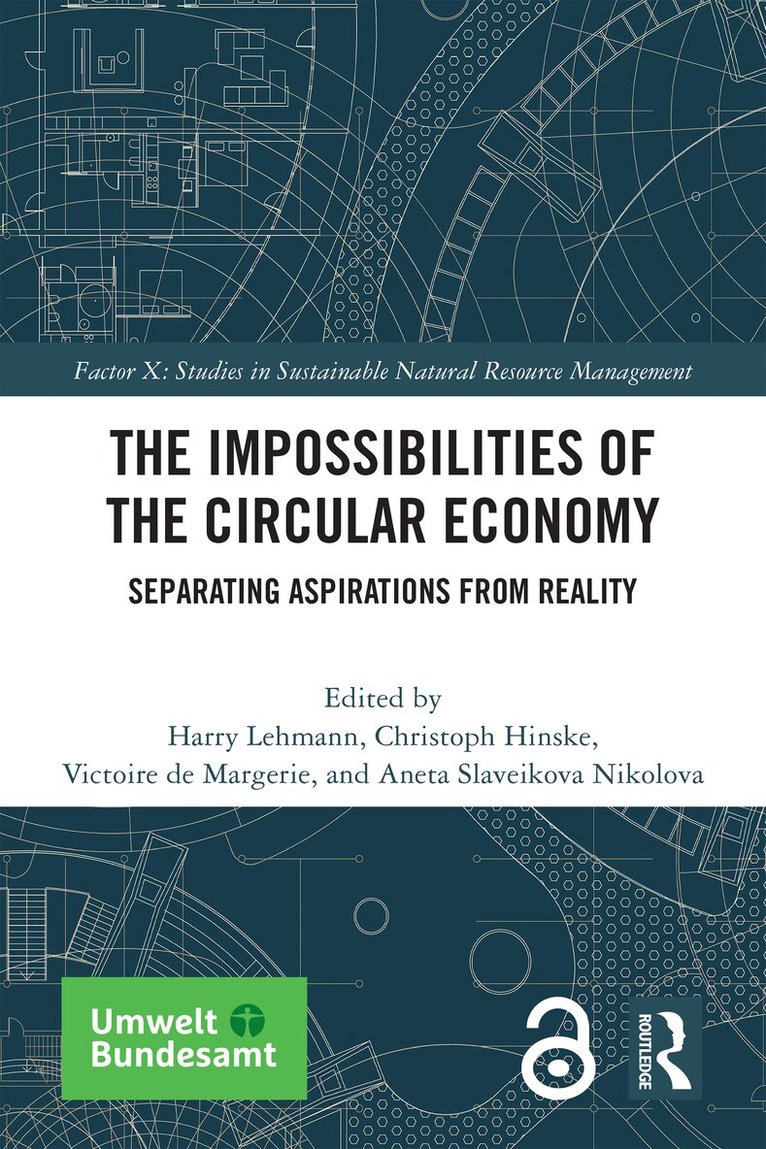
    Impossibilities of the Circular Economy

    Separating Aspirations from Reality

    AvHarry Lehmann,Christoph Hinske

    Inbunden, Engelska, 2022

    Del i serien Factor X: Studies in Sustainable Natural Resource Management

    1 713 kr

    Skickas . Fri frakt över 249 kr.

    Beskrivning

    The fifth Factor X publication from the Federal Environment Agency (Umweltbundesamt, UBA), The Impossibilities of the Circular Economy provides an overview of the limits to the circular economy, emphasising the relationship between integrated resource use and more systemic leadership-management approaches.On a European level, the book ties into the recent European Green Deal and aims to empower actors across sectors and EU member countries to transition from existing linear models of value capture and expression to more systemic-circular solutions of value capture and expression. The volume provides a hands-on contribution towards building the knowledge and skill sets of current and future decision-makers who face these complex-systemic crises in their day-to-day business. The book further provides access to best practices from cutting-edge research and development findings, which will empower decision-makers to develop a more sustainable and equitable economy.Providing solutions for a more sustainable economy, this book is essential reading for scholars and students of natural resource use, sustainable business, environmental economics and sustainable development, as well as decision-makers and experts from the fields of policy development, industry and civil society.The Open Access version of this book, available at www.taylorfrancis.com, has been made availableunder a Creative Commons Attribution- Non Commercial- No Derivatives 4.0 license.

    Produktinformation

    • Utgivningsdatum:2022-11-23
    • Mått:156 x 234 x 24 mm
    • Vikt:820 g
    • Format:Inbunden
    • Språk:Engelska
    • Serie:Factor X: Studies in Sustainable Natural Resource Management
    • Antal sidor:314
    • Förlag:Taylor & Francis Ltd
    • ISBN:9781032154435

    Utforska kategorier

    • Referensverk och tvärvetenskap inom Samhälle och politik
    • Projektledning inom Ekonomi och Ledarskap
    • Miljöekonomi inom Ekonomi och Ledarskap

    Mer om författaren

    Harry Lehmann is General Director of the Environmental Planning and Sustainability Strategies Division of the German Federal Environment Agency. He was an early member and is now the President of the Factor 10 Club for resource productivity and sustainable use of natural resources. He is one of the founders of Eurosolar, and since 2011 he has been Executive Chairman of the World Renewable Energy Council.Christoph Hinske is Associate Professor of System Leadership-Management, SAXION University of Applied Sciences, School of Finance and International Business; Founder of 360° Dialogues. He lectures on societal transformations at the Eberswalde University for Sustainable Development and advises Global Action Networks, financial institutions and Transformation Networks. He is a fellow at the European School of Governance.Victoire de Margerie is the Founder and Vice-Chairman of the World Materials Forum and Executive Chairman of Rondol. She has spent 35 years in the Materials Industry in Canada, France, Germany, UK and USA, first as an Executive and since 1999 as a Board Director (now Arkema and Eurazeo). She was elected an Academician at the National Academy of Technologies of France in 2020.Aneta Slaveikova Nikolova is the Climate Policy Lead, Environment and Development Division, Economic and Social Commission for Asia and the Pacific UNESCAP. Ms Nikolova heads a climate action team focusing on climate finance, Paris Agreement implementation and review of national GHG reduction commitments. She has vast experience in sustainable development policy and advocacy, capacity development and technical assistance to developing countries and countries with economies in transition.

    Innehållsförteckning

    • PART 1: WHAT WE DREAM OF! 1. Circularity dreams - denying physical realities 2. Does waste equal food? Examining the feasibility of circular economy in the food industry 3. The impossible dream’: can the circular economy alone solve waste management complexities of the Global South? 4. The entropic nature of the economic process: a scientific explanation of the blunder of circular economy 5. The impossibility of circular recycling PART 2: WHAT ARE OUR BLIND SPOTS? 6. Circular economy, sustainability and functional differentiation: an impossibility and its strategic-methodological implications 7. Circularity is not sustainability: how well-intentioned concepts distract us from our true goals, and how SiD can help navigate that challenge 8. Circular Economy: from panacea for sustainability to conceptual and resource realities 9. Some observations on the current Circular Economy model: in particular, the mineral-metal-material stream blind spots 10. Circular economy leadership: leadership mindsets and behaviours – the unseen impossibility 11. Can there be a responsible narrative about the circular economy? 12. Who has discursive agency to change global environmental narratives? Insights from the China-EU cooperation discourse on circular economy 13. Brazil's structural issues in advancing the circular economy: the case of biogas PART 3: WHAT WE NEED TO STRESS MORE! 14. The Circular Economy should finally demand the impossible 15. System leadership for overcoming the impossibilities of a circular economy 16. From closed to open systems: applying systems thinking to reframe strategic decision-making 17. Truly circular economies require deep collaboration: the principles underlying successful circular economies 18. Development and implementation of resource labelling 19. Circularity’s stumbling blocks: how stuttering implementation and socio-metabolic root causes adversely interact PART 4: WHAT OPPORTUNITIES DO WE SEE? 20. Global resource use and the future: any room for the circular economy? 21. Regenerative economy: the embedding of circularity 22. Circular Economy through a system change lens 23. Practising circular economy: stumbling blocks for circulation and recycling 24. Implementation of refuse derived fuel technology toward achieving a sustainable circular economy: potentials and compatibility in Bangladesh. 25. From profit to prosperity: making the impossible possible through integral investing 26. Coming full circle: putting the social into circular economy