• Fri frakt över 249 kr
  • •
  • Snabba leveranser
  • •
  • Billiga böcker
Kundservice

Du är på sajten för privatpersoner.

Företag, bibliotek eller offentlig verksamhet?

Du handlar på classic.bokus.com, där alla dina funktioner finns intakta.
Till classic.bokus.com
Bokus logotyp. Gå till startsidan.
  • Erbjudanden
  • Nyheter
  • Student
  • Topplistor
  • Barn & ungdom
  • Bokus Play
  • E-böcker
  • Pocketböcker
  • Spel & pussel

10% rabatt på allt med kod: NYSTART10 →

Sidfot

Mina sidor

    Hjälp

    • Kundservice
    • Vanliga frågor och svar
    • Frakt och leverans
    • Retur vid ångerrätt
    • Reklamera vara
    • Betalning
    • Köpvillkor
    • Allmänna villkor
    • Information om webbplatsens tillgänglighet

    Om Bokus

    • Om oss
    • Pressrum
    • För studenter
    • För företag
    • För bibliotek och offentlig verksamhet
    • För leverantörer
    • Hållbarhet

    Populärt

    • Aktuella erbjudanden
    • Presentkort
    • Studentlitteratur
    • Nya böcker
    • Topplistor
    • Signerade böcker
    • Engelska böcker

    Inspiration

    • Boktips
    • BookTok
    • Populära bokserier
    • Barnbokskaraktärer
    • Populära författare
    Logotyp för Bokus
    Följ oss på Facebook (extern länk)Följ oss på Instagram (extern länk)Följ oss på YouTube (extern länk)Följ oss på TikTok (extern länk)
    bokus @ CookiesAnpassa cookiesIntegritetspolicyKöpvillkor
    Till Citymail hemsida (extern länk)Till Budbee hemsida (extern länk)Till Postnord hemsida (extern länk)Till Schenker hemsida (extern länk)Till Early Bird hemsida (extern länk)Till Walleys hemsida (extern länk)
    1. Naturvetenskap och teknik
    2. Geovetenskap
    3. Miljövetenskap och miljöpolitik

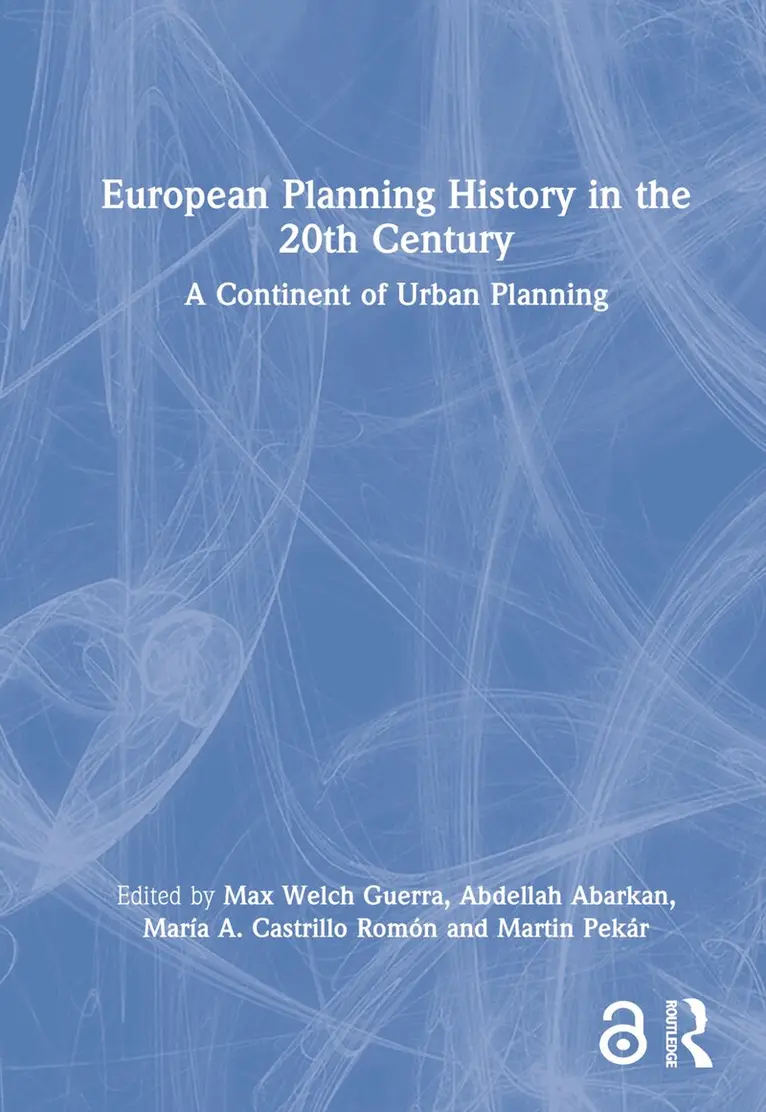
    European Planning History in the 20th Century

    A Continent of Urban Planning

    AvMax Welch Guerra,Abdellah Abarkan

    Inbunden, Engelska, 2022

    2 421 kr

    Beställningsvara. Skickas inom 10-15 vardagar. Fri frakt över 249 kr.

    Beskrivning

    The history of Europe in the 20th century is closely tied to the history of urban planning. Social and economic progress but also the brute treatment of people and nature throughout Europe were possible due to the use of urban planning and the other levels of spatial planning. Thereby, planning has constituted itself in Europe as an international subject. Since its emergence, through intense exchange but also competition, despite country differences, planning has developed as a European field of practice and scientific discipline. Planning is here much more than the addition of individual histories; however, historiography has treated this history very selective regarding geography and content.This book searches for an understanding of the historiography of planning in a European dimension. Scholars from Eastern and Western, Southern and Northern Europe address the issues of the public led production of city and the social functions of urban planning in capitalist and state-socialist countries. The examined examples include Poland and USSR, Czech Republic and Slovakia, UK, Netherlands, Germany, France, Portugal and Spain, Italy, and Sweden. The book will be of interest to students and scholars for Urbanism, Urban/Town Planning, Spatial Planning, Spatial Politics, Urban Development, Urban Policies, Planning History and European History of the 20th Century.The Open Access version of this book, available at www.taylorfrancis.com, has been made available under a Creative Commons Attribution-Non Commercial-No Derivatives 4.0 license.

    Produktinformation

    • Utgivningsdatum:2022-09-09
    • Mått:178 x 254 x undefined mm
    • Vikt:766 g
    • Format:Inbunden
    • Språk:Engelska
    • Antal sidor:296
    • Förlag:Taylor & Francis Ltd
    • ISBN:9781032222264

    Utforska kategorier

    • Miljövetenskap och miljöpolitik inom Naturvetenskap och teknik
    • Regional planering inom Naturvetenskap och teknik

    Mer om författaren

    Max Welch Guerra is a Professor of Spatial Planning and Spatial Research and Head of the BSc and MSc Urbanistik at the Bauhaus-Universität Weimar. Abdellah Abarkan is a Professor and heads the Chair of Spatial Planning at the Blekinge Institute of Technology (BTH) in Karlskrona, Sweden. María A. Castrillo Romón is a full Professor of Urban and Regional Planning in the Department of Urban Planning and Representation of Architecture and Researcher of the University Institute of Urban Planning (Instituto Universitario de Urbanística, IUU), both at the University of Valladolid (Spain). Martin Pekár, PhD, is a Professor of Slovak history, at the Department of History, Faculty of Arts, Šafárik University in Košice.

    Recensioner i media

    "Simultaneously expansive and focused, evocative and rigorous, carefully attentive to the past and cautiously prescient about the future, this thoughtful selection of essays is an invaluable testimony to the potential of Planning History as a discipline at the service of an ever-changing and increasingly complex society.Advancing along the trajectory defined by The Routledge Handbook of Planning History, this new publication is essential reading for everybody interested in the discipline."Carmen D’ez Medina, University of Zaragoza, Spain"This vibrant collection retrieves the variegated roots and functions that shaped planning in different European countries. Undoubtedly, researchers and students will draw on these studies for a long time to come."Marco Cremaschi, Professor of Urbanism Sciences Po, Paris. PrŽsident, the French association of Planning School APERAU"Bringing together international experts in the field, this volume gives powerful evidence that the history of urban planning in Europe can only be written by listening to a polyphony of voices rather than providing a monolithic image.Avoiding the traps of focusing on the grand projects of famous urban planners the authors offer a comprehensive, critical overview of the discipline of planning in the 20th century. The volume gives visibility to the planning discourse in the former socialist countries as well, long neglected by urban historians, and emphasizes the political and social underpinnings of the production of urban form. The book is an essential resource for readers interested in the tasks and perspectives of urban planning."Ákos Moravánszky, Professor Emeritus, Institut gta, ETH ZŸrich"This rich compilation of studies brings to light the multifaceted nature of European urban planning practices across the continent, from Spain to Russia, from Sweden to Italy. Ranging from carefully designed in-depth case studies to thought-provoking theoretical observations the book provides an important addition to the dynamic field of urban history understood as an intersection of power, expertise and space."Petr Roubal, Czech Academy of Sciences, Prague

    Innehållsförteckning

    • Introduction: The Continent of Urban Planning and Its Changing Historiography Max Welch Guerra Part 1: The Emergence of Contemporary Urban Planning 1. Historiography avant la lettre? On the Uses of History in Early Town Planning Manuals Helene Bihlmaier 2. Urban Hygiene and Slum Clearance as Catalysts: The Emergence of the Sanitary City and Town Planning Dirk Schubert 3. The Reverse of Urban Planning: First Steps for a Genealogy of Informal Urbanization in Europe Noel Manzano 4. The Beginning of the Urbanism Teaching in the Schools of Architecture of Madrid and Barcelona: From Trazado, Urbanización y Saneamiento de Poblaciones to Urbanología María Cristina García-González 5. Rethinking Urban Extension and International Influences: Spain and the International Housing and Town Planning Congresses during the 1920s María Castrillo Romón and Miguel Fernández-Maroto 6. Influences of European Urban Planning in post-war Spain: Pedro Bidagor Collection of the Historical Service Archive of the Official College of Architects of Madrid Alberto Sanz Hernando 7. Aménagement, embellissement et extension des villes: The French Law of 1919/1924 on Urban Plans Laurent Coudroy de Lille 8. Bending Interests and Blending Media in the Inter-war Modernism of Central Europe: Wohnung und Werkraum Exhibition Marcelo Sagot Better Part 2: Functions and Practices of Urban Planning under Changing Social Orders 1. Swedish Planning and Development in the 20th and 21st CenturiesAnn Maudsley 2. Bratislava under Fascist DictatorshipMartin Pekár3. French Tools for Urban Heritage Protection in the Second Half of the Twentieth Century: From Groundbreaking Systematization to a General Trend toward Integration of Planning InstrumentsVíctor Pérez-Eguíluz 4. History and Heritage: The Reconstruction of Blitzed Cities Peter J. Larkham5. Planning GDR and Czechoslovakia: The Scale Question under State SocialismAzmah Arzmi 6. Transportation and Urban Planning under State Socialism: The Tramway in Medium-Sized Cities of the USSR, GDR and CSSR in the 1960s and 1970sElvira Khairullina and Luis Santos y Ganges 7. Contemporary European City-Making Process: Materialisation-Emptying-Regeneration on Large Land PropertiesFederico Camerin 8. Elective Affinities: The Recovery of Historic Seminal Ideas of European Urbanism for a Sustainable Urban Design in the Late 20th CenturyJuan Luis de las Rivas Part 3: Interpretation of the Twentieth Century Planning History 1. Is There a European Planning Tradition? Stephen V. Ward2. European Planning History in the 20th century as a Reflexive Concept Harald Bodenschatz 3. The Anarchist Strain of Planning History: Pursuing Peter Hall’s Cities of Tomorrow Thesis through the Geddes Connection, 1866–1976 José Luis Oyón and Jere Kuzmanić4. Mapping Transnational Planning History in Port City Regions – London, Rotterdam, Hamburg Carola Hein 5. A Look to Transgressive Planning Practices: Calling for Alternative Sources and ActorsAndrea Gimeno 6. Neglected Narratives of Post-war Italian Cities: Actors and Rationalities in the Shaping of the Ordinary Residential LandscapeGaia Caramellino and Nicole De Togni 7. The End of the Planned City? Urban planning after 1989 Florian Urban 8. Interpreting 20th Century European Planning History: Eight ThesesMax Welch Guerra