• Fri frakt över 249 kr
  • •
  • Snabba leveranser
  • •
  • Billiga böcker
Kundservice

Du är på sajten för privatpersoner.

Företag, bibliotek eller offentlig verksamhet?

Du handlar på classic.bokus.com, där alla dina funktioner finns intakta.
Till classic.bokus.com
Bokus logotyp. Gå till startsidan.
  • Erbjudanden
  • Nyheter
  • Student
  • Topplistor
  • Barn & ungdom
  • Bokus Play
  • E-böcker
  • Pocketböcker
  • Spel & pussel

10% rabatt på allt med kod NYSTART10 →

Sidfot

Mina sidor

    Hjälp

    • Kundservice
    • Vanliga frågor och svar
    • Frakt och leverans
    • Retur vid ångerrätt
    • Reklamera vara
    • Betalning
    • Köpvillkor
    • Allmänna villkor
    • Information om webbplatsens tillgänglighet

    Om Bokus

    • Om oss
    • Pressrum
    • För studenter
    • För företag
    • För bibliotek och offentlig verksamhet
    • För leverantörer
    • Hållbarhet

    Populärt

    • Aktuella erbjudanden
    • Presentkort
    • Studentlitteratur
    • Nya böcker
    • Topplistor
    • Signerade böcker
    • Engelska böcker

    Inspiration

    • Boktips
    • BookTok
    • Populära bokserier
    • Barnbokskaraktärer
    • Populära författare
    Logotyp för Bokus
    Följ oss på Facebook (extern länk)Följ oss på Instagram (extern länk)Följ oss på YouTube (extern länk)Följ oss på TikTok (extern länk)
    bokus @ CookiesAnpassa cookiesIntegritetspolicyKöpvillkor
    Till Citymail hemsida (extern länk)Till Budbee hemsida (extern länk)Till Postnord hemsida (extern länk)Till Schenker hemsida (extern länk)Till Early Bird hemsida (extern länk)Till Walleys hemsida (extern länk)
    1. Naturvetenskap och teknik
    2. Matematik och naturvetenskap
    3. Matematik
    4. Matematisk statistik

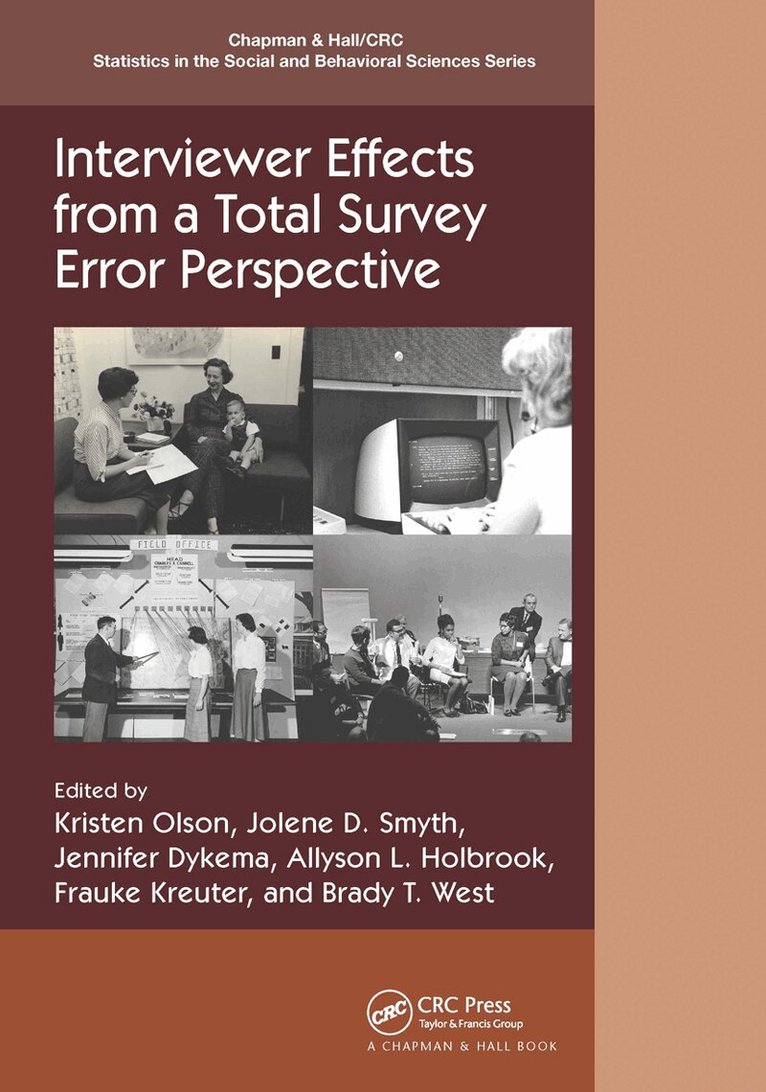
    Interviewer Effects from a Total Survey Error Perspective

    AvKristen Olson,Jolene D. Smyth

    Häftad, Engelska, 2021

    Del i serien Chapman & Hall/CRC Statistics in the Social and Behavioral Sciences

    878 kr

    Beställningsvara. Skickas inom 10-15 vardagar. Fri frakt över 249 kr.

    Beskrivning

    Interviewer Effects from a Total Survey Error Perspective presents a comprehensive collection of state-of-the-art research on interviewer-administered survey data collection. Interviewers play an essential role in the collection of the high-quality survey data used to learn about our society and improve the human condition. Although many surveys are conducted using self-administered modes, interviewer-administered modes continue to be optimal for surveys that require high levels of participation, include difficult-to-survey populations, and collect biophysical data. Survey interviewing is complex, multifaceted, and challenging. Interviewers are responsible for locating sampled units, contacting sampled individuals and convincing them to cooperate, asking questions on a variety of topics, collecting other kinds of data, and providing data about respondents and the interview environment. Careful attention to the methodology that underlies survey interviewing is essential for interviewer-administered data collections to succeed.In 2019, survey methodologists, survey practitioners, and survey operations specialists participated in an international workshop at the University of Nebraska-Lincoln to identify best practices for surveys employing interviewers and outline an agenda for future methodological research. This book features 23 chapters on survey interviewing by these worldwide leaders in the theory and practice of survey interviewing. Chapters include:The legacy of Dr. Charles F. Cannell’s groundbreaking research on training survey interviewers and the theory of survey interviewingBest practices for training survey interviewersInterviewer management and monitoring during data collectionThe complex effects of interviewers on survey nonresponseCollecting survey measures and survey paradata in different modesDesigning studies to estimate and evaluate interviewer effectsBest practices for analyzing interviewer effectsKey gaps in the research literature, including an agenda for future methodological researchChapter appendices available to download from https://digitalcommons.unl.edu/sociw/ Written for managers of survey interviewers, survey methodologists, and students interested in the survey data collection process, this unique reference uses the Total Survey Error framework to examine optimal approaches to survey interviewing, presenting state-of-the-art methodological research on all stages of the survey process involving interviewers. Acknowledging the important history of survey interviewing while looking to the future, this one-of-a-kind reference provides researchers and practitioners with a roadmap for maximizing data quality in interviewer-administered surveys.

    Produktinformation

    • Utgivningsdatum:2021-12-13
    • Mått:178 x 254 x 32 mm
    • Vikt:453 g
    • Format:Häftad
    • Språk:Engelska
    • Serie:Chapman & Hall/CRC Statistics in the Social and Behavioral Sciences
    • Antal sidor:360
    • Förlag:Taylor & Francis Ltd
    • ISBN:9781032241517

    Utforska kategorier

    • Matematisk statistik inom Naturvetenskap och teknik

    Mer om författaren

    Kristen Olson, Ph.D., is Leland J. and Dorothy H. Olson Professor and Vice Chair of the Department of Sociology at the University of Nebraska-Lincoln.Jennifer Dykema, Ph.D., is Distinguished Scientist and Senior Survey Methodologist at the University of Wisconsin Survey Center.Allyson L. Holbrook, Ph.D., is a Professor of Public Administration and Psychology at the University of Illinois at Chicago. Frauke Kreuter, Ph.D., is Director of the Joint Program in Survey Methodology at the University of Maryland, Professor of Statistics and Methodology at the University of Mannheim, and Head of the Statistical Methods Research Department (on leave) at the Institute for Employment Research in Nuremberg.Jolene D. Smyth, Ph.D., is an Associate Professor in the Department of Sociology and the Director of the Bureau of Sociological Research at the University of Nebraska-Lincoln. Brady T. West, Ph.D., is a Research Associate Professor in the Survey Research Center at the Institute for Social Research on the University of Michigan-Ann Arbor campus.

    Innehållsförteckning

    • Section I. History and OverviewChapter 1: The Past, Present, and Future of Research on Interviewer EffectsChapter 2: The Legacy of Charles CannellSection II: Training InterviewersChapter 3: General Interviewing Techniques: Developing Evidence-Based Practices for Standardized InterviewingChapter 4: How to Conduct Effective Interviewer Training: A Meta-Analysis and Systematic ReviewSection III: Managing and Monitoring Interviewers and the Survey ProcessChapter 5: Exploring the Mind of the Interviewer: Findings from Research with Interviewers to Improve the Survey ProcessChapter 6: Behavior Change Techniques for Reducing Interviewer Contributions to Total Survey ErrorChapter 7: Statistical Identification of Fraudulent Interviews in Surveys: Improving Interviewer ControlsChapter 8: Examining the Utility of Interviewer Observations on the Survey Response ProcessSection IV: Interviewer Effects and Interview Context and ModeChapter 9: Why do Interviewers Vary in Achieving Interview Privacy and Does Privacy Matter?Chapter 10: Unintended Interviewer Bias in a Community-based Participatory Research Randomized Control Trial among American Indian YouthChapter 11: Virtual Interviewers, Social Identities, and Survey Measurement ErrorChapter 12: Differences in Interaction Quantity and Conversational Flow in CAPI and CATI InterviewsChapter 13: Interacting with Interviewers in Voice and Text Interviews on SmartphonesSection V: Interviewers and NonresponseChapter 14: Explaining Interviewer Effects on Survey Unit Nonresponse: A Cross-Survey AnalysisChapter 15: Comparing Two Methods for Managing Telephone Interview CasesChapter 16: Investigating the Use of Nurse Paradata in Understanding Nonresponse to Biological Data CollectionSection VI: Interview Pace and BehaviorsChapter 17: Exploring the Antecedents and Consequences of Interviewer Reading Speed (IRS) at the Question LevelChapter 18: Response Times as an Indicator of Data Quality: Associations with Question, Interviewer, and Respondent Characteristics in a Health Survey of Diverse RespondentsChapter 19: Accuracy and Utility of Using Paradata to Detect Question-Reading DeviationsChapter 20: What do Interviewers Learn? Changes in Interview Length and Interviewer Behaviors over the Field PeriodSection VII: Estimating Interviewer EffectsChapter 21: Modeling Interviewer Effects in the National Health Interview StudyChapter 22: A Comparison of Different Approaches to Examining Whether Interviewer Effects Tend to Vary Across Different Subgroups of RespondentsChapter 23: Designing Studies for Comparing Interviewer Variance in Two Groups of Survey Interviewers