• Fri frakt över 249 kr
  • •
  • Snabba leveranser
  • •
  • Billiga böcker
Kundservice

Du är på sajten för privatpersoner.

Företag, bibliotek eller offentlig verksamhet?

Du handlar på classic.bokus.com, där alla dina funktioner finns intakta.
Till classic.bokus.com
Bokus logotyp. Gå till startsidan.
  • Erbjudanden
  • Student
  • Topplistor
  • Barn & ungdom
  • Bokus Play
  • E-böcker
  • Ljudböcker
  • Pocketböcker
  • Spel och pussel

Pocketfynda! Hundratals böcker för 49 kr/st →

Sidfot

Mina sidor

    Hjälp

    • Kundservice
    • Vanliga frågor och svar
    • Frakt och leverans
    • Retur vid ångerrätt
    • Reklamera vara
    • Betalning
    • Köpvillkor
    • Allmänna villkor
    • Information om webbplatsens tillgänglighet

    Om Bokus

    • Om oss
    • Pressrum
    • För studenter
    • För företag
    • För bibliotek och offentlig verksamhet
    • För leverantörer
    • Hållbarhet

    Populärt

    • Aktuella erbjudanden
    • Presentkort
    • Studentlitteratur
    • Nya böcker
    • Topplistor
    • Signerade böcker
    • Engelska böcker

    Inspiration

    • Boktips
    • BookTok
    • Barnbokskaraktärer
    • Populära författare
    Logotyp för Bokus
    Följ oss på Facebook (extern länk)Följ oss på Instagram (extern länk)Följ oss på YouTube (extern länk)Följ oss på TikTok (extern länk)
    bokus @ CookiesAnpassa cookiesIntegritetspolicyKöpvillkor
    Till Citymail hemsida (extern länk)Till Budbee hemsida (extern länk)Till Postnord hemsida (extern länk)Till Schenker hemsida (extern länk)Till Early Bird hemsida (extern länk)Till Walleys hemsida (extern länk)
    1. Psykologi och pedagogik
    2. Psykologi
    3. Socialpsykologi och gruppsykologi

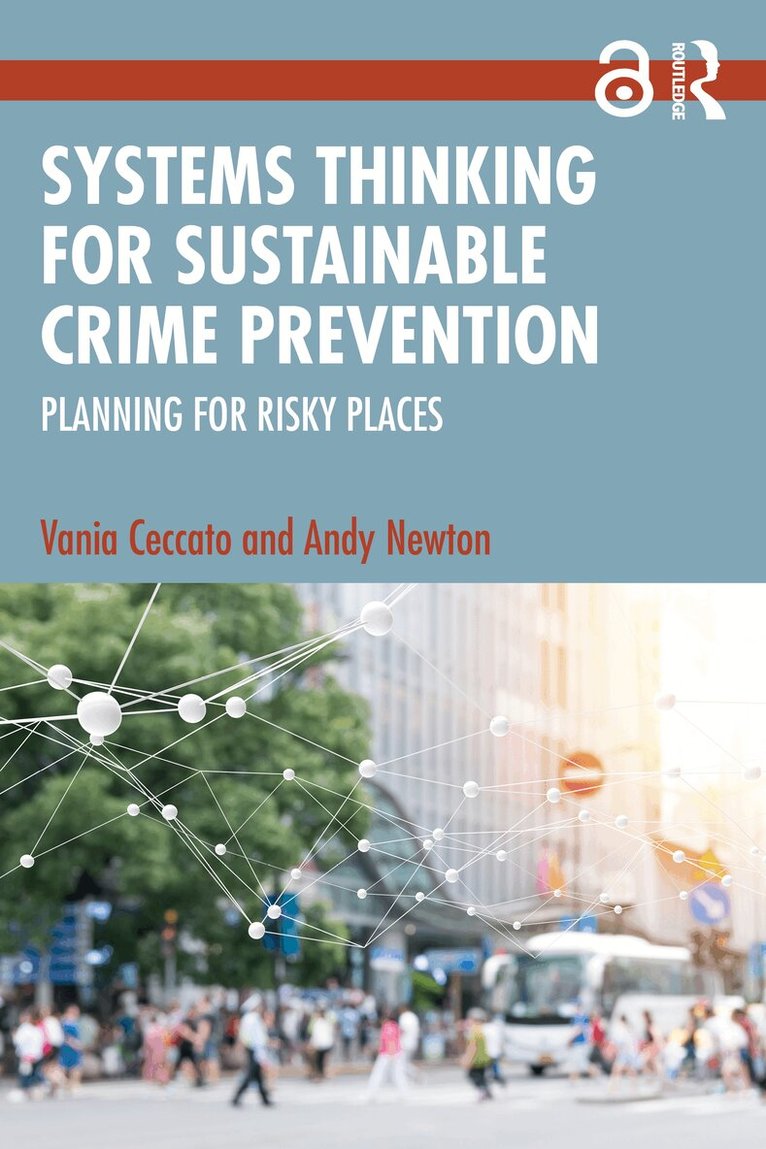
    Systems Thinking for Sustainable Crime Prevention

    Planning for Risky Places

    AvVania Ceccato,Andy Newton

    Häftad, Engelska, 2024

    580 kr

    Beställningsvara. Skickas inom 10-15 vardagar. Fri frakt över 249 kr.

    Fler format och utgåvor

    Inbunden

    2 410 kr

    Beskrivning

    This book offers a comprehensive overview of areas with elevated levels of crime, which we consider ‘risky places.’ These can be facilities, nodes, or paths and can be found everywhere, from small towns to megacities. Crime and fear are examined from the perspective of those who use these places, based on examples from the US, the UK, Sweden, Nigeria, Brazil, China, Australia, and more. Advocating for a systems thinking approach, the book shows what can be learned from risky places and identifies ways to address their inherent problems. The book also assesses current barriers to applying systems thinking and identifies ways to foster interconnected long-term crime prevention strategies that meet the diverse needs of multiple stakeholders. Aimed at academics, students, and professionals in urban planning, criminology, geography, and related fields, this book is a vital resource for those dedicated to creating safer, more inclusive, and sustainable environments. The Open Access version of this book, available at http://www.taylorfrancis.com, has been made available under a Creative Commons Attribution (CC-BY) 4.0 license.

    Produktinformation

    • Utgivningsdatum:2024-11-07
    • Mått:152 x 229 x 19 mm
    • Vikt:420 g
    • Format:Häftad
    • Språk:Engelska
    • Antal sidor:238
    • Förlag:Taylor & Francis Ltd
    • ISBN:9781032249865

    Utforska kategorier

    • Socialpsykologi och gruppsykologi inom Psykologi och pedagogik
    • Regional planering inom Naturvetenskap och teknik
    • Geografi inom Naturvetenskap och teknik

    Mer om författaren

    Vania Ceccato is Professor at the Department of Urban Planning and Environment, School of Architecture and the Built Environment in Stockholm, Royal Institute of Technology, Sweden.Andy Newton is Professor of Criminology and Policing at Nottingham Trent University, Nottingham, UK. He is a co-director of the cross-disciplinary strategic research theme Safety and Sustainability.

    Recensioner i media

    "This book provides an important advancement in sustainable crime prevention in risky places. The authors ask the reader to look at risky places within the context of the surrounding complex systems that make up the local, regional and larger areas as well as the actors that shape what occurs. Each chapter in the book is of great value but, as a whole, it brings criminologists, geographers, psychologists, urban planners, architects, sociologists and government officials closer together in advancing safety and reducing risk."Patricia Brantingham, Professor of Computational Criminology, Simon Fraser University, Canada"Through a systems thinking approach, the authors explore the interconnected nature of risky places and the socio-spatial contexts in which they are located to understand the challenges and opportunities for more appropriate intervention. They offer new ways to analyze the complex dynamics giving rise to crime in specific areas and propose a framework for applying systems thinking to study and intervene in risky places. The book offers a valuable lens and tool towards safer and more sustainable human settlements."Karina Landman, Professor, Department of Town and Regional Planning, University of Pretoria, South Africa "Through their wide-ranging and stimulating treatment of risky places, the two internationally leading authors of this book show why it is now necessary and appropriate to build a systems perspective onto two well-established approaches to safety and security. Situational crime prevention first emerged as a successful field of research and practice by isolating itself from traditional criminological domains of societal structure and offender motivation. CPTED (Crime Prevention Through Environmental Design) arose as a school of practice within architecture. The authors show how to treat situations and built environments both urban and rural via a wider and deeper systems-level analysis. Systems thinking promises to guide understanding, intervention, practical implementation, and evaluation in this complex domain involving many diverse stakeholders at various geographical scales. It also enables us to merge security goals creatively and rigorously with those of sustainability and other beneficial outcomes."Paul Ekblom, Emeritus Professor, Design Against Crime Research Lab, Central Saint Martins, University of the Arts London; Visiting Professor, Department of Security & Crime Science, University College London and Applied Criminology & Policing Centre, University of Huddersfield, United Kingdom

    Innehållsförteckning

    • 1. Introducing risky places for crime. 2. Thinking in risky places as systems. 3. Revisiting the theoretical foundations of risky places. 4. Identifying risky facilities. 5. Analyzing risky nodes. 6. Unraveling risky paths and journeys. 7. Discovering opportunities for actions in risky places. 8. Re-framing methods for systems thinking for risky places. 9. Exemplifying the governance of risky places. 10. Activating systems thinking for sustainable crime prevention.