• Fri frakt över 249 kr
  • •
  • Snabba leveranser
  • •
  • Billiga böcker
Kundservice

Du är på sajten för privatpersoner.

Företag, bibliotek eller offentlig verksamhet?

Du handlar på classic.bokus.com, där alla dina funktioner finns intakta.
Till classic.bokus.com
Bokus logotyp. Gå till startsidan.
  • Erbjudanden
  • Nyheter
  • Student
  • Topplistor
  • Barn & ungdom
  • Bokus Play
  • E-böcker
  • Pocketböcker
  • Spel & pussel

10% rabatt på allt med kod: NYSTART10 →

Sidfot

Mina sidor

    Hjälp

    • Kundservice
    • Vanliga frågor och svar
    • Frakt och leverans
    • Retur vid ångerrätt
    • Reklamera vara
    • Betalning
    • Köpvillkor
    • Allmänna villkor
    • Information om webbplatsens tillgänglighet

    Om Bokus

    • Om oss
    • Pressrum
    • För studenter
    • För företag
    • För bibliotek och offentlig verksamhet
    • För leverantörer
    • Hållbarhet

    Populärt

    • Aktuella erbjudanden
    • Presentkort
    • Studentlitteratur
    • Nya böcker
    • Topplistor
    • Signerade böcker
    • Engelska böcker

    Inspiration

    • Boktips
    • BookTok
    • Populära bokserier
    • Barnbokskaraktärer
    • Populära författare
    Logotyp för Bokus
    Följ oss på Facebook (extern länk)Följ oss på Instagram (extern länk)Följ oss på YouTube (extern länk)Följ oss på TikTok (extern länk)
    bokus @ CookiesAnpassa cookiesIntegritetspolicyKöpvillkor
    Till Citymail hemsida (extern länk)Till Budbee hemsida (extern länk)Till Postnord hemsida (extern länk)Till Schenker hemsida (extern länk)Till Early Bird hemsida (extern länk)Till Walleys hemsida (extern länk)
    1. Djur och Natur
    2. Naturböcker
    3. Växtböcker

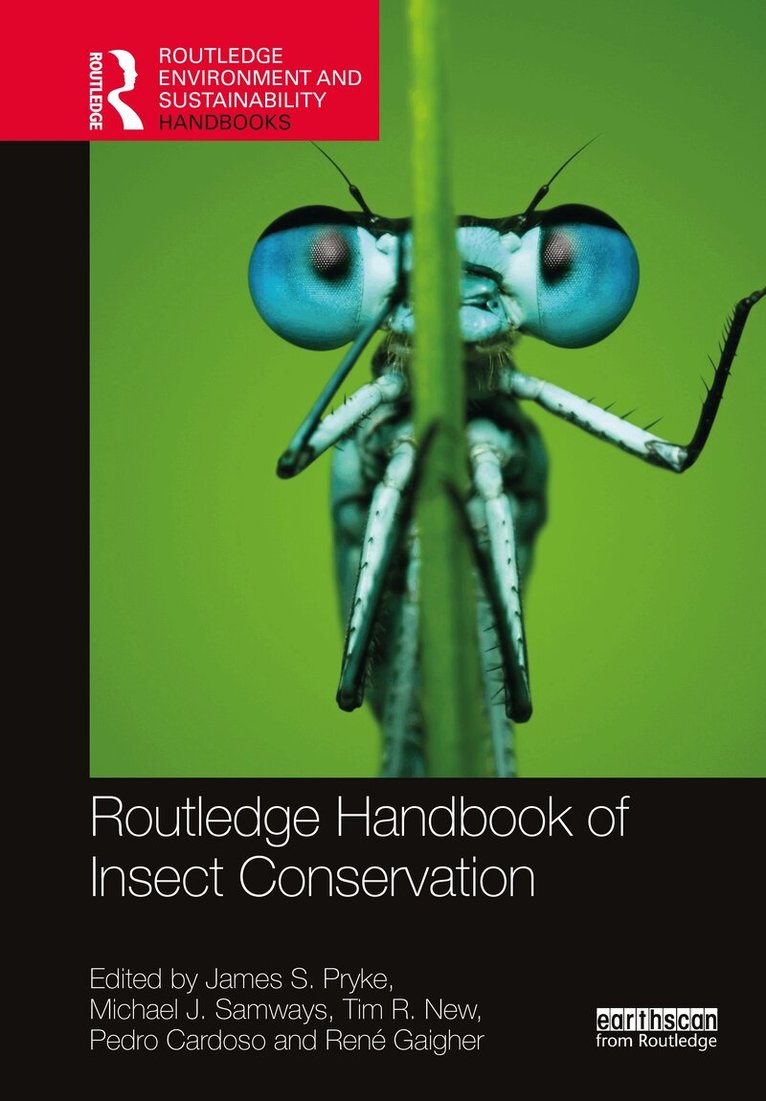
    Routledge Handbook of Insect Conservation

    AvJames S. Pryke,Michael J. Samways

    Inbunden, Engelska, 2024

    Del i serien Routledge Environment and Sustainability Handbooks

    3 656 kr

    Beställningsvara. Skickas inom 10-15 vardagar. Fri frakt över 249 kr.

    Beskrivning

    Winner of the 2025 Choice Outstanding Academic TitleThis handbook presents a comprehensive overview of insect conservation and provides practical solutions to counteract insect declines, at a time where insects are facing serious threats across the world from habitat destruction to invasive species and climate change.The Routledge Handbook of Insect Conservation consist of six sections, covering all aspects of insect conservation, containing contributions from academics, researchers and practitioners from across the globe. Section I addresses the fundamentals of insect conservation and outlines the reason why insects are important and discusses the greatest drivers of insect decline. The chapters in Section II examine the approaches that can be used for insect conservation globally, such as protected areas and agroecology, while highlighting the importance of insects in the composition and function of ecosystems. The chapters in Section III focus on insect populations in the major biomes around the world, from temperate and tropical forests to savannas and grasslands, with the chapters in Section IV focusing on natural and manmade ecosystems of the world, including mountain, soil, urban, island and agricultural habitats. They discuss the unique pressures and challenges for each biome and ecosystem and offer practical solutions for conserving their insect populations. Section V focuses on the assessment and monitoring of insects for conservation, discussing how we can implement practical monitoring protocols and what options are available. A wide variety of methods and tools are examined, including citizen science, bioindication, the role of taxonomy, drones and eDNA. The book concludes by examining policy and education strategies for insect conservation in Section VI. The chapters discuss key issues around social and policy strategies and conservation legislation for ensuring the long-term protection of insects.This book is essential reading for students and scholars of biodiversity conservation and entomology as well as professionals and policymakers involved in conservation looking for real-world solutions to the threats facing insects across the globe.

    Produktinformation

    • Utgivningsdatum:2024-06-14
    • Mått:174 x 246 x 38 mm
    • Vikt:1 240 g
    • Format:Inbunden
    • Språk:Engelska
    • Serie:Routledge Environment and Sustainability Handbooks
    • Antal sidor:562
    • Förlag:Taylor & Francis Ltd
    • ISBN:9781032259505

    Utforska kategorier

    • Växtböcker inom Djur och Natur
    • Fjärilar, insekter, spindlar inom Djur och Natur
    • Botanik inom Naturvetenskap och teknik

    Mer om författaren

    James S. Pryke is an Associate Professor of Conservation Ecology and Entomology at Stellenbosch University, South Africa, and is the co-Editor in Chief for the Journal of Insect Conservation.Michael J. Samways is a Distinguished Professor in the Department of Conservation Ecology and Entomology at Stellenbosch University, South Africa, Fellow of the Royal Society of South Africa, and Member of the Academy of Science of South Africa. Michael is the recipient of several major awards, including the John Herschel Medal of the Royal Society of South Africa.Tim R. New is Emeritus Professor of Zoology at La Trobe University, Australia. He is a past Editor-in-Chief of Journal of Insect Conservation and former Regional Editor of Biological Conservation. Tim is the recipient of several major awards, including the Mackerras and Marks Medals of the Australian Entomological Society.Pedro Cardoso is a Researcher at the Centre for Ecology, Evolution and Environmental Changes, University of Lisbon, Portugal. He works in conservation biology and biogeography of invertebrates, particularly from islands and caves. Also, he has a special interest in the development of new methods in statistics and computer science.René Gaigher is a Researcher in the Department of Conservation Ecology and Entomology at Stellenbosch University, South Africa. She works primarily with terrestrial arthropods and focuses on ways to mitigate human impacts on arthropods in transformed landscapes.

    Recensioner i media

    “…concern for the stability of insect populations worldwide has been a research focus of ecological and biodiversity entomologists for the past 25 years. This remarkable volume documents the activity of these scientists. Its diversity of topics is extensive, as one might expect in a text with more than 100 contributors…The stated goal is to provide “a practical handbook that will help guide conservation practitioners in finding solutions.” The volume accomplishes this goal. This text will serve as a primary reference in the field for many years and will be found in all libraries around the world that have significant entomology and biodiversity/conservation holdings. Summing Up: Essential. Advanced undergraduates through faculty.CHOICE REVIEW, P. K. Lago, emeritus, University of Mississippi

    Innehållsförteckning

    • SECTION I Fundamentals of insect conservationChapter 1 The foundations of insect conservationJames S. Pryke, Tim R. New, Michael J. Samways, René Gaigher and Pedro CardosoChapter 2 Philosophy on insect conservationMichael J. Samways, Charl Deacon, Tim Lomas and John P. SimaikaChapter 3 The conservation target: global insect biodiversityTim R. New and Peter H. Adler Chapter 4 Insects as functional components of communities and ecosystemsJorge Ari Noriega and Timothy D. SchowalterChapter 5 Conserving insects for the provision of ecosystem servicesKlaus Birkhofer, Mmabaledi Buxton, Lanya Feng, Lavhelesani Simba and Tim DiekötterChapter 6 Global threats to insectsPedro Cardoso, Caroline S. Fukushima, Eliza M. Grames, Mackenzie Kwak, Marija Miličić and David WagnerChapter 7 Insect declines, an overview of current knowledge on the status of the world’s insectsLynn V. Dicks, Eliza Grames, Diana E. Bowler and Nick J.B. IsaacChapter 8 Pervasive and synergistic effects of climate changeCharlotte L. Outhwaite, Rob Cooke, Joseph Millard and Andrew J. BladonChapter 9 Practical solutions to climate change for insect conservationAndrew J. Bladon, Rob Cooke, Joseph Millard and Charlotte L. OuthwaiteSECTION IIApproaches to insect conservationChapter 10 Insect species conservation: planning for actionMonika Böhm, Axel Hochkirch and Vicky WilkinsChapter 11 Agroecological farming for insect conservationRené Gaigher, Johnnie van den Berg, Péter Batáry and Ingo GrassChapter 12 Protected areas and insect conservationSimone Fattorini, Leonardo Dapporto and Paulo A.V. BorgesChapter 13 Connecting landscapes for insect conservationJames S. Pryke and Julia van SchalkwykChapter 14 Interaction networks, their limitations and applicability to insect conservationOpeyemi A. Adedoja, Eduardo Soares Calixto, Benoît Geslin, Temitope Kehinde and Rachel E. MallingerChapter 15 Ecological and habitat restoration for insect conservationElise Buisson, Manon C. M. Hess, Romane Blaya, Tania De Almeida, Natan Huberson, Emile Melloul, Clémentine Mutillod, Léo Rocher, Jean-François Alignan, Thierry Dutoit, Grégory Mahy and Olivier BlightChapter 16 Breeding and relocating insects for conservationPaul Pearce-Kelly, Amanda Ferguson, Donald McFarlane, Kate Pearce, Tony Sainsbury, Erin Sullervin and Helen R. TaylorChapter 17 Conservation benefits and threats from insects-as-foodÅsa Berggren and Matthew LowSECTION IIIBiomes of the world: specific pressures and solutionsChapter 18 Insect conservation in boreal and temperate forestsRudi C. Swart, Tim R. New, D. Johan Kotze and Michael J. SamwaysChapter 19 Insect conservation in tropical forestsFabio de Oliveira Roque, Bindiya Rashni, Danilo Bandini Ribeiro, Davidson Gomes Nogueira, Hilda Sakiti-Waqa, Laura Gisloti, Marciel Elio Rodrigues, Marildo da Silva Pedro, Perpetra Akite, Sundar Shunmuga Velayutham and Nigel E. StorkChapter 20 Insect conservation in savannasStefan Hendrik Foord, Colin S. Schoeman, Thinandavha Caswell Munyai and Alan N. AndersenChapter 21 Insect conservation in grasslandsThomas FartmannChapter 22 Insect conservation in Mediterranean-type shrublandsFrancois RoetsSECTION IVEcosystems of the world: specific pressures and solutionsChapter 23 Soil ecosystems for insect diversity conservationCharlene Janion-ScheepersChapter 24 Conservation of subterranean insectsStefano MammolaChapter 25 Insect conservation on islandsJustin Gerlach, Paulo Borges, Simone Fattorini, Nick Porch and Vicky WilkinsChapter 26 Mountain habitats for insect conservationTom R. Bishop and Mark P. RobertsonChapter 27 Insect conservation in streams and rivers: conservation threats and solutionsJohn P. Simaika and Craig R. MacadamChapter 28 Aquatic macroinvertebrate conservation in lentic systemsMatthew J. Hill, Charl Deacon, Paul J. Wood, Mélanie Milin, Selam S. Gebreselassie and Christopher GibbinsChapter 29 Urban habitats for insect conservationThomas MerckxChapter 30 Insect conservation in agricultural landscapesChristine Haaland, Jorge L. León-Cortés and James S. PrykeSECTION VAssessment and monitoring insects for conservationChapter 31 Assessment and surrogates for insect conservationJames S. Pryke, Michael J. Samways, Pedro Cardoso and Charl DeaconChapter 32 Monitoring and bioindication for insect conservationMichael J. Samways, James S. Pryke and Charl DeaconChapter 33 Assessing the Red List Status and Green Status for insect speciesAxel HochkirchChapter 34 Citizen science for insect conservationJorge L. León-Cortés, Jason T. Bried and David B. RoyChapter 35 The role of taxonomy and museums in insect conservationSimon van NoortChapter 36 Drones and satellite mapping for insect conservationTobias Landmann, Pamela Ochungo and Jan C. HabelChapter 37 Automated visual systems for insect monitoring and conservationJamie Alison and Toke Thomas HøyeChapter 38 Metabarcoding and eDNA for insect conservationAnandi Bierman and Melissa LloydSECTION VIPolicy and education strategies for insect conservationChapter 39 Legal and illegal trade in insectsCaroline S. FukushimaChapter 40 Government Policies for Insects conservation legislationScott Hoffman Black, Sarah Hoyle, Aimee Code and Beth LaussChapter 41 Insect conservation education and outreachRassim Khelifa, John Simaika, Shantanu Joshi, Sévérin Tchibozo, Federico Lozano, Jenilee Montes, Javier Muzon, Christine L. Goforth, Erin Kinal, Amanda Dillon, Tyler Kelly, Hayat Mahdjoub and Viola ClausnitzerChapter 42 Future perspectives for insect conservationJames S. Pryke, René Gaigher, Tim R. New, Michael J. Samways and Pedro Cardoso