• Fri frakt över 249 kr
  • •
  • Snabba leveranser
  • •
  • Billiga böcker
Kundservice

Du är på sajten för privatpersoner.

Företag, bibliotek eller offentlig verksamhet?

Du handlar på classic.bokus.com, där alla dina funktioner finns intakta.
Till classic.bokus.com
Bokus logotyp. Gå till startsidan.
  • Erbjudanden
  • Nyheter
  • Student
  • Topplistor
  • Barn & ungdom
  • Bokus Play
  • E-böcker
  • Pocketböcker
  • Spel & pussel

10% rabatt på allt med kod NYSTART10 →

Sidfot

Mina sidor

    Hjälp

    • Kundservice
    • Vanliga frågor och svar
    • Frakt och leverans
    • Retur vid ångerrätt
    • Reklamera vara
    • Betalning
    • Köpvillkor
    • Allmänna villkor
    • Information om webbplatsens tillgänglighet

    Om Bokus

    • Om oss
    • Pressrum
    • För studenter
    • För företag
    • För bibliotek och offentlig verksamhet
    • För leverantörer
    • Hållbarhet

    Populärt

    • Aktuella erbjudanden
    • Presentkort
    • Studentlitteratur
    • Nya böcker
    • Topplistor
    • Signerade böcker
    • Engelska böcker

    Inspiration

    • Boktips
    • BookTok
    • Populära bokserier
    • Barnbokskaraktärer
    • Populära författare
    Logotyp för Bokus
    Följ oss på Facebook (extern länk)Följ oss på Instagram (extern länk)Följ oss på YouTube (extern länk)Följ oss på TikTok (extern länk)
    bokus @ CookiesAnpassa cookiesIntegritetspolicyKöpvillkor
    Till Citymail hemsida (extern länk)Till Budbee hemsida (extern länk)Till Postnord hemsida (extern länk)Till Schenker hemsida (extern länk)Till Early Bird hemsida (extern länk)Till Walleys hemsida (extern länk)
    1. Historia och arkeologi
    2. Arkeologi

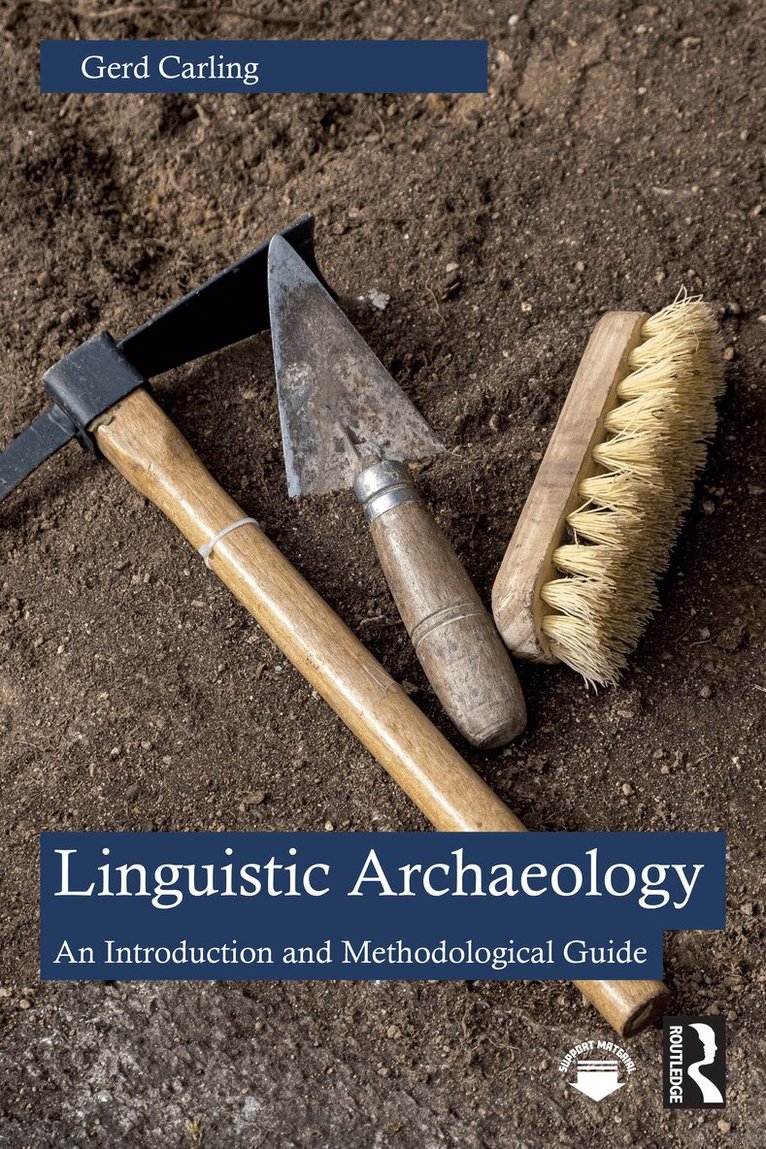
    Linguistic Archaeology

    An Introduction and Methodological Guide

    AvGerd Carling

    Häftad, Engelska, 2024

    615 kr

    Beställningsvara. Skickas inom 10-15 vardagar. Fri frakt över 249 kr.

    Fler format och utgåvor

    Inbunden

    2 495 kr

    E-bok

    725 kr

    E-bok

    693 kr

    Beskrivning

    Linguistic Archaeology provides students with an accessible introduction to the field of linguistic archaeology, both as theoretical framework and methodological toolkit, for understanding the conceptual foundations and practical considerations involved in reconstructing the prehistory of language.The book introduces the field’s expansion out of traditional approaches to focus more on the interplay of related disciplines and the reconstruction of human language beyond the written period. The opening chapter outlines key theories and charts their development from the nineteenth century through to today, drawing on work from computational historical linguistics, phylogenetics, and linguistic anthropology. Subsequent chapters build on theory to take a hands-on approach in mining empirical data in the process of reconstructing language prehistory, including references, links, and instructions to open access resources, and offering a step-by-step guide for employing the rich range of available methods in working with this data. Closing chapters situate theory and method in context against chronological and geographic perspectives and look ahead to future trajectories for continued progress in this emerging area of study.Offering a holistic entry point into linguistic archaeology, this innovative volume will be a helpful resource for students in historical linguistics, linguistic anthropology, language evolution, and cultural geography.

    Produktinformation

    • Utgivningsdatum:2024-05-22
    • Mått:152 x 229 x 15 mm
    • Vikt:320 g
    • Format:Häftad
    • Språk:Engelska
    • Antal sidor:182
    • Förlag:Taylor & Francis Ltd
    • ISBN:9781032271767

    Utforska kategorier

    • Arkeologi inom Historia och arkeologi
    • Språkvetenskap och lingvistik inom Språk och ordböcker
    • Geografi inom Naturvetenskap och teknik

    Mer om författaren

    Gerd Carling is Professor of Empirical Linguistics at Goethe University, Frankfurt am Main, Germany.

    Recensioner i media

    'Linguistic Archaeology is unparalleled in its scope and depth. In this indispensable core resource, Gerd Carling provides detailed historical accounts of the theoretical currents informing the contemporary study of language and languages in the deep past, complementing these with state-of-the-art descriptions of the methodological toolbox available to researchers.'Chris Sinha, University of East Anglia, UK

    Innehållsförteckning

    • Acknowledgements1. Setting the field: what is linguistic archaeology?1.1. What is linguistic archaeology?1.2. Defining the field: an overview of the content and organization of this book 1.3. Theoretical preconditions for reconstructing language prehistory1.3.1. Placing language reconstruction in the discipline of general linguistics 1.3.2. Controversies on the nature and origin of human language 1.4. Core concepts in models and methods of language reconstruction1.4.1. Defining and explaining pattern similarity 1.4.2. The tree and wave models 1.4.3. Family-based and deep reconstruction: ancestral nodes, proto-languages, and early language Further reading2. Basics: Structures and components of human language 2.1. Phonemes: the smallest units of speech2.2. Words and word classes2.3. Morphemes: the smallest meaning-bearing unit of a language 2.4. How words are glued together in grammar Further reading3. The diversity and origin of human language 3.1. Linguistic diversity and language population size 3.2. Origin of human language: why, when, and how?3.3. How to investigate linguistic diversity Further reading4. The comparative method 4.1. Basics of the comparative method 4.1.1. The comparative method and language classification 4.1.2. The problem of etymology and semantic change4.1.3. Reconstructing grammar by the comparative method Further reading4.2. Philology 4.2.1. Understanding the nature of writing and interpreting writing systems 4.2.2. Interpreting the linguistic value of writing4.2.3. Understanding the meaning of words and texts Further readingUseful resources 4.3. Historical linguistics 4.3.1. Historical linguistics: using the comparative method to observe language change 4.3.2. Sound change 4.3.3. Reconstructing lexical change: replacement, meaning change, and borrowing 4.3.4. Analogy 4.3.4. Grammaticalization Further readingUseful resources 5. The typological method5.1. Basics of the typological method Further readingUseful resources 5.2. Data mining for typology: language documentation Further readingUseful resources 5.3. Applying the typological method 5.3.1. Reconstructing early language Further reading5.3.2. Observing the evolution of language types Further reading5.3.3. Diachronic typology: reconstructing the typology of proto-languages Further reading6. The phylogenetic method 6.1. Phylogenetic and computational methods: a survey Further reading6.2. Data mining for phylogenetic methods Useful resources 6.3. Reconstruction of features of grammar, syntax, and phonology Further reading7. Archaeolinguistics: words, artefacts, and ancient DNA 7.1. Basics of the archaeolinguistic approach7.2. Methods in archaeolinguistic approach 7.2.1. Reconstructing the vocabulary of a proto-language Further reading7.2.2. Reconstructing the culture and beliefs of proto-language communities through language Further reading7.2.3. Reconstructing language contact and substrate influence7.3. Connecting reconstructed language to archaeology, ancient DNA, and prehistoric migrationsFurther reading8. Linguistic anthropology: relativist approaches to reconstructing language prehistory 8.1. The linguistic relativity approach: reconstructing diversity 8.2. Methods in linguistic relativity research 8.2.1. Observing small-scale societies 8.2.3. Designing experiments and stimuli for observing diversity of language-cognition-culture8.3. Contrasting results of small-scale societies cross-linguistically Further reading9. The cultural evolutionary approach 9.1. Overview of the cross-disciplinary field of cultural evolution 9.2. Methodologies of the cultural evolutionary approach 9.2.1. Data design and base concepts for compiling data 9.2.2. Models and methods: phylogenetic inference 9.2.3. Models and methods: experimental design 9.3. Triangulation Further reading10. Conclusion: linguistic archaeology in the past, present, and future BibliographyIndex