• Fri frakt över 249 kr
  • •
  • Snabba leveranser
  • •
  • Billiga böcker
Kundservice

Du är på sajten för privatpersoner.

Företag, bibliotek eller offentlig verksamhet?

Du handlar på classic.bokus.com, där alla dina funktioner finns intakta.
Till classic.bokus.com
Bokus logotyp. Gå till startsidan.
  • Erbjudanden
  • Nyheter
  • Student
  • Topplistor
  • Barn & ungdom
  • Bokus Play
  • E-böcker
  • Pocketböcker
  • Spel & pussel

10% rabatt på allt med kod: NYSTART10 →

Sidfot

Mina sidor

    Hjälp

    • Kundservice
    • Vanliga frågor och svar
    • Frakt och leverans
    • Retur vid ångerrätt
    • Reklamera vara
    • Betalning
    • Köpvillkor
    • Allmänna villkor
    • Information om webbplatsens tillgänglighet

    Om Bokus

    • Om oss
    • Pressrum
    • För studenter
    • För företag
    • För bibliotek och offentlig verksamhet
    • För leverantörer
    • Hållbarhet

    Populärt

    • Aktuella erbjudanden
    • Presentkort
    • Studentlitteratur
    • Nya böcker
    • Topplistor
    • Signerade böcker
    • Engelska böcker

    Inspiration

    • Boktips
    • BookTok
    • Populära bokserier
    • Barnbokskaraktärer
    • Populära författare
    Logotyp för Bokus
    Följ oss på Facebook (extern länk)Följ oss på Instagram (extern länk)Följ oss på YouTube (extern länk)Följ oss på TikTok (extern länk)
    bokus @ CookiesAnpassa cookiesIntegritetspolicyKöpvillkor
    Till Citymail hemsida (extern länk)Till Budbee hemsida (extern länk)Till Postnord hemsida (extern länk)Till Schenker hemsida (extern länk)Till Early Bird hemsida (extern länk)Till Walleys hemsida (extern länk)
    1. Samhälle och politik
    2. Samhälle och kultur
    3. Sociala och etiska frågor
    4. Migration

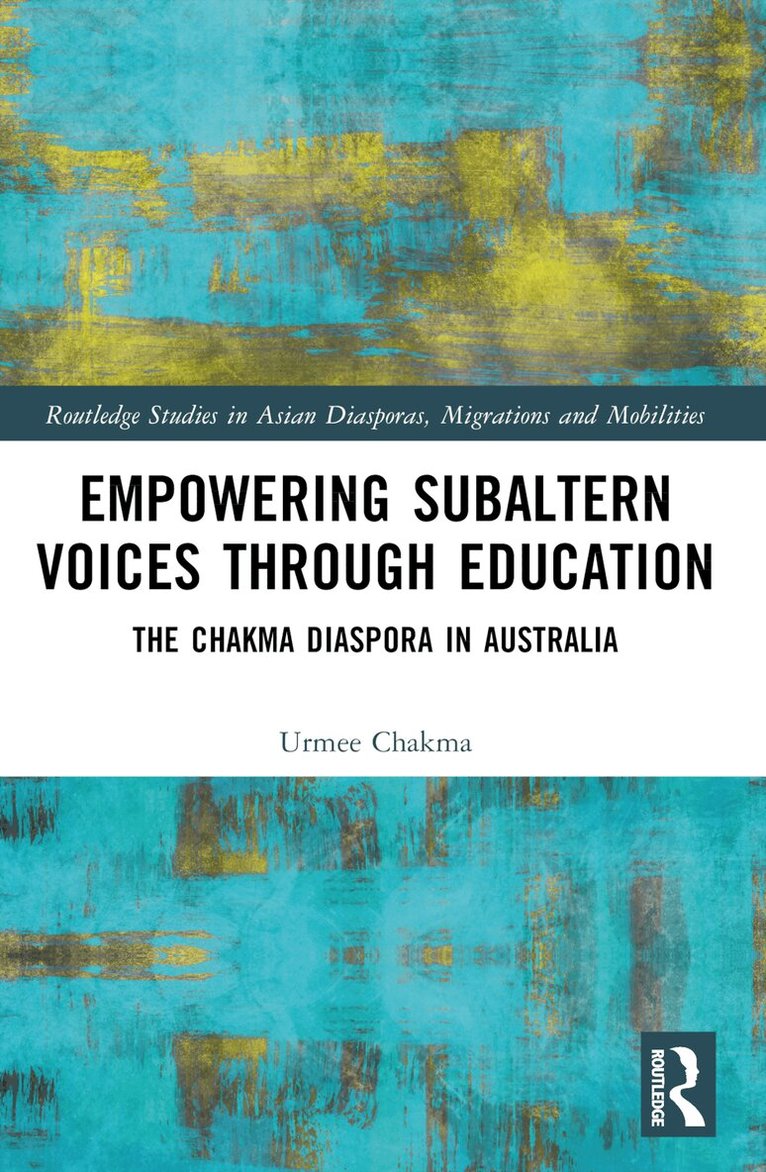
    Empowering Subaltern Voices Through Education

    The Chakma Diaspora in Australia

    AvUrmee Chakma

    Häftad, Engelska, 2024

    Del i serien Routledge Studies in Asian Diasporas, Migrations and Mobilities

    580 kr

    Beställningsvara. Skickas inom 10-15 vardagar. Fri frakt över 249 kr.

    Fler format och utgåvor

    E-bok

    704 kr

    E-bok

    704 kr

    Inbunden

    1 998 kr

    Beskrivning

    Based on a four‐year-long empirical study, this book employs contemporary theories from the Global South to investigate the role of education in the experience of migration and settlement of the Chakma people of Bangladesh in the city of Melbourne, Australia.Exploring the migration opportunities taken up by the Chakma and their efforts to retain, promote, and enrich their ethnic identity in Australia, the book critically examines the importance of education for ethnic, linguistic, and religious minorities and the extent to which education helped the diasporic community in achieving a ‘better’ and ‘more secure’ life. It also positions education as a tool to help revive, maintain, and enrich the importance of culture and tradition, both in the home country and in the place of settlement and offers a theorisation of how the self-directed pursuit of education can create opportunities for minority peoples, to advocate human rights, Indigenous recognition and criticise a state’s failure to provide safety and security.This book will be of interest to academics and postgraduate students researching in the fields of education, diaspora studies, Indigenous studies, and migration studies.

    Produktinformation

    • Utgivningsdatum:2024-10-09
    • Mått:156 x 234 x 11 mm
    • Vikt:453 g
    • Format:Häftad
    • Språk:Engelska
    • Serie:Routledge Studies in Asian Diasporas, Migrations and Mobilities
    • Antal sidor:176
    • Förlag:Taylor & Francis Ltd
    • ISBN:9781032354521

    Utforska kategorier

    • Migration inom Samhälle och politik
    • Utbildningsstrategier och utbildningspolitik inom Psykologi och pedagogik

    Mer om författaren

    Urmee Chakma works as a lecturer of humanities and pedagogy in the School of Education at La Trobe University, Australia. She earned her PhD from the Faculty of Education, Monash University and worked as a teaching and research associate at Monash from 2018 to 2022. She has been an educator for over 15 years. Her areas of research interest include Indigenous education, diasporic communities, citizenship studies, and social justice.

    Recensioner i media

    "Urmee Chakma’s book on Chakma life and the way once marginalized migrants from this minority community of their own country have been settling down in Australia is welcome, because it is a thorough as well as thoughtful detailed account of a few migrants successfully coping with their diasporic existence in a new world. Readers of the book will be heartened by her finding that education had empowered such migrants and enabled them to settle down well, overcoming the many adversities faced overseas by diasporic people in another, far off country. The author draws on major theorists of the Global South to make her important point that education can be the route to empowerment for marginalized peoples by giving detailed accounts of the career paths of the Chakmas she has chosen for her case studies. What is more, Urmee Chakma writes about her subjects lucidly and sensitively. Clearly, her own lived experience has gone into the making of a compelling work that will be inspirational for readers everywhere."Fakrul Alam, Supernumerary Professor, Department of English, University of Dhaka "Urmee Chakma's book, "Empowering Subaltern Voices Through Education: The Chakma Diaspora in Australia" is both a reflection on her own experience as a Chakma Indigenous woman from the Chittagong Hill Tracts in Bangladesh, now living and working in Australia for over 20 years, as well as a critical reading of indigeneity in mainstream education viewed from the epistēmēs of the first part of the twenty-first century. As such it is rich in experiential and epistemo-ontological knowledge of a world that is fluid and transient in content and interpretation.It is a must read for those interested in a critical reading of the modernist education system as well as those working towards more inclusive policies of governance and society in a world that is increasingly becoming more exclusionary."Professor Meghna Guhathakurta, Executive Director of Research Initiatives, Bangladesh (RIB) "Urmee Chakma analyses the significance of education as a powerful enabler for Indigenous peoples, and how it can empower marginalised peoples to challenge stereotypes and forge a new future both at home and abroad. The book draws on the author’s own lived experiences complemented by research among the Chakma diaspora in Australia. While it illustrates a success story - the combination of education and immigration that offers stability and security free of political turmoil and oppression, it is not an easy option. It carries complex challenges with inherent feelings of loss and displacement, while at the same time struggling to transmit identity and culture to future generations. This compelling narrative of the Chakma diaspora in Australia is an important study that demonstrates the shared, yet unique challenges faced by Indigenous peoples around the world, and how education is key to empowerment. It calls for a new curriculum of Indigenous literature of lived experiences and oral historiesthat is an integral part of the formal education systems around the world. Only by learning from each other can we teach future generations to build a better world that is equitable and just, founded on respect and recognition of our differences."Princess Chandra Kalindi Roy, Former Chief of Indigenous Peoples and Development Branch United Nations Department of Economic and Social Affairs (UN DESA

    Innehållsförteckning

    • Part I: Overview: Contextualising the Study 1. History of the Chakma and the Chittagong Hill Tracts 2. Chakma and Education: A Critical Chronology of Socio-politics Part II: Theorising Minority Identities 3. The Politics of Indigeneity, Othering, and Belongingness 4. Chakma and Migration for and Through Education 5. Theoretical Understandings of the Chakmas Diasporic Journeys Part III: Empirically Situating the Study 6. Roles of Education in Upward Mobility, Security, and Advocacy 7. Enrichment, Not Assimilation: Preserving Culture in Diaspora 8. Conclusion