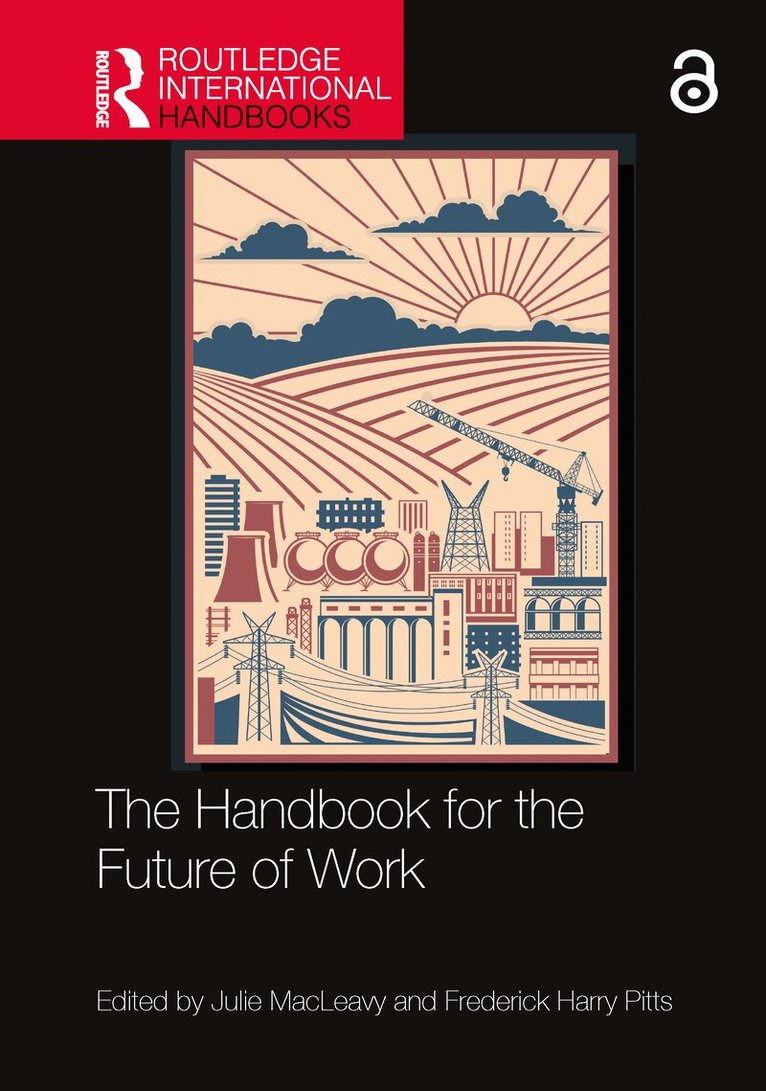
Häftad, Engelska, 2026
Handbook for the Future of Work
Av Julie MacLeavy, Frederick Harry Pitts
Del i serien Routledge International Handbooks
786 kr
Beställningsvara. Skickas inom 10-15 vardagar. Fri frakt över 249 kr.
Beskrivning
Produktinformation
- Utgivningsdatum: 2026-06-22
- Mått: 174 x 246 x 31 mm
- Vikt: 830 g
- Format: Häftad
- Språk: Engelska
- Serie: Routledge International Handbooks
- Antal sidor: 424
- Förlag: Taylor & Francis Ltd
- ISBN: 9781032355917
Utforska kategorier
Mer om författaren
Julie MacLeavy is a Professor of Economic Geography at the University of Bristol, UK specialising in feminist political economy, economic transformations and new forms of work. She is the Theme Lead for the ‘Innovation, Transition, Change’ challenge within the new Academic Research Hub for the Prevention of Gambling Harms at the University of Bristol, co-Editor-in-Chief of Geoforum and Treasurer of the Royal Geographical Society (with the Institute of British Geographers) Economic Geography Research Group. Julie is the co-editor of The Handbook of Neoliberalism (Routledge) and author of Enduring Austerity: The Uneven Geographies of the Post-Welfare State (University of Bristol Press), which examines how austerity policies create an uneven landscape of work and welfare opportunities across different communities.Frederick Harry Pitts is a Senior Lecturer in Politics at the University of Exeter’s Cornwall Campus in his hometown of Penryn, where he is also the Director of Business Engagement and Innovation for Humanities and Social Sciences. He is a Co-Investigator of the Economic and Social Research Council Centre for Sociodigital Futures, a Fellow of the Institute for the Future of Work, Secretary of the British Universities Industrial Relations Association and an Honorary Senior Research Fellow at University of Bristol Business School. He is the author or coauthor of five previous books, most recently Marx in Management and Organisation Studies: Rethinking Value, Labour and Class Struggles (Routledge).
Recensioner i media
"Develops a sophisticated approach that explores the ongoing interdependencies between pasts, presents and futures of work as these play out at the intersection of technological advancements, geopolitical realignments and evolving worker demands. In doing so, this book opens-up rather than closes-down the future of work - both as a topic for research and an opportunity for contestation."Professor Susan Halford, University of Bristol"A rich, insightful and provocative examination of disruptive histories and futures of work. The interdisciplinary, international approaches challenge established boundaries of analysis and explanation. Emerging working practices, differentiated experiences, global political challenges and environmental concerns shape the kaleidoscopic understanding of change and the potential role for agency in that process. A welcome pleasure and provocation to read – you will learn something and it will make you think again."Professor Jacqueline O'Reilly, ESRC Centre for Digital Futures at Work, University of Sussex“This handbook provides an innovative and valuable antidote to mainstream and strictly quantitative analyses of work and employment in the 21st century. Moving beyond technological determinism and unreflective speculation, it is critical, inter-disciplinary, theoretically rich, substantively diverse, and ultimately indispensable for scholars wishing to understand the present and future of work.”Professor Michael Samers, Department of Geography, University of Kentucky"Ambitious, open-minded, and comprehensive, The Handbook for the Future of Work offers a catalogue of emerging realities for working people. Intrigued by technological change and troubled by socio-ecological crises, the volume insists on the possibilities of different trajectories. Spanning continents, sectors, and intellectual viewpoints, this is a truly remarkable effort."Professor David Jordhus-Lier, Department of Sociology and Human Geography, University of Oslo
Betyg & recensioner
0 recensioner
Inga recensioner tillgängliga.