• Fri frakt över 249 kr
  • •
  • Snabba leveranser
  • •
  • Billiga böcker
Kundservice

Du är på sajten för privatpersoner.

Företag, bibliotek eller offentlig verksamhet?

Du handlar på classic.bokus.com, där alla dina funktioner finns intakta.
Till classic.bokus.com
Bokus logotyp. Gå till startsidan.
  • Erbjudanden
  • Nyheter
  • Student
  • Topplistor
  • Barn & ungdom
  • Bokus Play
  • E-böcker
  • Pocketböcker
  • Spel & pussel

10% rabatt på allt med kod: NYSTART10 →

Sidfot

Mina sidor

    Hjälp

    • Kundservice
    • Vanliga frågor och svar
    • Frakt och leverans
    • Retur vid ångerrätt
    • Reklamera vara
    • Betalning
    • Köpvillkor
    • Allmänna villkor
    • Information om webbplatsens tillgänglighet

    Om Bokus

    • Om oss
    • Pressrum
    • För studenter
    • För företag
    • För bibliotek och offentlig verksamhet
    • För leverantörer
    • Hållbarhet

    Populärt

    • Aktuella erbjudanden
    • Presentkort
    • Studentlitteratur
    • Nya böcker
    • Topplistor
    • Signerade böcker
    • Engelska böcker

    Inspiration

    • Boktips
    • BookTok
    • Populära bokserier
    • Barnbokskaraktärer
    • Populära författare
    Logotyp för Bokus
    Följ oss på Facebook (extern länk)Följ oss på Instagram (extern länk)Följ oss på YouTube (extern länk)Följ oss på TikTok (extern länk)
    bokus @ CookiesAnpassa cookiesIntegritetspolicyKöpvillkor
    Till Citymail hemsida (extern länk)Till Budbee hemsida (extern länk)Till Postnord hemsida (extern länk)Till Schenker hemsida (extern länk)Till Early Bird hemsida (extern länk)Till Walleys hemsida (extern länk)
    1. Kultur
    2. Konstböcker
    3. Konsthistoria

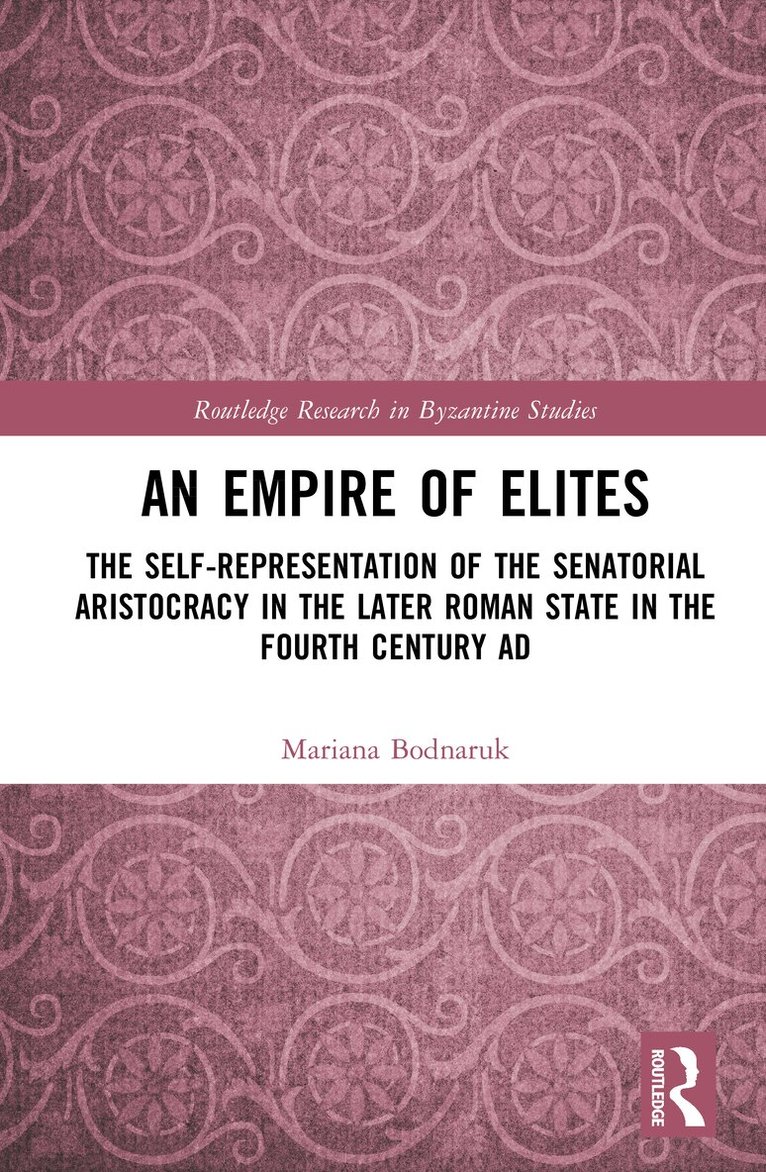
    Empire of Elites

    The Self-Representation of the Senatorial Aristocracy in the Later Roman State in the Fourth Century AD

    AvMariana Bodnaruk

    Inbunden, Engelska, 2025

    Del i serien Routledge Research in Byzantine Studies

    2 493 kr

    Beställningsvara. Skickas inom 10-15 vardagar. Fri frakt över 249 kr.

    Fler format och utgåvor

    E-bok

    829 kr

    E-bok

    831 kr

    Beskrivning

    Empire of Elites investigates the self-representation of the late Roman senatorial aristocracy in epigraphic evidence to illuminate the cultural, social, and political dynamics of the Later Roman Empire. In the Roman hierarchy, the senatorial order stood above all social strata. By examining aristocratic inscriptions and materiality – supplemented by art identified as senatorial and contextualized within contemporary literature – the study situates the self-image of the empire’s highest-ranking elites within the broader context of fourth-century imperial society.Arguing that the ideological portrayals of the late antique aristocracy reflect an artistic perception of social totality in cultural form, the book moves beyond analyses of elite dominance in the imperial state to address wider cultural and social transformations as mediated through epigraphy and art. It explores how the late imperial rule transformed the role of senators in governance, drawing on archaeological, inscriptional, and textual evidence to reveal the political, social, and cultural impact of transregional senatorial officeholders. This study demonstrates how the integrated relationship between state and aristocracy shaped the administration and government of the empire, offering new insights into the interplay of power, representation, and culture in the late Roman world.This book will appeal to scholars and students of Roman political and cultural history, administrative elites, institutional evolution, and the comparative study of premodern government. It will also be of interest to specialists in Latin and Greek epigraphy and literature, as well as late antique art, providing a multidisciplinary perspective on the social imagination and cultural expression of the late Roman aristocracy.

    Produktinformation

    • Utgivningsdatum:2025-12-31
    • Mått:156 x 234 x 22 mm
    • Vikt:760 g
    • Format:Inbunden
    • Språk:Engelska
    • Serie:Routledge Research in Byzantine Studies
    • Antal sidor:312
    • Förlag:Taylor & Francis Ltd
    • ISBN:9781032360089

    Utforska kategorier

    • Konsthistoria inom Kultur
    • Forntidens historia inom Historia och arkeologi
    • Arkeologiska perioder och områden inom Historia och arkeologi

    Mer om författaren

    Mariana Bodnaruk is Assistant Professor at the Faculty of History of the University of Warsaw, Poland, and a senior researcher at the Center for Medieval Visual Cultures and Research Communication at the Art History Department of the Masaryk University in Brno, Czechia. They received a Ph.D. in Medieval Studies from the Central European University in Budapest, Hungary, in 2019. Their research was published in Journal of Epigraphic Studies, Journal of Late Antiquity, Antichthon, Phoenix, and Byzantinoslavica. Their research interests include epigraphy, art history, and hagiography of the medieval East Roman Empire, gender studies, queer and trans theory, and historical materialism.

    Innehållsförteckning

    • IntroductionChapter 1Imperial Aristocracy: Senators and New Hierarchies of HonorsI. Quaestor, Praetor, Suffect ConsulII. Religious Offices1. Religious Activities of Senators in Their Private Non-Official Roles2. Religious Activities of Senators in Their Public Official Roles3. Christian Religious OfficesIII. Count, Patrician, Ordinary ConsulChapter 2Urban and Regional Administration: Civilian GovernmentI. Illustres as Imperial Proxy Presence1. Praetorian Prefect (Praefectus Praetorio)2. Urban Prefect (Praefectus Urbi)II. Spectabiles Between Center and Periphery1. Proconsul (Proconsul)2. Count of the East (Comes Orientis)3. Augustal Prefect (Praefectus Augustalis)4. Vicar (Vicarius)III. Clarissimi and Patterns in Office-Holding1. Provincial Governors: Consularis, Corrector, Praeses2. Prefect of the Annona (Praefectus Annonae) and Prefect of the Vigils (Praefectus Vigilum)3. Curators of the City of Rome (Curatores Urbis Romae)4. Legates of Proconsul (Legati Proconsulis)Chapter 3Regional Administration: Military GovernmentI. Illustres: The Ascendancy of High-Ranking Militares as a New Senatorial Elite1. Master of Soldiers (Magister Militum)2. Count of the Imperial Guard (Comes Domesticorum)II. Spectabiles: Middle-Tier Military Commanders As a Backbone of Hierarchy1. Count of Military Matters (Comes Rei Militaris)2. Duke (Dux)III. Clarissimi: Lower-Grade Military Officers As Pillars of the Ranks1. Tribune (Tribunus)2. Prefect (Praefectus) and Provost (Praepositus)3. Chief Officer of the Imperial Guard (Primicerius Protectorum Domesticorum)Chapter 4Central Administration: The Palatine BureaucracyI. The Rise of the Roman Bureaucrats: Illustres1. Provost of the Sacred Bedchamber (Praepositus Sacri Cubiculi)2. Consistorian Counts (Comites Consistoriani)i. Master of Offices (Magister Officiorum)ii. Quaestor (Quaestor Sacri Palatii)iii. Count of the Sacred Largess (Comes Sacrarum Largitionum)iv. Count of the Private Domains (Comes Rerum Privatarum)II. Working in the Proximity of the Ruler: Spectabiles1. Superintendent of the Sacred Bedchamber (Primicerius Sacri Cubiculi) and Castellan of the Sacred Palace (Castrensis Sacri Palatii)2. Tribunes and Notaries (Tribuni et Notarii): Chief of the Notaries (Primicerius Notariorum)3. Masters of the Record Bureaus (Magistri Scriniorum)i. Master of Memorials (Magister Memoriae)ii. Master of Correspondence and Master of Greek Correspondence (Magister Epistularum and Magister Epistularum Graecarum)iii. Master of Requests (Magister Libellorum)III. A New Bureaucratic Elite: Clarissimi1. Counts of the Diocesan Largesses (Comites Largitionum) and Accountants (Rationales)2. Chiefs of Office Staff of the Corps of General Agents (Principes Pfficiorum Ex Agentibus in Rebus)3. First Deputy-Chiefs of the Record Bureaus (Proximi Scriniorum) and Master of the Schedules (Magister Dispositionum)ConclusionBibliography