• Fri frakt över 249 kr
  • •
  • Snabba leveranser
  • •
  • Billiga böcker
Kundservice

Du är på sajten för privatpersoner.

Företag, bibliotek eller offentlig verksamhet?

Du handlar på classic.bokus.com, där alla dina funktioner finns intakta.
Till classic.bokus.com
Bokus logotyp. Gå till startsidan.
  • Erbjudanden
  • Student
  • Topplistor
  • Barn & ungdom
  • Bokus Play
  • Bokus Play
  • E-böcker
  • Ljudböcker
  • Pocketböcker
  • Spel & pussel

10% rabatt på allt med kod NYSTART10 →

Sidfot

Mina sidor

    Hjälp

    • Kundservice
    • Vanliga frågor och svar
    • Frakt och leverans
    • Retur vid ångerrätt
    • Reklamera vara
    • Betalning
    • Köpvillkor
    • Allmänna villkor
    • Information om webbplatsens tillgänglighet

    Om Bokus

    • Om oss
    • Pressrum
    • För studenter
    • För företag
    • För bibliotek och offentlig verksamhet
    • För leverantörer
    • Hållbarhet

    Populärt

    • Aktuella erbjudanden
    • Presentkort
    • Studentlitteratur
    • Nya böcker
    • Topplistor
    • Signerade böcker
    • Engelska böcker

    Inspiration

    • Boktips
    • BookTok
    • Populära bokserier
    • Barnbokskaraktärer
    • Populära författare
    Logotyp för Bokus
    Följ oss på Facebook (extern länk)Följ oss på Instagram (extern länk)Följ oss på YouTube (extern länk)Följ oss på TikTok (extern länk)
    bokus @ CookiesAnpassa cookiesIntegritetspolicyKöpvillkor
    Till Citymail hemsida (extern länk)Till Budbee hemsida (extern länk)Till Postnord hemsida (extern länk)Till Schenker hemsida (extern länk)Till Early Bird hemsida (extern länk)Till Walleys hemsida (extern länk)
    1. Naturvetenskap och teknik
    2. Matematik och naturvetenskap
    3. Matematik
    4. Tillämpad matematik

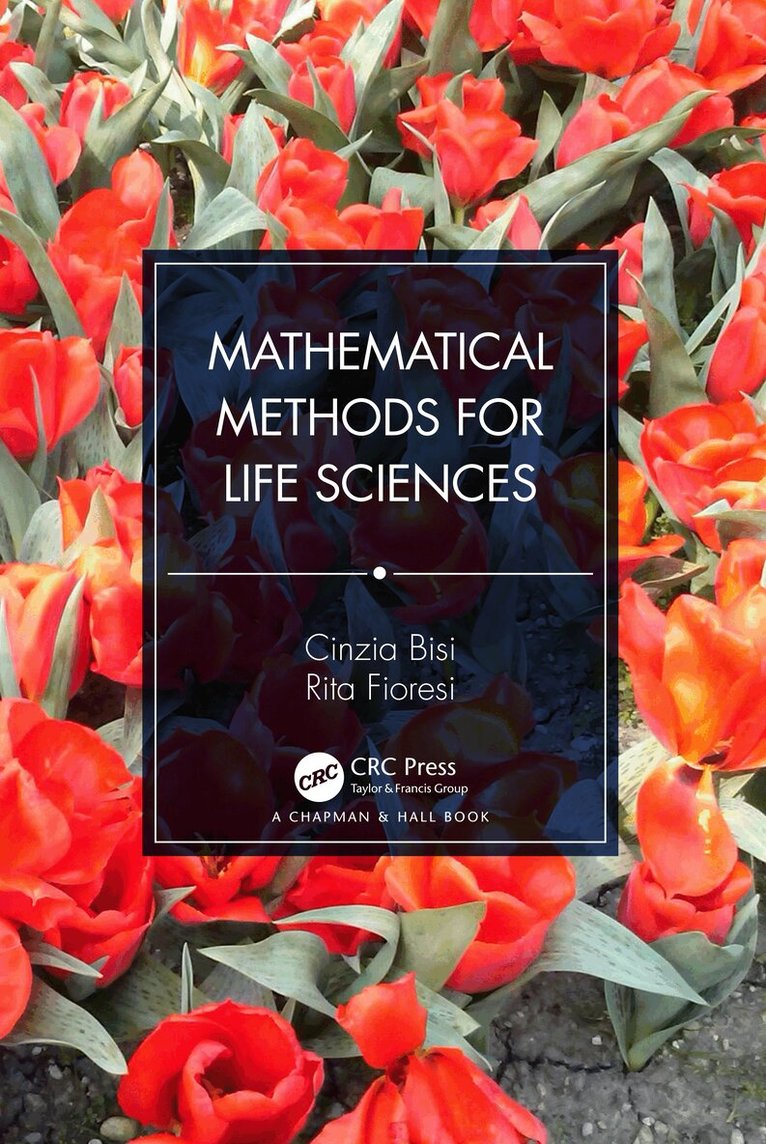
    Mathematical Methods for Life Sciences

    AvCinzia Bisi,Rita Fioresi

    Häftad, Engelska, 2024

    849 kr

    Beställningsvara. Skickas inom 10-15 vardagar. Fri frakt över 249 kr.

    Fler format och utgåvor

    Inbunden

    2 422 kr

    Beskrivning

    Mathematical Methods for Life Sciences introduces calculus, and other key mathematical methods, to students from applied sciences (biology, biotechnology, chemistry, pharmacology, material science, etc). Special attention is paid to real-world applications, and for every concept, many concrete examples are provided. The book does not aim to enable students to prove theorems and construct elaborate proofs, but rather to leave students with a clear understanding of the practical mathematics behind the power of optimization, dynamical systems, and all the predictive tools these theories give rise to.FeaturesNo prerequisites beyond high school algebra and geometryCould serve as the primary text for a first-year course in mathematical methods for biology, biotechnology, or other life sciencesEasy to read: the students may skip all the proofs and go directly to key examples and applications

    Produktinformation

    • Utgivningsdatum:2024-01-19
    • Mått:156 x 234 x 19 mm
    • Vikt:380 g
    • Format:Häftad
    • Språk:Engelska
    • Antal sidor:232
    • Förlag:Taylor & Francis Ltd
    • ISBN:9781032380582

    Utforska kategorier

    • Tillämpad matematik inom Naturvetenskap och teknik
    • Beräkning och matematisk analys inom Naturvetenskap och teknik
    • Diskret matematik inom Naturvetenskap och teknik

    Mer om författaren

    Cinzia Bisi is a Professor of Geometry at the Department of Mathematics and Computer Sciences at the University of Ferrara, Italy. She has wide experience in teaching mathematics and statistics to students in the Department of Life Sciences. She has an interest in the areas of pure and applied mathematics.Rita Fioresi is a professor of Geometry at the FaBiT Department at the University of Bologna, Italy. She has written textbooks in linear algebra, and her research interests are primarily in the areas of pure and applied mathematics.

    Innehållsförteckning

    • 1. Functions in applied sciences. 1.1. The concept of function. 1.2. Linear functions. 1.3. Polynomial functions. 1.4. Rational functions and algebraic functions. 1.5. The exponential and logarithmic functions. 1.6. Malthusian Law. 1.7. Elementary trigonometric functions. 1.8. Exercises with solutions. 1.9. Suggested Exercises. 2. Limits and Derivatives. 2.1. Limits. 2.2. Properties of limits and standard limits. 2.3. Indeterminate forms. 2.4. Continuity. 2.5. Derivative of a function. 2.6. Derivability and Continuity. 2.7. De L’Hopital’s Rule. 2.8. Derivative of the Inverse Function. 2.9. Exercises with solutions. 2.10. Suggested Exercises. 2.11. Appendix: Derivation rules. 2.12. Appendix: Derivatives. 2.13. Appendix: Theorems on limits. 3. Applications of the derivative. 3.1. The linear approximation. 3.2. The derivative as rate of change. 3.3. Local Maxima and Minima. 3.4. Graph sketching. 3.5. Optimization. 3.6. Exercises with SolutionsSuggested Exercises. 3.7. Appendix: Theorems of differential calculus. 4. Integrals. 4.1. The Definite Integral. 4.2. Properties of the definite integral. 4.3. The Fundamental Theorem of Calculus. 4.4. Integration by substitution. 4.5. Integration by parts. 4.6. Integration of rational functions. 4.7. Integration of trigonometric functions. 4.8. Applications. 4.9. Exercises with solutions. 4.10. Suggested Exercises. 4.11. Appendix: Indefinite integrals. 4.12. Appendix: Theorems on integral calculus. 5. First order differential equations. 5.1. First order equations. 5.2. The Cauchy problem. 5.3. Direction field. 5.4. Separable Equations. 5.5. Newton’s law of cooling. 5.6. Linear equations. 5.7. Mixing problems. 5.8. Malthusian laws and population dynamics. 5.9. Homogeneous equations. 5.10. Autonomous differential equations. 5.11. The Logistics Model. 5.12. Solution of the logistic equation. 5.13. Exercises with solutions. 5.14. Suggested exercises. 6. Second order differential equations. 6.1. Cauchy’s Theorem. 6.2. The Wronskian. 6.3. Homogeneous linear equations. 6.4. Linear equations. 6.5. Linear equations with constant coefficients. 6.6. Equations with constant coefficients: the general case. 6.7. Simple harmonic motion. 6.8. Harmonic motion with external force. 6.9. Damped harmonic motion. 6.10. Exercises with Solutions. 6.11. Suggested Exercises. 6.12. Appendix: Linear Systems. 7. Elementary Statistics. 7.1. Populations and Variables. 7.2. Absolute Frequencies and Percentages. 7.3. Graphical representation of data. 7.4. Mode, Average, and Median. 7.5. Variance and standard deviation. 7.6. Quartiles and Interquartile Range. 7.7. Normal Distribution. 7.8. Exercises with solutions. 7.9. Suggested Exercises. A. Solutions of some exercises.