• Fri frakt över 249 kr
  • •
  • Snabba leveranser
  • •
  • Billiga böcker
Kundservice

Du är på sajten för privatpersoner.

Företag, bibliotek eller offentlig verksamhet?

Du handlar på classic.bokus.com, där alla dina funktioner finns intakta.
Till classic.bokus.com
Bokus logotyp. Gå till startsidan.
  • Erbjudanden
  • Nyheter
  • Student
  • Topplistor
  • Barn & ungdom
  • Bokus Play
  • E-böcker
  • Pocketböcker
  • Spel & pussel

10% rabatt på allt med kod: NYSTART10 →

Sidfot

Mina sidor

    Hjälp

    • Kundservice
    • Vanliga frågor och svar
    • Frakt och leverans
    • Retur vid ångerrätt
    • Reklamera vara
    • Betalning
    • Köpvillkor
    • Allmänna villkor
    • Information om webbplatsens tillgänglighet

    Om Bokus

    • Om oss
    • Pressrum
    • För studenter
    • För företag
    • För bibliotek och offentlig verksamhet
    • För leverantörer
    • Hållbarhet

    Populärt

    • Aktuella erbjudanden
    • Presentkort
    • Studentlitteratur
    • Nya böcker
    • Topplistor
    • Signerade böcker
    • Engelska böcker

    Inspiration

    • Boktips
    • BookTok
    • Populära bokserier
    • Barnbokskaraktärer
    • Populära författare
    Logotyp för Bokus
    Följ oss på Facebook (extern länk)Följ oss på Instagram (extern länk)Följ oss på YouTube (extern länk)Följ oss på TikTok (extern länk)
    bokus @ CookiesAnpassa cookiesIntegritetspolicyKöpvillkor
    Till Citymail hemsida (extern länk)Till Budbee hemsida (extern länk)Till Postnord hemsida (extern länk)Till Schenker hemsida (extern länk)Till Early Bird hemsida (extern länk)Till Walleys hemsida (extern länk)
    1. Ekonomi och Ledarskap
    2. Nationalekonomi
    3. Mikroekonomi

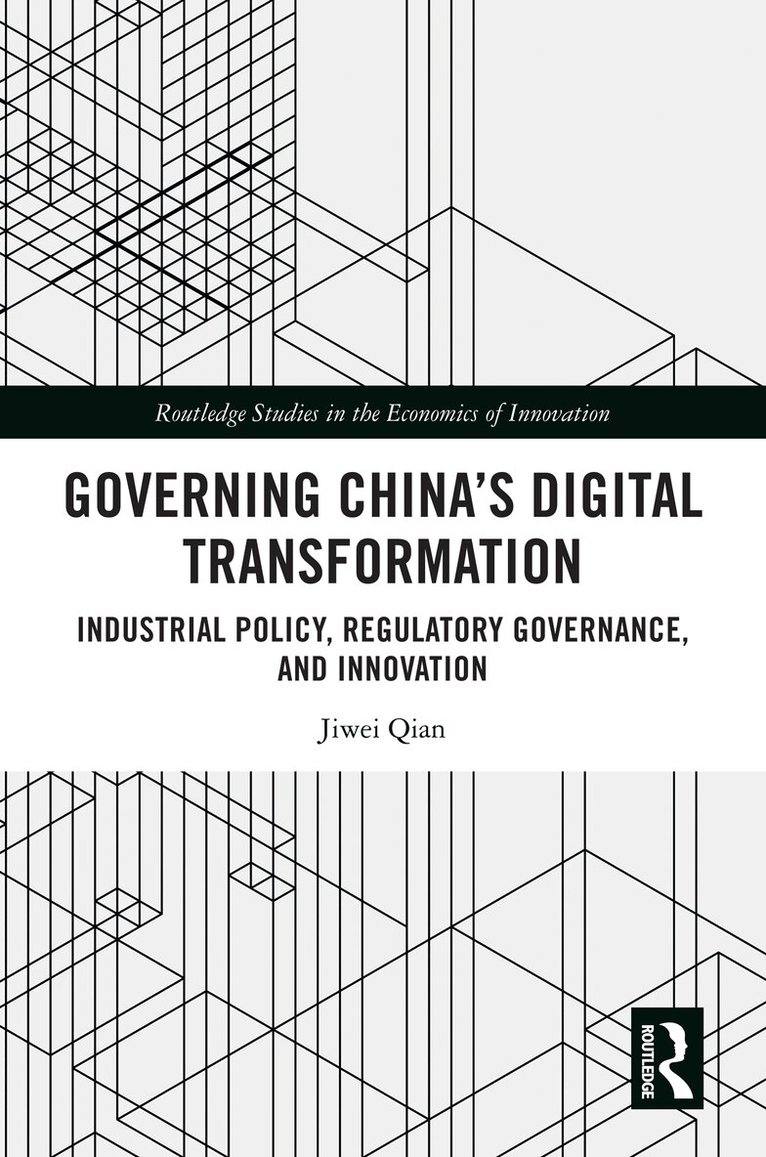
    Governing China's Digital Transformation

    Industrial Policy, Regulatory Governance, and Innovation

    AvJiwei Qian

    Inbunden, Engelska, 2025

    Del i serien Routledge Studies in the Economics of Innovation

    2 493 kr

    Beställningsvara. Skickas inom 10-15 vardagar. Fri frakt över 249 kr.

    Fler format och utgåvor

    E-bok

    741 kr

    E-bok

    741 kr

    Beskrivning

    This book examines China’s digital transformation and its complex policy landscape, offering fresh insights into how the world’s second-largest economy navigates the challenges of governing its rapidly evolving digital sector. Through detailed analysis, it reveals the intricate relationship between technological innovation and policy implementation in contemporary China.The book explores critical themes including digital industrial policies, competition policy, data governance, and artificial intelligence development. It introduces two dynamics: the “digital amplification of fragmentation,” which explains how digital technologies intensify existing governance challenges, and the “technology-policy recursive loop,” which describes the interaction between technological advancement and regulatory responses. Using diverse data sources and covering developments such as China’s 2020–2021 regulatory crackdown of major technology firms like Alibaba and Tencent, the book provides a comprehensive examination of China’s unique approach to digital governance. Special attention is paid to pressing issues such as data security, cross-border data flows, and technological self-reliance.An essential read for policymakers, business leaders, and scholars seeking to understand China’s digital economy and its implications for global digital governance. Its accessible analysis offers valuable insights for anyone interested in the intersection of technology, policy, and economic development in contemporary China.

    Produktinformation

    • Utgivningsdatum:2025-07-31
    • Mått:156 x 234 x 15 mm
    • Vikt:500 g
    • Format:Inbunden
    • Språk:Engelska
    • Serie:Routledge Studies in the Economics of Innovation
    • Antal sidor:180
    • Förlag:Taylor & Francis Ltd
    • ISBN:9781032386584

    Utforska kategorier

    • Mikroekonomi inom Ekonomi och Ledarskap
    • Entreprenörskap inom Ekonomi och Ledarskap
    • Digital ekonomi inom Ekonomi och Ledarskap

    Mer om författaren

    Jiwei Qian is Senior Research Fellow at the East Asian Institute, National University of Singapore. He has published widely in leading academic journals, including China Quarterly, Journal of European Social Policy, Journal of Social Policy, Policy and Society, Policy Studies Journal, and Social Science & Medicine.

    Recensioner i media

    "Jiwei Qian’s book, Governing China’s Digital Transformation, offers an incisive, up-to-date and comprehensive survey of China’s efforts to guide the growth of the digital economy. Emphasizing the tradeoffs between promotion of rapid technological innovation while preserving state control over the use of data, Qian analyzes the interplay between technological change and regulatory responses in such areas as e-commerce, fintech, smart manufacturing, and AI. Treating digital technology as the main driver of economic growth compounds the old problem of fragmented governance and competing goals. For example, the government has pressed the digital platform giants to develop indigenous “chokepoint” technologies to replace overseas-origin software, while at the same time encouraging them to realize the economic benefits of consumer-facing network technologies. The book will stand as an authoritative study of this hugely important and rapidly developing sector of China’s economy."- Thomas F. Remington, Professor, Emory University, USA"This book is a timely and important contribution. Understanding China’s rapid rise as a technological superpower—and the challenges it faces in governing its digital sectors—has become a matter of both urgent policy relevance and scholarly significance as competition for digital and AI supremacy increasingly defines the new frontier of China–US geostrategic rivalry. With comprehensive coverage spanning digital technological change, industrial policy, as well as the regulation of cross-border data flows and artificial intelligence, this book offers both breadth and depth. Dr. Qian provides a sophisticated analysis of China’s industrial and regulatory strategies, showing how digital technologies and state policies co-evolve in shaping the country’s digital economy. This book is essential reading for policymakers, business leaders, and scholars alike. It not only advances our understanding of China’s digital transformation but also underscores its global implications for innovation, regulation, and digital governance."- Hongzhou Zhang, Assistant Professor, Nanyang Technological University, Singapore"China is in the midst of a fascinating development of its digital economy, and few scholars are as familiar and up-to-date with the transition as Jiwei Qian. In this book, he offers an authoritative analysis of the economic and technological forces that provides a complex and challenging environment for China’s efforts to promote and regulate digital innovation. At the center of his theoretical argument is the digital amplification of fragmentation in policies for regulating data, affecting issues such as public data sharing, cross-border data flows, as well as data security. This has introduced a recursive loop in the implementation of innovation policies and regulation of digital platforms, shifting from top-down imposition of policies and consensus-building initiatives through negotiation and bargaining processes. Undergirding these theoretical insights Qian offers a robust base of empirical evidence about key events that have shaped the digital transformation of China in recent decades. This book is therefore essential reading for students of China’s current and future economic development."- Erik Baark, Professor Emeritus, Hong Kong University of Science and Technology, Hong Kong"Governing China’s Digital Transformation is a masterful account of China’s digital industrial policies and their implementation. In this timely intervention, Qian captures with clarity and insight how the Chinese state navigates the tensions between rapid digital innovation and the imperatives of regulation, market order, and social stability. This book is a must-read for scholars, policymakers, and practitioners seeking to understand governance in China’s digital economy." - Luzhou Li, Senior Lecturer, Monash University, Australia; Author of Zoning China: Online Video, Popular Culture, and the State"Governing China’s Digital Transformation offers a sophisticated and deeply researched analysis of how digital technologies reshape economic governance. Jiwei Qian shows with striking clarity how big data, digital platforms, and AI do not merely transform markets - they amplify the structural fragmentation of China’s policymaking system. Insightful, theoretically innovative, and empirically rich, this book is essential reading for anyone seeking to understand the evolving relationship between state capacity, institutional constraints, and digital capitalism in China and beyond."- Michael Rochlitz, Associate Professor, University of Oxford, UK"The picture of China’s tech sector that emerges from this detailed account is far more halting, confused and humble than is often portrayed in the West. […] The book presents convincing evidence that China’s tech policy is best understood as an exercise in struggling to maintain a semblance of central control and direction over a vastly complex and fragmented set of actors – not exactly the Panopticon often portrayed by foreign observers."- Scott Moore, Practice Professor of Political Science, University of Pennsylvania, USA; Review in The China Quarterly, DOI: 10.1017/S0305741025101884"Governing China’s Digital Transformation is a valuable resource for scholars, business leaders, and policymakers, particularly against the backdrop of geopolitical tensions."- Michael Keane, Professor, Queensland University of Technology, Australia; The China Journal

    Innehållsförteckning

    • 1. Digital Technological Changes and Economic Governance in China2. The Interplay of Policy Implementation and Technological Changes in the Chinese Digital Economy3. Digital Industrial Policy in China: Strategic Ambitions and Implementation Challenges4. Promoting Indigenous Digital Innovation5. Competition Policy Enforcement in the Chinese Digital Economy6. Regulating Cross-Border Data Flow7: The Development and Regulation of Artificial Intelligence8: Conclusions and Policy ImplicationsReferencesIndex