• Fri frakt över 249 kr
  • •
  • Snabba leveranser
  • •
  • Billiga böcker
Kundservice

Du är på sajten för privatpersoner.

Företag, bibliotek eller offentlig verksamhet?

Du handlar på classic.bokus.com, där alla dina funktioner finns intakta.
Till classic.bokus.com
Bokus logotyp. Gå till startsidan.
  • Erbjudanden
  • Student
  • Topplistor
  • Barn & ungdom
  • Bokus Play
  • E-böcker
  • Ljudböcker
  • Pocketböcker
  • Spel och pussel

Pocketfynda! Hundratals böcker för 49 kr/st →

Sidfot

Mina sidor

    Hjälp

    • Kundservice
    • Vanliga frågor och svar
    • Frakt och leverans
    • Retur vid ångerrätt
    • Reklamera vara
    • Betalning
    • Köpvillkor
    • Allmänna villkor
    • Information om webbplatsens tillgänglighet

    Om Bokus

    • Om oss
    • Pressrum
    • För studenter
    • För företag
    • För bibliotek och offentlig verksamhet
    • För leverantörer
    • Hållbarhet

    Populärt

    • Aktuella erbjudanden
    • Presentkort
    • Studentlitteratur
    • Nya böcker
    • Topplistor
    • Signerade böcker
    • Engelska böcker

    Inspiration

    • Boktips
    • BookTok
    • Barnbokskaraktärer
    • Populära författare
    Logotyp för Bokus
    Följ oss på Facebook (extern länk)Följ oss på Instagram (extern länk)Följ oss på YouTube (extern länk)Följ oss på TikTok (extern länk)
    bokus @ CookiesAnpassa cookiesIntegritetspolicyKöpvillkor
    Till Citymail hemsida (extern länk)Till Budbee hemsida (extern länk)Till Postnord hemsida (extern länk)Till Schenker hemsida (extern länk)Till Early Bird hemsida (extern länk)Till Walleys hemsida (extern länk)
    1. Språk och ordböcker
    2. Språkundervisning och språkinlärning

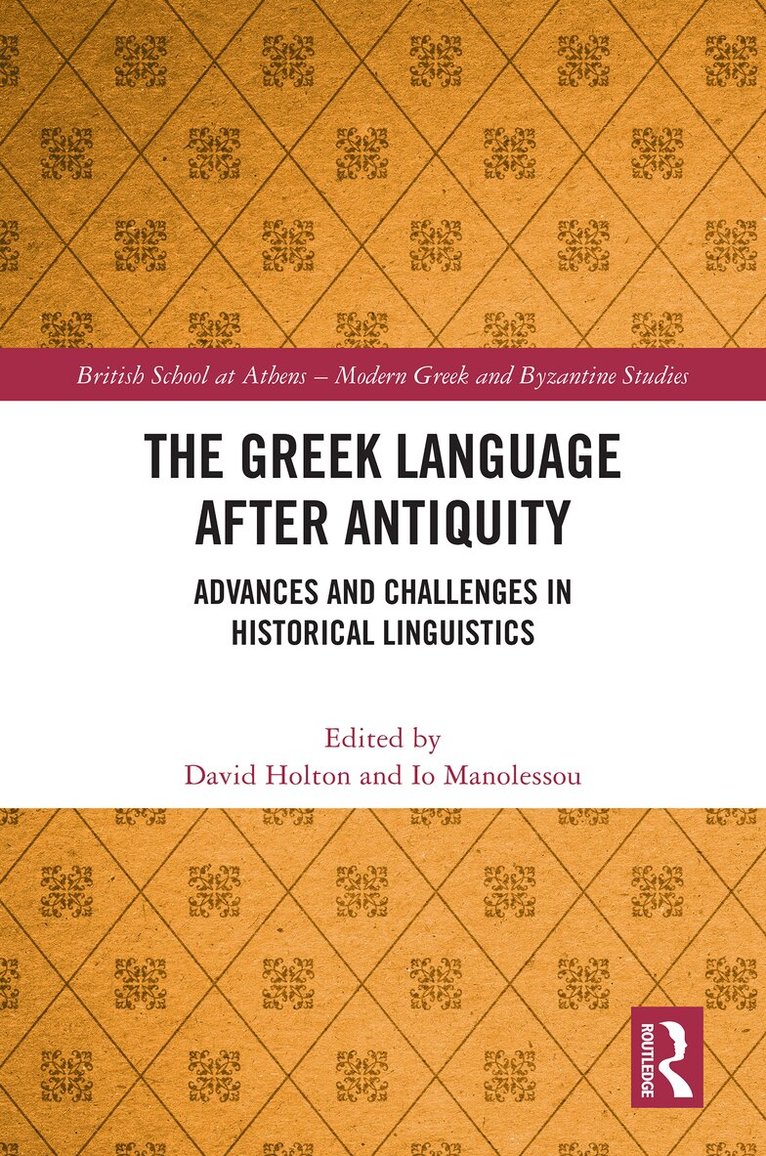
    Greek Language after Antiquity

    Advances and Challenges in Historical Linguistics

    AvDavid Holton,Io Manolessou

    Inbunden, Engelska, 2025

    Del i serien British School at Athens - Modern Greek and Byzantine Studies

    2 481 kr

    Beställningsvara. Skickas inom 10-15 vardagar. Fri frakt över 249 kr.

    Beskrivning

    The Greek Language after Antiquity offers an in-depth look at the diachrony of the Greek language, focusing on a period relatively neglected by modern scholarship: the more than 1,000 years between the end of Antiquity and the early modern period. These studies, written by experts in the field, target different levels of analysis (phonology, morphology, semantics, lexicon, dialectology, sociolinguistics), combining substantial primary data with various theoretical approaches.It begins with a radical proposal for a different approach to the historical linguistics of Greek, focused on the process of language diversification, as opposed to the traditional genetic approach to dialect emergence. Other topics include register variation in Byzantine literature, crucial for understanding the subsequent evolution of a written standard; morphological variation in conjunction with problems of textual transmission in medieval and early modern vernacular texts, with special focus on the notion of “philology”; evidence for language contact in the Late Medieval period; and the use of graphemic evidence, i.e. spelling, to detect changes in pronunciation over a long time span. Two chapters examine issues of word formation: one presents a new research project on diachronic derivational morphology; the other examines compound formation in the Cretan dialect. The final chapter examines theoretical and methodological issues in studying the historical semantics of Greek.This book is essential reading for researchers in Greek historical linguistics and especially useful for students, teachers and researchers in Classics, Byzantine studies and general linguistics, with important connections to the historical linguistics and text-critical studies of other languages, particularly Romance and Turkish.

    Produktinformation

    • Utgivningsdatum:2025-03-31
    • Mått:156 x 234 x 18 mm
    • Vikt:520 g
    • Format:Inbunden
    • Språk:Engelska
    • Serie:British School at Athens - Modern Greek and Byzantine Studies
    • Antal sidor:214
    • Förlag:Taylor & Francis Ltd
    • ISBN:9781032427348

    Utforska kategorier

    • Språkundervisning och språkinlärning inom Språk och ordböcker
    • Forntidens historia inom Historia och arkeologi
    • Språkvetenskap och lingvistik inom Språk och ordböcker

    Mer om författaren

    David Holton is Emeritus Professor of Modern Greek at the University of Cambridge and an Emeritus Fellow of Selwyn College. He has published widely on Greek language and literature from Late Medieval to Modern, particularly Cretan and Cypriot poetry of the Renaissance period. He edited Literature and Society in Renaissance Crete (1991; Greek edition 1997). He is the co-author of two grammars of Modern Greek, and he directed the research project that produced The Cambridge Grammar of Medieval and Early Modern Greek (4 vols., 2019). He holds an honorary doctorate from the Aristotle University of Thessaloniki (2024).Io Manolessou is the Acting Director of the Research Centre for Modern Greek Dialects of the Academy of Athens. She holds a PhD in historical linguistics from the University of Cambridge and has published many papers on the history of the Greek language and its dialects. Major contributions include the Cambridge Grammar of Medieval and Early Modern Greek (co- author, 2019), vol. 7 of the Historical Dictionary of Modern Greek (chief editor, 2021), and the Historical Dictionary of the Dialects of Cappadocia (chief editor, 2024).

    Recensioner i media

    ‘… this volume delivers on its aims to fill in some gaps in our knowledge of the Greek language ‘after antiquity’. Its contributors do so by diving into understudied topics such as derivational morphology and compounding, re-evaluating crucial historical questions of dialect diversification and language contact with new frameworks, and, most of all, by capitalizing on new tools to reconstruct the development of the Greek language’ - Bryn Mawr Classical Review (2026).

    Innehållsförteckning

    • IntroductionDavid Holton and Io Manolessou1. The regional diversification of Greek ADIo Manolessou2. Investigating the diachronic phonology of Medieval and Modern Greek through graphemic evidenceNikolaos Pantelidis3. Language contact in Late Medieval Greek: an under-estimated phenomenon?Theodore Markopoulos4. Philology and φιλολογία: linguistic variation in Medieval and Early Modern Greek from the viewpoint of textual scholarshipTina Lendari5. Many linguistic ways to tell the same story: the four versions of the Life of Maximos the HutburnerMartin Hinterberger6. Medieval and Early Modern Greek derivational morphology: the missing chaptersTina Lendari and Io Manolessou 7. Compounding in Cretan across centuriesAngela Ralli and George Chairetakis8. Issues in the historical semantic analysis of Modern GreekChristina Bassea-Bezantakou