• Fri frakt över 249 kr
  • •
  • Snabba leveranser
  • •
  • Billiga böcker
Kundservice

Du är på sajten för privatpersoner.

Företag, bibliotek eller offentlig verksamhet?

Du handlar på classic.bokus.com, där alla dina funktioner finns intakta.

Till classic.bokus.com
Bokus logotyp. Gå till startsidan.
  • Erbjudanden
  • Student
  • Topplistor
  • Barn & ungdom
  • Bokus Play
  • E-böcker
  • Ljudböcker
  • Pocketböcker
  • Spel & pussel

Upp till 25% på utvalda nyheter →

Sidfot

Mina sidor

    Hjälp

    • Kundservice
    • Vanliga frågor och svar
    • Frakt och leverans
    • Retur vid ångerrätt
    • Reklamera vara
    • Betalning
    • Köpvillkor
    • Allmänna villkor
    • Information om webbplatsens tillgänglighet

    Om Bokus

    • Om oss
    • Pressrum
    • För studenter
    • För företag
    • För bibliotek och offentlig verksamhet
    • För leverantörer
    • Hållbarhet

    Populärt

    • Aktuella erbjudanden
    • Presentkort
    • Studentlitteratur
    • Nya böcker
    • Topplistor
    • Signerade böcker
    • Engelska böcker

    Inspiration

    • Boktips
    • BookTok
    • Populära bokserier
    • Barnbokskaraktärer
    • Populära författare
    Logotyp för Bokus
    Följ oss på Facebook (extern länk)Följ oss på Instagram (extern länk)Följ oss på YouTube (extern länk)Följ oss på TikTok (extern länk)
    bokus @ CookiesAnpassa cookiesIntegritetspolicyKöpvillkor
    Till Citymail hemsida (extern länk)Till Budbee hemsida (extern länk)Till Postnord hemsida (extern länk)Till Schenker hemsida (extern länk)Till Early Bird hemsida (extern länk)Till Walleys hemsida (extern länk)
    1. Psykologi och pedagogik
    2. Psykologi
    3. Psykologi: känslor

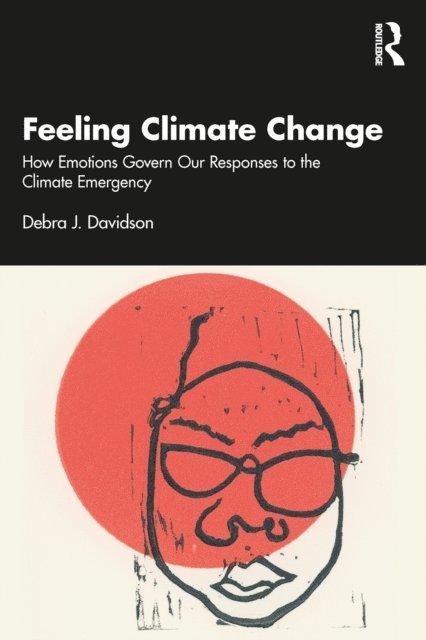
    Feeling Climate Change

    How Emotions Govern Our Responses to the Climate Emergency

    AvDebra J. Davidson

    Inbunden, Engelska, 2024

    2 057 kr

    Beställningsvara. Skickas inom 10-15 vardagar. Fri frakt över 249 kr.

    Fler format och utgåvor

    Häftad

    569 kr

    E-bok

    671 kr

    E-bok

    671 kr

    Beskrivning

    Feeling Climate Change podcast with Debra Davidson | Amazon | Spotify | Apple PodcastsExamining the social response to the mounting impacts of climate change, Feeling Climate Change illuminates what the pathways from emotions to social change look like—and how they work—so we can recognize and inform our collective attempts to avert further climate catastrophe.Debra J. Davidson engages with how our actions are governed by a complex of rules, norms, and predispositions, central among which operates our emotionality, to assess individual and collective responses to the climate crisis, applying a critical and constructive analysis of human social prospects for confronting the climate emergency in manners that minimize the damage and perhaps even enhance the prospects for meaningful collective living.Providing a crucial understanding of our emotionality and its role in individual behaviour, collective action, and ultimately in social change, this book offers researchers, policymakers, and citizens essential insights into our personal and collective responses to the climate emergency.

    Produktinformation

    • Utgivningsdatum:2024-08-16
    • Mått:156 x 234 x 16 mm
    • Vikt:421 g
    • Format:Inbunden
    • Språk:Engelska
    • Antal sidor:194
    • Förlag:Taylor & Francis Ltd
    • ISBN:9781032462813

    Utforska kategorier

    • Psykologi: känslor inom Psykologi och pedagogik
    • Miljövetenskap och miljöpolitik inom Naturvetenskap och teknik
    • Geografi inom Naturvetenskap och teknik

    Mer om författaren

    Debra J. Davidson is professor of environmental sociology at the University of Alberta.

    Recensioner i media

    Debra J. Davidson gives us a hugely important lens through which to understand the crisis of climate change, and motive to do something about it. A highly important book.Dr. Arlie Russell Hochschild, Sociology, University of California-Berkeley, author of The Managed Heart: Commercialization of Human Feeling (2012), Strangers in Their Own Land (2016), and Stolen Pride (forthcoming)Feeling Climate Change is a compelling account of the way emotions affect how individuals, institutions and societies respond to the climate emergency. Davidson offers a pragmatic and personal exploration of our collective capacity to better respond to climate change. Going beyond disciplinary boundaries, the book illuminates an in-depth understanding of the challenges we face. The main thesis is that while humanity may not emerge unscathed, there exists considerable potential to transform our relationship with the planet into one that is more mutually respectful. Davidson offers a thought-provoking exploration that empowers readers to play a vital role in shaping the future, offering hope and a roadmap to transform our current trajectory into one that is more sustainable and equitable.Dr. Emily Huddart Kennedy, Sociology, University of British Columbia, author of Eco-Types: Five Ways of Caring about the Environment (2022, Princeton)Reason, cognition, language, and facts still matter in Feeling Climate Change. But if we want to tackle something as complex and politicized as climate change, we need to also understand that these debates are as much about what we feel in our gut as what we know in our head. I highly recommend this book, as it helps cultivate our collective emotional intelligence.Dr. Michael Carolan, Sociology, Colorado State University, author of Society and the Environment: Pragmatic Solutions to Ecological Issues (2020, Routledge)There have been many publications on climate change in the past two years. Feeling the Climate is certainly one of the most important. The emerging literature on emotions and climate change, to which Davidson has made key contributions, demonstrates emotions matter. Davidson here orchestrates a concerto, showing how the literature on emotions outside of environmental work can be used to better understand emotions around climate change. She also clarifies how emotions work in consort with other factors that have been more extensively studied around environment, such as identity, values, beliefs and norms. This is exactly the kind of synthetic work we need both to advance the science and to offer advice for practice.Dr. Tom Dietz, Sociology and Environmental Science, Michigan State University, author of Decisions for Sustainability: Facts and Values (2023)In Feeling Climate Change, Davidson draws from and integrates important areas of research on emotions from across various disciplines, ranging from sociology to neuroscience, and in doing so offers a compelling case for how an emotionality lens can help create meaningful strategies for climate action. Ultimately, this is a book about bottom-up solutions to the climate crisis. It is beautifully and accessibly written and will work very well in courses and seminars on climate, sustainability, social change, emotions, and other related topics.Dr. Andrew Jorgenson, Sociology, University of British Columbia, co-author of Super Polluters: Tackling the World’s Largest Sites of Climate-Disrupting Emissions (2020)Facing the climate emergency, how can we cultivate visionary collective action rather than apathy and denialism? In this remarkable, engaging, and accessible book, Davidson – one of the most high-profile environmental social scientists internationally – helps us understand the conditions for human agency. The author explains why and how our emotionality is both a blocker and opener for transformational change. After reading this book you will never again maintain that the future is already determined.Dr. Magnus Boström, Sociology, Örebro University, co-author of Environmental Sociology and Social Transformation: Key Issues (2024, Routledge)In Feeling Climate Change, Debra Davidson provides an incredibly useful summation of the existing research explaining apathy, denial and withdrawal, and the role of emotions in these responses. The tandem emotional impacts of capitalism on fear and empathy are deeply entangled, and the emergent outcome is a social world of conflict and distrust, while stripped of our inherited capacities to combat that conflict and distrust – to cooperate. The ‘pathways to action’ put forward by Davidson provide some suggestions about how to change these, highlighting the potential for re-orienting belonging towards ecological practice. In highlighting the complexity of the links between structure, agency and emotions in relation to climate change, in many ways the book further highlights the intensely difficult path towards changing that to a ‘yes’.Vanessa Bowden, University of Newcastle, in Environmental Politics 34:5 (2025)Feeling Climate Change is filled with crucial insights regarding the societal response to the climate emergency, spanning inaction to action. Debra Davidson clearly illuminates the importance of strengthening the social structures, conditions, and relationships that foster effective emotional responses that are part of contributing to the prospects of meaningful collective action. She makes an important contribution to environmental social science, climate studies, and environmental justice, indicating how reflexivity, efficacy, social belonging, empathy, envisioning just futures, and bottom-up politics are central to our efforts to address the ongoing climate crisis. Davidson contends that fostering ‘emotional pathways’ toward promising forms of individual and collective ‘action’ will expand ‘the capacity to navigate the climate emergency in a manner that transforms our current, highly toxic relationship with our climate into one that is more mutually respectful.’Brett Clark, University of Utah, in International Sociology Reviews 40:5 (2025)

    Innehållsförteckning

    • 1 Introduction: why a book on emotions? 2 What Lies Ahead 3 Can We Do This? Embarking on Transformational Social Change 4 What Are Emotions and Why Should We Care? 5 Scaling Up Emotions, from the Individual, to Social Structures and Back Again 6 Inaction Pathways: On Why We Don’t Do the Things We Don’t Do 7 Pathways to Action, or Doing the Hard Thing 8 Threading the Needle from Emotions to Transformational Social Change