• Fri frakt över 249 kr
  • •
  • Snabba leveranser
  • •
  • Billiga böcker
Kundservice

Du är på sajten för privatpersoner.

Företag, bibliotek eller offentlig verksamhet?

Du handlar på classic.bokus.com, där alla dina funktioner finns intakta.
Till classic.bokus.com
Bokus logotyp. Gå till startsidan.
  • Erbjudanden
  • Nyheter
  • Student
  • Topplistor
  • Barn & ungdom
  • Bokus Play
  • E-böcker
  • Pocketböcker
  • Spel & pussel

10% rabatt på allt med kod: NYSTART10 →

Sidfot

Mina sidor

    Hjälp

    • Kundservice
    • Vanliga frågor och svar
    • Frakt och leverans
    • Retur vid ångerrätt
    • Reklamera vara
    • Betalning
    • Köpvillkor
    • Allmänna villkor
    • Information om webbplatsens tillgänglighet

    Om Bokus

    • Om oss
    • Pressrum
    • För studenter
    • För företag
    • För bibliotek och offentlig verksamhet
    • För leverantörer
    • Hållbarhet

    Populärt

    • Aktuella erbjudanden
    • Presentkort
    • Studentlitteratur
    • Nya böcker
    • Topplistor
    • Signerade böcker
    • Engelska böcker

    Inspiration

    • Boktips
    • BookTok
    • Populära bokserier
    • Barnbokskaraktärer
    • Populära författare
    Logotyp för Bokus
    Följ oss på Facebook (extern länk)Följ oss på Instagram (extern länk)Följ oss på YouTube (extern länk)Följ oss på TikTok (extern länk)
    bokus @ CookiesAnpassa cookiesIntegritetspolicyKöpvillkor
    Till Citymail hemsida (extern länk)Till Budbee hemsida (extern länk)Till Postnord hemsida (extern länk)Till Schenker hemsida (extern länk)Till Early Bird hemsida (extern länk)Till Walleys hemsida (extern länk)
    1. Naturvetenskap och teknik
    2. Geovetenskap
    3. Miljövetenskap och miljöpolitik

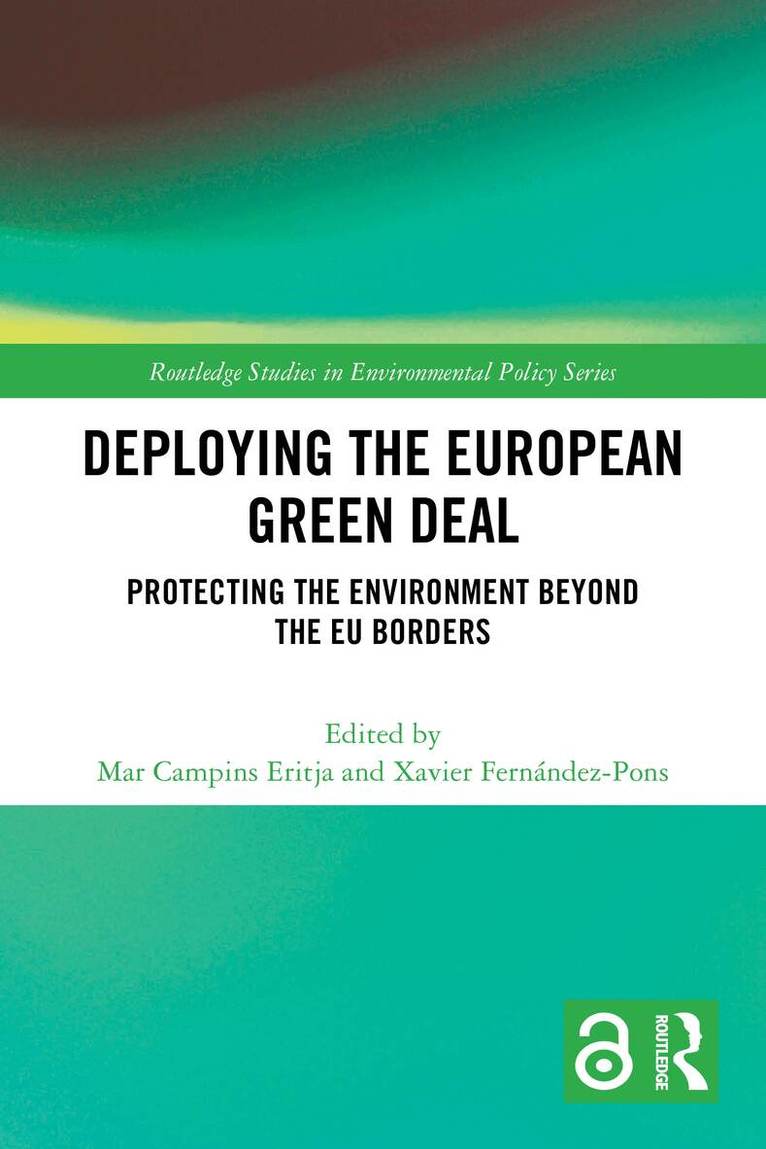
    Deploying the European Green Deal

    Protecting the Environment Beyond the EU Borders

    AvMar Campins Eritja,Xavier Fernández-Pons

    Häftad, Engelska, 2025

    Del i serien Routledge Studies in Environmental Policy

    626 kr

    Beställningsvara. Skickas inom 10-15 vardagar. Fri frakt över 249 kr.

    Beskrivning

    Drawing on a range of expert contributions, this book explores how the European Green Deal is being deployed in practice and observes how the EU tries to promote the protection of the environment in third countries.This book begins by assessing the state of the art in terms of the key conceptual issues and analyses sectoral initiatives that are particularly relevant for the deployment of the European Green Deal external dimensions. These include the Carbon Border Adjustment Mechanism, the EU’s regulatory action in the control of maritime emissions, the 2030 Biodiversity Strategy, the Deforestation Initiative, the Zero Pollution Initiative, the From Farm to Fork Initiative, and the Climate Neutrality and Clean Energy Initiative in the context of the Energy Charter Treaty. Next, the authors deal with horizontal aspects of the European Green Deal that also have external dimensions, such as the Green Deal Diplomacy, the Green Public Procurement, funding measures, initiatives related to corporate sustainability and due diligence, and the implementation and enforcement of EU environmental law. This volume concludes with a cross-cutting analysis, focusing on how the EU can strengthen the impact of its normative power on international environmental governance, while also noting its limitations.Deploying the European Green Deal will be of great interest to students and scholars of international and EU environmental law and environmental policy and governance.Chapter 10 of this book is available for free in PDF format as Open Access from the individual product page at www.taylorfrancis.com. It has been made available under a Creative Commons Attribution-Non Commercial-No Derivatives (CC-BY-NC-ND) 4.0 license.

    Produktinformation

    • Utgivningsdatum:2025-07-30
    • Mått:156 x 234 x 16 mm
    • Vikt:320 g
    • Format:Häftad
    • Språk:Engelska
    • Serie:Routledge Studies in Environmental Policy
    • Antal sidor:268
    • Förlag:Taylor & Francis Ltd
    • ISBN:9781032487359

    Utforska kategorier

    • Miljövetenskap och miljöpolitik inom Naturvetenskap och teknik
    • Affärsetik inom Ekonomi och Ledarskap
    • Folkrätt inom Juridik

    Mer om författaren

    Mar Campins Eritja is Professor of Public International Law at the Universitat de Barcelona (Spain). Her scientific interest has focused on the international and EU legal protection of the environment, with a special emphasis on the international regime on climate change, the international regime on dangerous wastes, and the environmental protection of the Arctic. She leads and participates in various competitive research projects and has published extensively in these areas and is the holder of the Jean Monnet Chair on EU Environmental Law (2017–2020, 2020–2023) funded by the EU Commission. In addition to her teaching duties at the Faculty of Law of the Universitat de Barcelona, she has held various management positions: Vice-Dean of the Faculty of Law (2002–2004 and 2016–2021), Assistant to the Vice-Rector for International Policy, and Vice-Rector for International Policy (2005–2008). She has been a Fulbright scholar at American University and visiting professor at Nova Southeastern University, the University of Puerto Rico, Lapland University, the University of Ottawa, Dalhousie University, the Université de Montréal, and Strathclyde University. She was Member of the Direction Board of the UB Research Water Institute (2015–2022) and Member of the Center for Environmental Law Studies of Tarragona (CEDAT) at the University Rovira i Virgili.Xavier Fernández-Pons is Associate Professor of Public International Law at the University of Barcelona. He obtained his PhD in Law from the University of Bologna, and he is also Diplomate of the Centre for Studies and Research of The Hague Academy of International Law. He is Researcher at the Centre for Environmental Law Studies of Tarragona (CEDAT) at the University Rovira i Virgili and Member of the Jean Monnet Chair on European Union Environmental Law at the University of Barcelona. His main lines of research are international economic law, World Trade Organization, regional trade agreements, foreign investments, European Union’s trade policy, trade and environment, and trade and health, all areas in which he has published extensively.

    Innehållsförteckning

    • 1. Introductory remarks and conceptual frameworkXavier Fernández-Pons and Mar Campins Eritja1. Introduction2. Significance of the EGD3. EU competences to deploy the EGD4. External dimensions of the EGD and extraterritoriality5. Some clarifications and acknowledgementsReferences2. Conditioning access to the European Union market on carbon footprint: the Carbon Border Adjustment Mechanism Xavier Fernández-Pons1. Introductory remarks2. Measures against climate change and the risk of carbon leakage3. Key features of the EU CBAM4. Compatibility of the EU CBAM with WTO rules4.1 The principles on non-discrimination between like products4.2 The exception on measures relating to the conservation of exhaustible natural resources4.3 The chapeau of Article XX GATT 19945. Compatibility of the EU CBAM with the global rules on climate change6. Final remarks3. EU regulatory action on maritime emissions: Unilaterally protecting the environment beyond IMO’s global strategyMarta Abegón Novella1. Introductory remarks2. The IMO’s global regulatory framework on the reduction of GHG maritime emissions2.1 The IMO’s first initiatives on the reduction of GHG emissions from ships2.2 The Initial IMO Strategy on the reduction of GHG emissions from ships (2018) and its revision (2023)3. EU regulatory action to reduce GHG maritime emissions3.1 The EU strategy to reduce CO2 emissions from maritime transport (2013) and the MRV Regulation (2015)3.2 EU initiatives included in the “Fit for 55” package to deliver the EGD (2021): the FuelEU Maritime Initiative and the extension of the EU ETS to maritime transport4. The UE unilateral regulatory action and their controversial extraterritorial effects5. The fit of EU regulatory action with respect to the IMO’s global regulatory framework: between unilateralism and cooperation6. Final remarks4. The 2030 Biodiversity Strategy: The EU’s international commitment and responsibility to reverse the biodiversity lossSusana Borràs-Pentinat1. Introductory remarks2. The EU 2030 Biodiversity Strategy in the era of the “sixth extinction”3. The external dimension of the EU Biodiversity Strategy: A global biodiversity agenda3.1 The EU’s international commitments to protect biodiversity worldwide3.2 Facing the responsibilities of the EU’s external biodiversity footprint: the structural and systemic causes of biodiversity loss4. The “nature-positive” economy leads the way; ecological integrity lags behind5. Final remarks5. Understanding the deforestation initiative for European trade in products from the Brazilian AmazonMárcia Rodrigues Bertoldi1. Introductory remarks2. The current state of deforestation in the Amazon: we are eating the forest3. The EGD and the Deforestation Initiative4. A new regulation for a “standing forest”5. Considerations about possible impacts of the deforestation initiative in Brazil6. Special reference to the absence of principles of environmental law7. Final remarks6. Zero Chemical Pollution: A real new impetus for change?Mar Campins Eritja1. Introductory remarks2. Specific objectives of the Zero Pollution initiative3. Strategies to achieve the objectives of the Zero Pollution initiative in chemicals and chemical wastes4. Legal challenges posed by the Zero Pollution initiative4.1 Combining the definition of “zero pollution” with the high level of environmental protection4.2 The legal basis for EU measures related to Zero Pollution4.3 The external dimension of EU measures related to production, marketing, and use of chemicals5. Final remarks7. Farm to Fork: Strengths and Weaknesses of a European Strategy for a Global Transition towards Fair, Healthy and Sustainable Food SystemsXavier Pons Rafols1. Introductory remarks2. The international approach to food systems and food security3. General overview of the F2F Strategy of the EU4. The role of the EU’s F2F Strategy in enabling global transition of food systems5. Final remarks8. The European Green Deal and the Energy Charter Treaty: Chronicle of a Breakup Foretold?Gastón Medici-Colombo1. Introductory remarks2. The ECT investment protection regime3. The EGD and the need for bold regulatory action (in the fossil fuel sector)4. The climate “regulatory chill” of investment protection5. The ECT “fossil fuel litigation affair”6. The “modest” ECT modernization7. The European exodus8. Final remarks9. From Climate diplomacy to Green Deal diplomacyTeresa Fajardo del Castillo1. Introductory remarks2. From Climate Diplomacy to Green Deal Diplomacy3. The EGD Diplomacy at the climate change COPs4. The new generation of Free Trade and Association Agreements and the Global Green Deal5. The Global Climate Change Alliance6. The EGD Diplomacy and the Global Gateway7. Final remarks10. The European Green Deal and Public Procurement Law: Its Extraterritorial Reach beyond the EU’s BordersEzgi Uysal and Willem A. Janssen1. Introductory remarks2. EU public procurement law and green procurement3. Public procurement in the EU Green Deal3.1 Nudging the member States towards GPP3.2 Mandating GPP through sectoral legislation4. The extraterritorial effects of public procurement under the Green Deal4.1 Extraterritorial effects of PPMs of an economic operator’s supply chain: relevance of the link to the subject matter of the contract and life-cycle thinking4.2 Extraterritorial effects of an economic operator’s violation of environmental law: the relevance of CSDD and the Public Sector Directive4.3 Ensuring that extraterritorial effects materialize: Contract Compliance5. Final remarks11. The European Green Deal Investment Plan. The External Impact of Mobilizing Climate Finance with an Experimentalist DesignGonzalo Larrea1. Introductory remarks2. The experimentalist design of the EGDIP3. The EGDIP’s external potential3.1 The UNFCCC Financial Mechanism3.2 Replicating the EGDIP’s experimentalist design4. Final remarks12. Business, Human Rights and the Environment: From Corporate Social Responsibility to Mandatory Human Rights and Environmental Due DiligenceAlfonso González Bondia1. Introductory remarks2. Adoption of a voluntary approach to CSR3. First steps towards mandatory human rights and environmental DD3.1 Timber and other products associated with deforestation or forest degradation3.2 Minerals from conflict zones4. The proposal for a Directive on corporate sustainability DD5. Final remarks13. Implementation and enforcement of environmental legislation as a cornerstone of the European Green DealAlexandre Peñalver i Cabré1. Introductory remarks2. The role of the EU in implementing and enforcing environmental legislation3. The most important causes of the lack of environmental implementation and their main negative effects4. Mechanisms for strengthening the implementation and enforcement of environmental law5. Information on environmental enforcement5.1 The importance of information for the enforcement of environmental legislation5.2 Annual Reports of the EU Commission monitoring the application of EU law5.3 Environmental Implementation Review (EIR)5.4 The EU Network for the IMPEL5.5 Reports from international organizations6. Final remarks14. Joint analysis of cross-cutting issues and final considerationsXavier Fernández-Pons, Teresa Fajardo del Castillo, Mar Campins Eritja1. Introduction: the weaknesses of current global environmental protection systems2. The ambition of the EGD’s external dimensions3. Limitations of the EGD’s external dimensions4. Towards a Global Green Deal?ReferencesIndex